Long-Tail Keywords, and Which of Them Are Worth a Page
Most of what you turn up will never earn a page. See what makes a search rare enough to count, where the real ones hide, and how to judge them.


/ On this page9 sections
Most of the phrases you turn up will never earn a page of their own, and sorting the two is the actual work.
A long-tail keyword is a search hardly anybody makes. That is the whole definition, and it explains both why these are winnable and why finding real ones takes more than adding words to a phrase you already had.
A Long-Tail Keyword Is a Search Almost Nobody Makes
Long-tail keywords are searches with little demand behind them. Few people type them in a month, so few pages are built to answer them, so the pages that exist are easier to beat.
Everything people like about these follows from that one property.
"How often should you replace running shoes" is long-tail. "Running shoes" is not.
The difference is not the word count. It is that one of them gets typed all day and the other gets typed occasionally.
Word count is a symptom, and a good one. A rare search usually is longer, because specificity is how a person narrows a want down to the thing they mean.
But the symptom is not the rule.
Rare has no fixed number either. Ahrefs puts that plainly: "There's no specific search volume threshold that defines a keyword as 'long-tail'. It mostly depends on the head keyword you're comparing it to."
Rare against long sends you in opposite directions.
If long-tail means rare, you go looking for evidence that somebody searched. If it means long, you start inventing longer phrases, and an invented phrase has no evidence of demand behind it at all.
The words you added
Put in a phrase you are thinking about. Then lengthen it, the way the advice tells you to, and watch which number moves.
Words in the phrase
0
Nothing typed yet.
No word count makes a phrase long-tail. One-word searches can be rare, and six-word searches can be huge.
Evidence somebody searched it
Type a phrase first
Adding a word will move the counter on the left. It will not move this.
Lengthening a phrase does not find demand behind it.
The question that does decide
Where have you seen a real person go looking for this?
Word count is a symptom, and a good one. A rare search usually is longer, because specificity is how a person narrows a want down to the thing they mean. But the symptom is not the rule, so the answer is in this row and not in the number above it.
Why It Is Called the Long Tail
The name describes a shape on a graph, not a shape in the words.
It is borrowed from Chris Anderson's book The Long Tail, about markets where a few products sell enormously and a great many sell a little, and the little ones add up to real money.
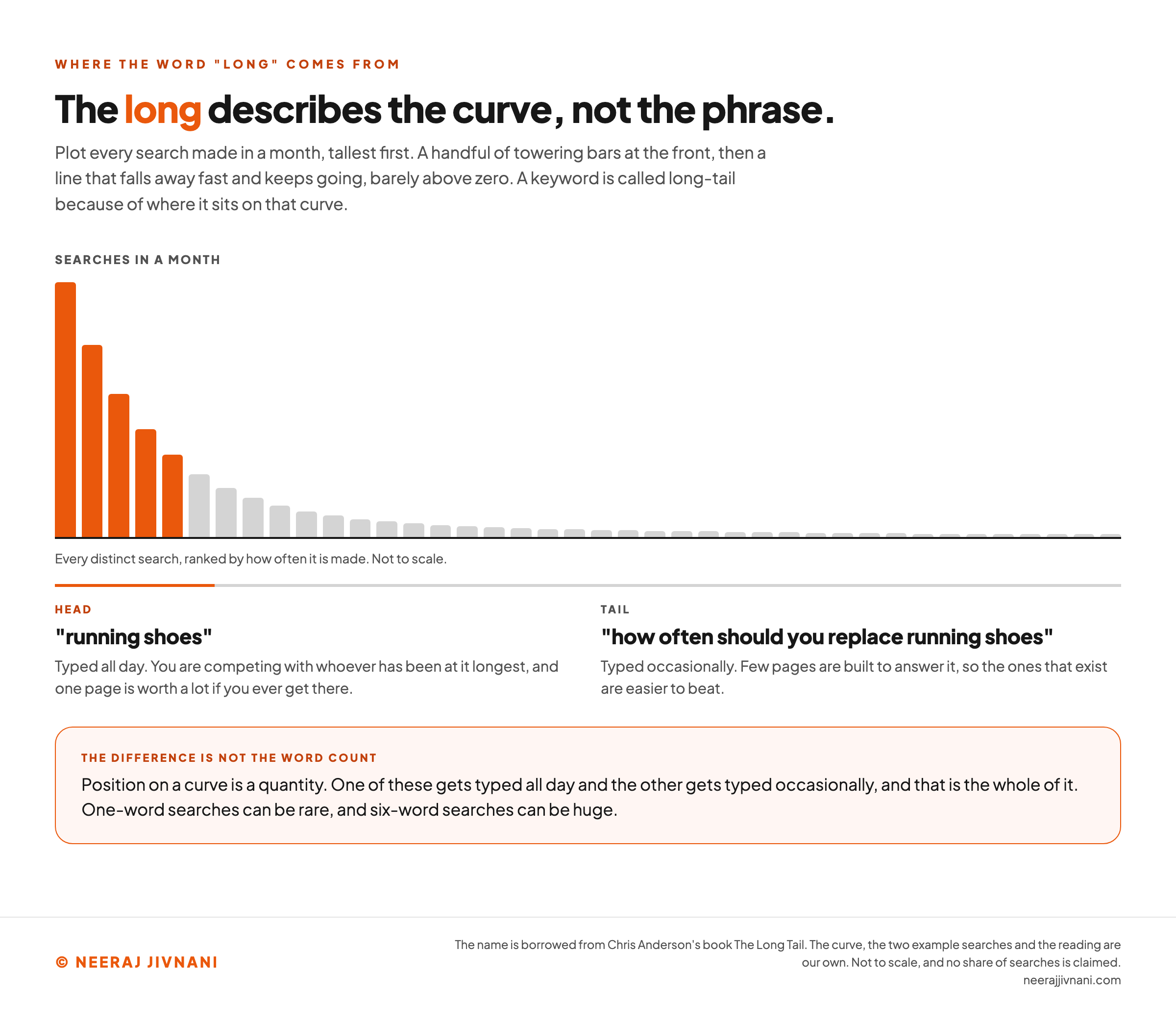
Plot every search made in a month, tallest first, and you get that shape.
A handful of towering bars at the front. Then a line that falls away fast and keeps going, for a long time, barely above zero.
The bars at the front are head terms. The flat stretch is the tail, and a keyword is called long-tail because of where it sits on that curve.
Position on a curve is a quantity, not a word count.
Which is exactly where the confusion gets in. The word "long" describes the curve, and it reads like a description of the phrase.
You will see percentages attached to this, some share of all searches said to be long-tail. Treat them carefully.
The tail has no agreed starting point. Until somebody names the volume threshold they used, a share of the tail is a number with no question attached to it.
The shape is the useful part, and it needs no percentage.
The curve says both things at once. Any one search out in the tail is tiny, and the tail keeps going long after the bars have flattened.
Use this chart — embed code and citation
<a href="https://neerajjivnani.com/blog/long-tail-keywords/"><img src="https://neerajjivnani.com/infographics/long-tail-keywords/the-long-is-the-curve.png" alt="A bar chart of every distinct search made in a month, ranked tallest first, drawn to show that the word long describes the curve and not the phrase. Five towering orange bars stand at the left, then the line falls away fast and runs on as a long stretch of low grey bars barely above the baseline. The vertical axis is labeled searches in a month, the horizontal axis is labeled every distinct search, ranked by how often it is made, and not to scale, and neither axis carries a number. An orange rail under the first few bars marks the head, where the search running shoes sits, noted as typed all day, with whoever has been at it longest as the competition, and one page worth a lot if you ever get there. A grey rail runs under the whole of the rest and marks the tail, where how often should you replace running shoes sits, noted as typed occasionally, with few pages built to answer it, so the ones that exist are easier to beat. A band at the foot says the difference is not the word count: position on a curve is a quantity, one of these gets typed all day and the other gets typed occasionally, and one-word searches can be rare while six-word searches can be huge." width="1200"></a>
<p>Chart: <a href="https://neerajjivnani.com/blog/long-tail-keywords/">Neeraj Jivnani</a></p>Neeraj Jivnani, "Long-Tail Keywords, and Which of Them Are Worth a Page", neerajjivnani.com, https://neerajjivnani.com/blog/long-tail-keywords/Free to republish with a link back to this page.
Long-Tail and Short-Tail, Side by Side
A short-tail keyword, or head term, is a search a great many people make. Long-tail is the opposite end of the same curve, and everything else follows from the demand.
| Short-tail | Long-tail | |
|---|---|---|
| Demand | High | Low, sometimes too low to measure |
| What the searcher told you | Almost nothing | Nearly everything |
| Who you compete with | Whoever has been at it longest | Often nobody in particular |
| What one page is worth | A lot, if you ever get there | A little, reliably |
Real pairs make the difference concrete.
- "Lawn mower" against "cordless mower for a garden with a slope." The first is a shelf in a shop. The second is one person standing on a hill.
- "Air fryer" against "why does my air fryer smoke when I cook bacon." One is a product. The other is a kitchen with a problem in it right now.
- "Accountant" against "does a sole trader need an accountant." The second names the whole situation, not the category it belongs to.
Search intent is why the second column converts better. Intent usually gets sorted four ways: someone learning, someone looking for a particular site, someone comparing before they buy, and someone ready to buy now.
A head term mixes all four on one results page, because the words never say which one you are.
Long-tail phrases mostly announce themselves.
What You Get for the Trouble
Three things, and each of them is steadier and less dramatic than the pitch for them. The trouble is worth it for the third one.
Less competition. Fewer sites have written a page for a question few people ask, so you compete against general coverage rather than against a dedicated answer. Easier is the honest word. Not easy.
A reader who told you what they want. Somebody typing a whole situation into a search box has done the qualifying for you. You are not persuading them to care.
They add up. One of these is not a plan. The thing you are building is a total, and no single page in it is meant to look like much on its own.
That third point has an edge worth being honest about.
A page will not collect every search its phrase gets. You will not hold the top position forever, and the results page takes its own share before anyone reaches you.
So the arithmetic only works at volume, and volume means a lot of posts.
Multiply the traffic you would honestly expect from one of these by the number you can write in a year. Do it before you start, not after twenty of them.
Where the Real Ones Are
The best sources are places where somebody has already typed or written something in their own words, without being asked to be concise.
All three cost nothing. Each shows you something the others cannot, and each has a blind spot worth knowing before you build a routine on it.
The Search Box Before You Press Enter
Autocomplete and the question panels give you phrasing that no keyword tool will, because they are built from what people finished typing rather than from what a database kept.
That is their value, and it comes with a bias worth naming.
They favor the middle of the tail, not the end of it, so the phrases that come back are more popular than the ones you are hunting for.
They are also shaped by you: your location, your history, what you searched last week.
So use them for vocabulary rather than for discovery. What you are taking away is how people say the thing, and you will find the genuinely rare version somewhere else.
Places People Write in Their Own Words
Forums, subreddits, Quora threads, product reviews, your own support inbox. People asking each other questions phrase them the way they think, not the way they imagine a search engine wants.
That is the gap between "mower blade sharpening" and "my mower blade goes blunt after one cut." Both get searched. Only the second one hands you a page.
Your own site's internal search is the most underused of these.
It is a list of things people expected to find on your site, in their words, and the searches that returned nothing are the most useful rows in it.
What Search Console Will and Will Not Show You
Search Console's Performance report is the only free source here that measures demand you have already proved, rather than demand in general. It lists the searches your site has appeared for.
It also leaves the rarest queries out on purpose.
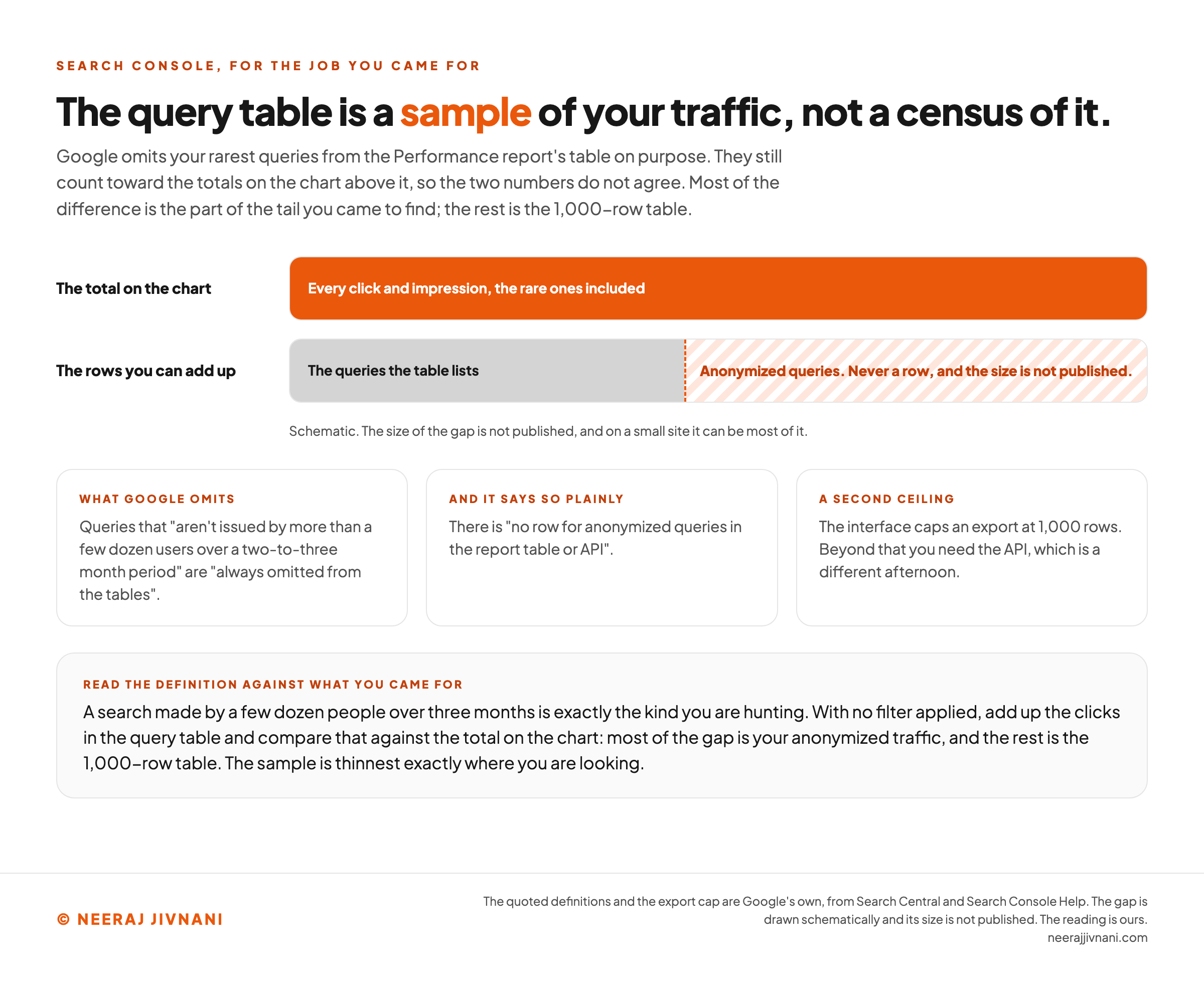
Google calls them anonymized queries. Its documentation defines them as those that "aren't issued by more than a few dozen users over a two-to-three month period."
Those queries "are always omitted from the tables" while still counting toward the chart totals, unless you filter by query, and Google is explicit that there is "no row for anonymized queries in the report table or API."
Read that definition against what you came for. A search made by a few dozen people over three months is exactly the kind you are hunting, and it is the kind Google is removing from the table you are reading.
The consequence is not that the report is useless.
It is that the query list is a sample of your traffic rather than a census of it, and the sample is thinnest exactly where you are looking.
Two things follow. With no filter applied, add up the clicks in the query table and compare that against the total on the chart above it.
Most of the gap is your anonymized traffic, and on a small site that can be most of your traffic.
Some of the gap is the table itself, which shows at most 1,000 rows, and an interface export stops at the same 1,000. Beyond that you need the API, which is a different afternoon.
When the Tool Says Zero
Plenty of real searches report no volume at all.
A question gets typed a dozen slightly different ways, no single phrasing accumulates enough to register, and the tool rounds the whole thing to nothing. That is a measurement problem rather than an absence of people.
It happens most where the phrasing is longest, because the longer somebody's phrasing is, the less likely two people phrase it identically.
So when a phrase reads zero, stop asking the tool and ask yourself two things.
Did a real person say this, in a thread or an email or a support ticket? And can you answer it better than whatever comes up now?
If both are yes, the zero is telling you about the tool.
Use this chart — embed code and citation
<a href="https://neerajjivnani.com/blog/long-tail-keywords/"><img src="https://neerajjivnani.com/infographics/long-tail-keywords/the-rows-you-can-add-up.png" alt="Two horizontal bars comparing what Search Console's Performance report counts with what it will list, drawn to show that the query table is a sample of your traffic rather than a census of it. The upper bar, in solid orange and running the full width, is labeled the total on the chart and reads every click and impression, the rare ones included. The lower bar, labeled the rows you can add up, is grey for part of its length and reads the queries the table lists, then breaks at a dashed orange line into a hatched region reading anonymized queries, never a row, and the size is not published. A note underneath says the drawing is schematic, that the size of the gap is not published, and that on a small site it can be most of it. The deck above the bars says most of the difference is the part of the tail you came to find and the rest is the 1,000-row table. Three cards below carry Google's own wording: that queries which are not issued by more than a few dozen users over a two-to-three month period are always omitted from the tables; that there is no row for anonymized queries in the report table or API; and that the interface caps an export at 1,000 rows, beyond which you need the API. A band at the foot says a search made by a few dozen people over three months is exactly the kind you are hunting, that with no filter applied you add up the clicks in the query table and compare them against the total on the chart, that most of the gap is your anonymized traffic and the rest is the 1,000-row table, and that the sample is thinnest exactly where you are looking." width="1200"></a>
<p>Chart: <a href="https://neerajjivnani.com/blog/long-tail-keywords/">Neeraj Jivnani</a></p>Neeraj Jivnani, "Long-Tail Keywords, and Which of Them Are Worth a Page", neerajjivnani.com, https://neerajjivnani.com/blog/long-tail-keywords/Free to republish with a link back to this page.
Which of Them Is Worth Writing For
A phrase is worth its own page when it is a different question, and worth a paragraph when it is the same question in different words. Almost all of them are the second kind.
A morning of keyword research leaves you with a long list. Sorting it is the output; the list is not.
A Different Question, or a Different Wording
The reason most of them fold together is mechanical rather than editorial. A search engine already treats many phrasings as the same question, so a page answering the bigger one tends to pick up its variations without being asked.
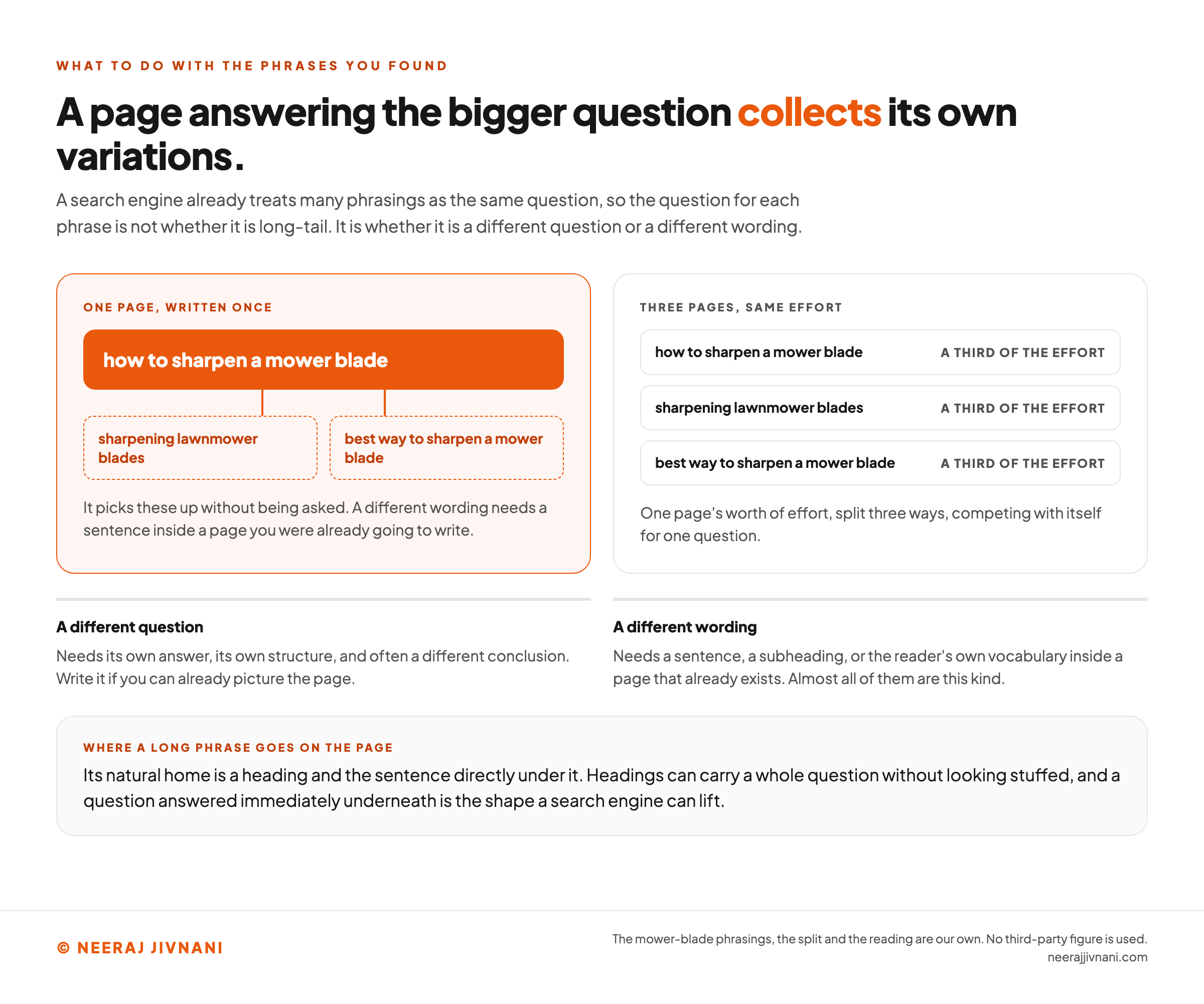
Rank for "how to sharpen a mower blade" and the same page collects "sharpening lawnmower blades" and "best way to sharpen a mower blade" alongside it.
Write three pages for those three phrases and you split one page's worth of effort three ways.
So the question for each phrase is not whether it is long-tail. It is whether it is a different question or a different wording.
A different question needs its own answer, its own structure, and often a different conclusion. A different wording needs a sentence inside a page you were already going to write.
Where a Long Phrase Goes on the Page
A long-tail phrase is usually too long to sit in a title tag without reading badly, and that is the practical problem with the advice to put your keyword in the title.
Its natural home is a heading and the sentence directly under it.
Headings are where a question belongs, they can carry a whole sentence without looking stuffed, and a question answered immediately underneath is the shape a search engine can lift.
Nothing else needs forcing. If the page genuinely answers the question, the words will mostly be on it already.
What the Rest Are Good For
Finishing with mostly paragraphs and few pages is not a disappointing result.
Those phrases still do work. They tell you which subheadings the page needs, which words the reader uses, and which angle you would otherwise have missed.
The ones that earn a page are the ones where you can already picture the page. If you can see its structure, and it is not a section of something else, write it.
Use this chart — embed code and citation
<a href="https://neerajjivnani.com/blog/long-tail-keywords/"><img src="https://neerajjivnani.com/infographics/long-tail-keywords/one-page-or-a-sentence.png" alt="Two panels comparing one page written once against three pages written for three phrasings of the same question. The highlighted left panel shows a single orange page labeled how to sharpen a mower blade, with two dashed boxes hanging off it reading sharpening lawnmower blades and best way to sharpen a mower blade, and a note that it picks these up without being asked, because a different wording needs a sentence inside a page you were already going to write. The right panel lists the same three phrasings as three separate pages, each marked a third of the effort, under a note that this is one page's worth of effort split three ways, competing with itself for one question. Underneath, two rules: a different question needs its own answer, its own structure and often a different conclusion, and is worth writing when you can already picture the page; a different wording needs a sentence, a subheading or the reader's own vocabulary inside a page that already exists, and almost all of them are this kind. A band at the foot says where a long phrase goes on the page, which is a heading and the sentence directly under it, because headings can carry a whole question without looking stuffed and a question answered immediately underneath is the shape a search engine can lift." width="1200"></a>
<p>Chart: <a href="https://neerajjivnani.com/blog/long-tail-keywords/">Neeraj Jivnani</a></p>Neeraj Jivnani, "Long-Tail Keywords, and Which of Them Are Worth a Page", neerajjivnani.com, https://neerajjivnani.com/blog/long-tail-keywords/Free to republish with a link back to this page.
Long-Tail Keywords in Paid Search
The same phrases usually cost less and almost always waste less when you are bidding on them. A specific search draws fewer advertisers, so there is less pressure on the price.
The bigger gain is the waste you avoid.
A broad term brings clicks from people who wanted something adjacent, and you pay for every one. A specific term brings fewer clicks, and more of them are the right person.
One thing to check rather than assume: long-tail is not automatically cheap. Some specific phrases are specific about something expensive, and the bidding reflects it.
Check the bid on a phrase before you budget for it being cheap.
What AI Search Changed
AI search made the tail longer and thinner, and what that changes is your instruments rather than your method.
More phrasings, each one rarer, most of them never repeated by anybody else, and almost none of them measurable.
So a volume number decides less than it did. A tool reading zero was always weak evidence about whether anybody wants something, and an assistant that invites a whole sentence makes it weaker.
You are still looking for real questions and answering them plainly, in a section that makes sense when it is pulled out on its own.
When to Leave the Long Tail Alone
There are four situations where this is the wrong thing to be doing, and leaving it alone is the right call in all of them.
When you cannot publish at volume. The arithmetic needs many posts. At one a month, twelve small posts a year will not add up, and one genuinely good page on something people search will do more.
When the phrases are variations rather than questions. If your list is forty ways of saying one thing, you have one page to write.
When your site is already strong enough for the head term. The head term was always worth more; what changes is whether you can reach it. Once you can, one page there beats another twenty small ones.
When nobody is searching at all. This is the failure that word counting causes. A phrase built by adding modifiers, that no person has ever typed, is not a long-tail keyword. It is a string.
The test that separates a keyword from a string is the same one every time.
Somewhere, can you point at evidence that a real person went looking for this? If you can, the size of the number is a detail. If you cannot, no amount of specificity turns it into a search.