What Product Marketing Owns, Where It Stops, and Who Actually Does It
Product marketing makes a product sellable. Here is what nearly every team owns, what your employer decides on top, and how to read the posting you have.


/ On this page10 sections
Ten duties sit under the product marketing title. One of them is on nearly every team, three more on about four in five, and the last six are your employer's choice.
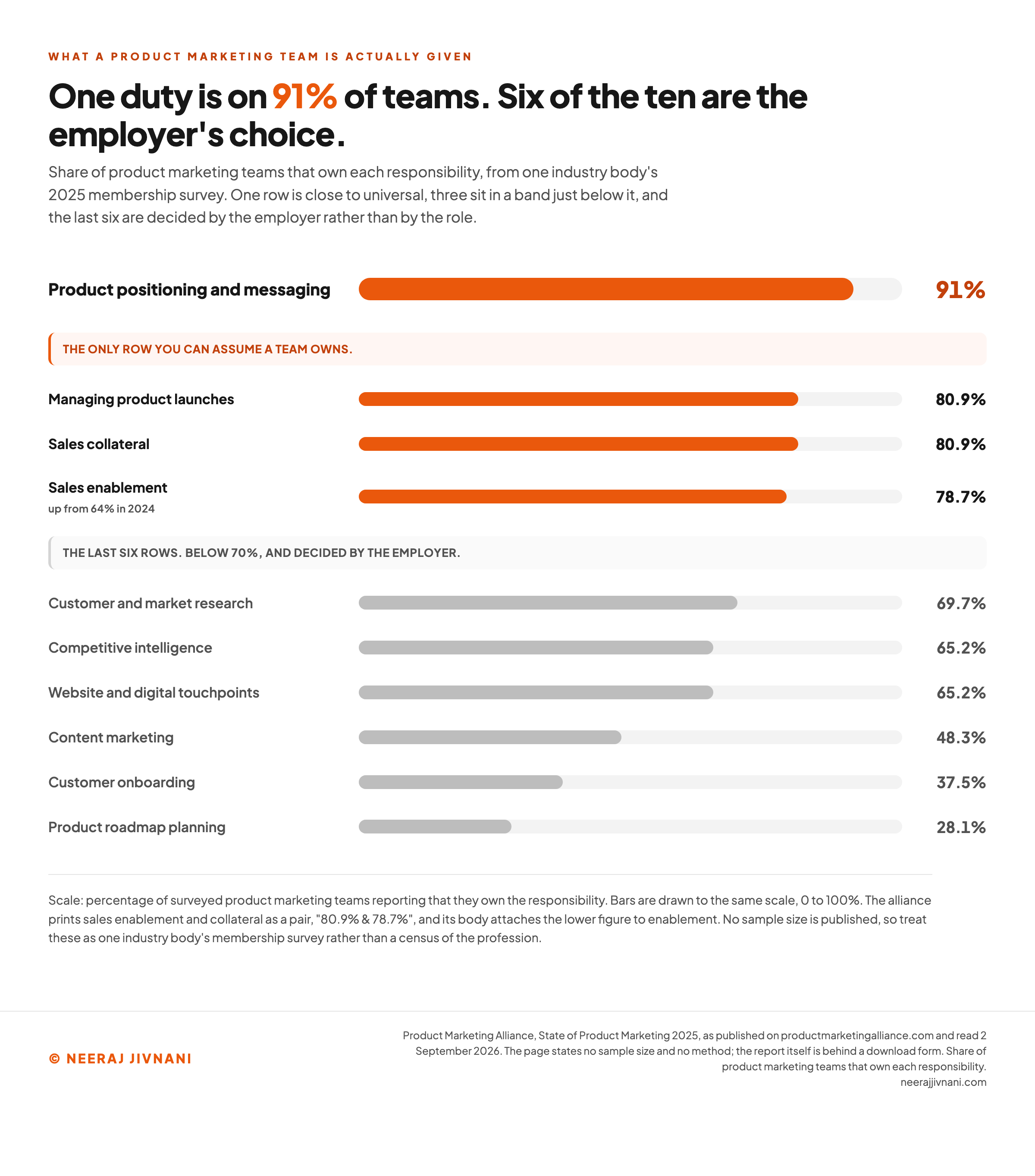
Positioning and messaging sits on 91% of product marketing teams, and product roadmap planning on 28.1%, in the Product Marketing Alliance's State of Product Marketing 2025 report.
That gap is the job, and it is why two postings for the same title can describe different work.
Product Marketing Is the Commercial Half of a Product
Product marketing is the work of deciding who a product is for, how it is explained to a buyer, and how it reaches one. It is the commercial half of a product, and the job title is product marketing manager, or PMM.
If you are working out whether this is a job you want, or a function your company needs, the definitions are where the confusion starts.
They are not the same size, and the difference between the narrowest and the widest changes what the job includes.
The narrow definition is a launch job. Coursera calls product marketing an area of marketing that focuses on launching products and driving awareness for them.
The middle one adds what happens after the launch. The Product Marketing Alliance calls it the process of bringing a product to market and overseeing its ongoing success, sitting at the intersection of product, sales and marketing.
Strip that down and you get Salesloft's one-line version: bring the product to market and make it sellable.
The widest one adds price. Quoting a 2023 review article, Wikipedia calls product marketing a core business function that plans and executes how a product is positioned, priced and promoted to a defined audience.
What Only the Widest Definition Names
Price appears in one of those four definitions, and the measured responsibility list has no pricing row at all.
One of the three job postings further down makes it a duty of the role in its own right.
That definition rests on a single author, and the Wikipedia article carrying it flags itself for original research and thin inline citations.
So take the shape from a definition, and take the boundary from somewhere else.
The shape is not in dispute: somebody has to make the product sellable.
Where that job stops is the harder question, and it is the one you came here with.
Why Companies Add the Role at All
Companies add product marketing when the product is good and the market is not hearing it. The engineering is done, the demonstrations go well, and the pipeline does not move.
If you are being hired into this, that is the problem you are being hired into. The hire is a bet that the words are the bottleneck rather than the code.
The failure the role exists to prevent is not a technical one. The Product Marketing Alliance reports a lack of market need as the #1 reason startups and new product lines fail rather than bad technology, and credits that to studies it never names.
Take the unnamed studies out and the claim still stands on its own logic. A team that builds first and asks later has no way of finding the gap until the launch finds it for them.
The Three Signs That the Moment Has Arrived
Three signs mark the moment, and Bessemer Venture Partners' Atlas guide names all three. Read them as a checklist against your own situation rather than as advice:
- The company is moving from early adopters to scaled growth. Early adopters forgive an unclear pitch. The next group does not.
- There are product launches to support. A launch nobody has written the story for gets its story written by whoever speaks first.
- You are breaking into new markets. New market, new buyer, new words, and your old messaging does not travel.
None of these is about the product getting worse.
They are all about the buyer being further away than they used to be.
Only One Responsibility Is Near-Universal
One responsibility turns up on close to every product marketing team. The table below is where the rest of the answer is.
Here are the ten duties and the share of teams holding each, from the Product Marketing Alliance's State of Product Marketing 2025 report. It prints six numbered responsibilities, one of which is a pair, plus three it calls emerging trends.
| what the team owns | share of teams |
|---|---|
| Product positioning and messaging | 91% |
| Managing product launches | 80.9% |
| Sales collateral | 80.9% |
| Sales enablement | 78.7% |
| Customer and market research | 69.7% |
| Competitive intelligence | 65.2% |
| Website and digital touchpoints | 65.2% |
| Content marketing | 48.3% |
| Customer onboarding | 37.5% |
| Product roadmap planning | 28.1% |
The alliance prints sales collateral and sales enablement as one pair, "80.9% & 78.7%", and its body attaches the lower figure to enablement. That is why they are split here.
Reading the Spread as the Finding
Positioning and messaging at 91% is the one row you can assume a team owns.
Three more sit in the band below it: launches and collateral at 80.9%, enablement at 78.7%. Across the last six rows the figures fall away, and by roadmap planning at 28.1% the duty belongs to a minority of teams.
Below the top rows, the answer is a property of the employer rather than of the role. A duty list can be accurate and still not describe the job you are looking at.
That gives you a way to read a job description.
A posting that names positioning is normal, and a posting that hands you the roadmap is describing an unusual arrangement.
If you are looking at one of those, ask why before you take it as flattery.
Use the numbers for the shape rather than the decimal. Whether positioning is on 91% of teams or a few points either side, it is the only row without a serious rival.
That caution is owed. No sample size and no method are published beside these percentages, so they carry the weight of one industry body's membership survey rather than a census of the profession.
One thing people ask about is not on the list at all. The 3-3-3 rule is not a product marketing idea, and it is not among the ten responsibilities the survey counts.
Tick the rows your own posting names, and see which version of the job you are being offered.
Put a real duty list against the measured one
Tick what the job in front of you names
The ten rows are the responsibilities the State of Product Marketing 2025 report counted, with its share of teams beside each one. Tick the ones your posting or your role names, or load one of the three real adverts and watch the same ten rows light differently.
What that mix is
Nothing ticked yet. Tick the duties the job names, or load one of the three adverts above.
Shares are from the Product Marketing Alliance State of Product Marketing 2025 report, as published on its guide page. No sample size is stated there. This counts what you tick against those rows and reports the mix; it produces no score.
Why the Positioning Work Is Under More Pressure
The pressure comes from sameness. The alliance calls the symptom AI washing, companies slapping AI labels on every feature without explaining the value.
When every competitor claims the same capability, the sentence explaining what your thing does for a buyer is the only part left that can differ.
Use this chart — embed code and citation
<a href="https://neerajjivnani.com/blog/product-marketing/"><img src="https://neerajjivnani.com/infographics/product-marketing/duty-spread.png" alt="Horizontal bar chart of the ten responsibilities product marketing teams own, from the Product Marketing Alliance State of Product Marketing 2025 report, with product positioning and messaging alone at the top on 91 percent, managing product launches and sales collateral tied at 80.9 percent and sales enablement at 78.7 percent, then a labeled drop through customer and market research at 69.7 percent, competitive intelligence and website at 65.2 percent, content marketing at 48.3 percent, customer onboarding at 37.5 percent and product roadmap planning last at 28.1 percent, with every row below the top four marked as company-dependent." width="1200"></a>
<p>Chart: <a href="https://neerajjivnani.com/blog/product-marketing/">Neeraj Jivnani</a></p>Neeraj Jivnani, "What Product Marketing Owns, Where It Stops, and Who Actually Does It", neerajjivnani.com, https://neerajjivnani.com/blog/product-marketing/Free to republish with a link back to this page.
The Same Title, in a Literacy Company and a Hardware Company
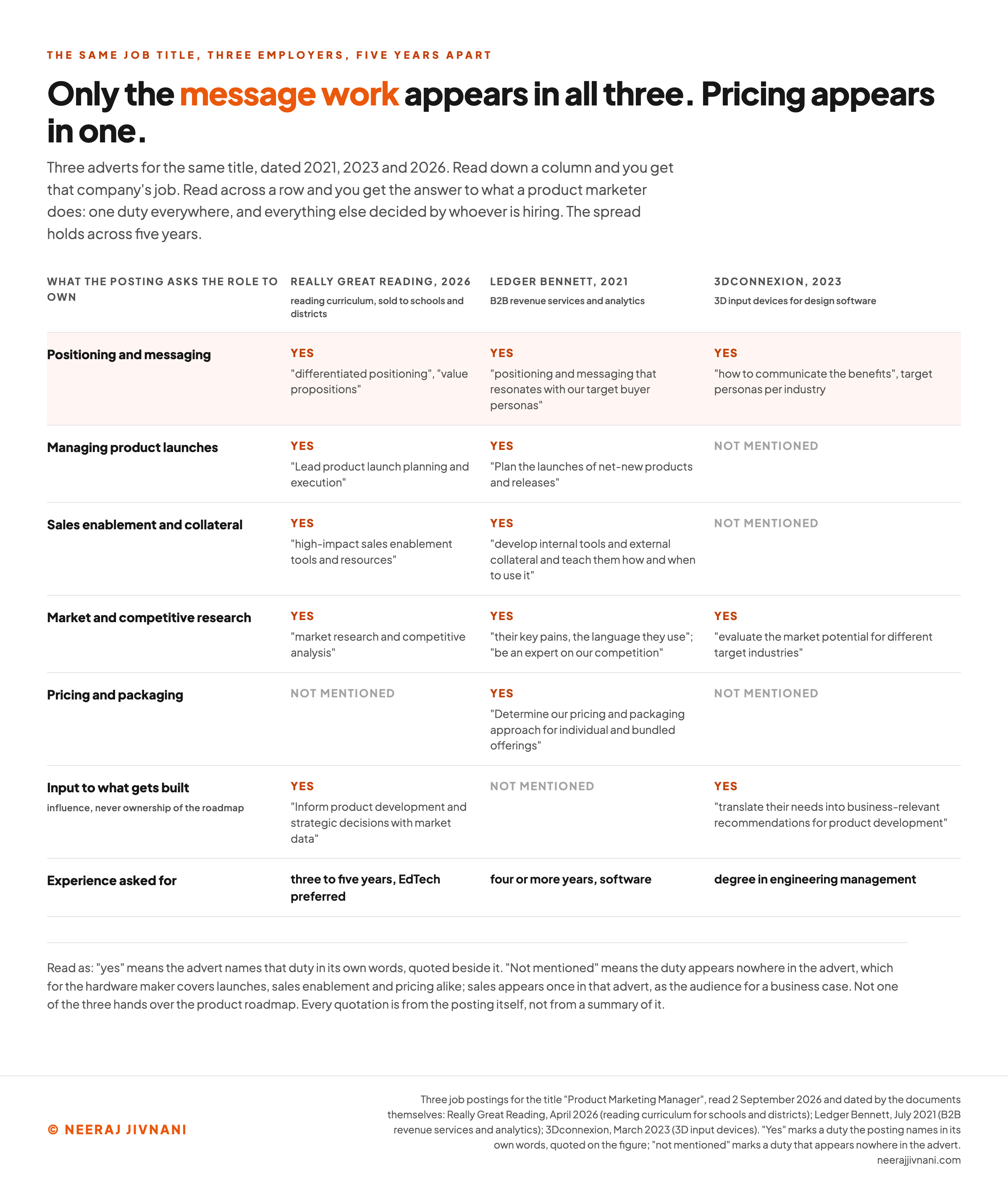
The same job title carries three different jobs. Three postings for a product marketing manager, dated 2021, 2023 and 2026, ask for three different things.
None of them is from a software company you would recognize.
The spread holding across five years is the point. Here is what each employer sells, and what each one wants the role to own:
| the employer | what it sells | what the posting asks the role to own |
|---|---|---|
| Really Great Reading, 2026 | reading curriculum, to schools and districts | positioning for educators and district leaders, launch planning, sales enablement, market research |
| Ledger Bennett, 2021 | business-to-business revenue services, including sales and marketing analytics | pricing and packaging, positioning and messaging, launches, market intelligence, competitor work, go-to-market content, sales training |
| 3Dconnexion, 2023 | 3D input devices for design and engineering software | market potential and business cases, target personas and workflows, technical content, customer feedback |
The literacy publisher has the product marketing manager reporting to a Director of Product Marketing Strategy. The work is positioning and messaging for educators and district leaders, launch planning, sales enablement, and market research.
Its measures are unusually specific for a job advert. It lists product adoption rate, pipeline contribution, win rate on supported opportunities, and asset utilization, which it glosses as sales enablement usage.
The agency posting asks the product marketing manager to help build a well-defined, packaged and priced set of offerings for its analytics products, and to write the go-to-market content that sells them: one-pagers, pitch decks, website content, blog posts.
Pricing is a duty in its own right there. The posting lists pricing, packaging and building as one line, and asks the holder to determine the pricing and packaging approach for individual and bundled offerings.
The hardware maker puts the role inside the Corporate Marketing team, working next to Product Management.
Its duties are evaluating market potential for target industries, building business cases, determining target personas and typical workflows, engaging power users and beta testers, creating screencasts, and turning customer feedback into recommendations for product development.
Read that third list again for what is missing from it, because it is probably what you assumed the job was.
No launch, a duty 80.9% of teams hold. No sales enablement. No pricing.
What Survives Across All Three
The message work is in all three postings, and each one calls it something else.
The literacy publisher asks for differentiated positioning and value propositions. The agency asks for product positioning and messaging that resonates with target buyer personas.
The hardware maker asks for target personas and for communicating the benefits of using its products. That is the 91% row, showing up in three companies with nothing else in common.
Market research is in all three too. Everything else moves: launches and sales enablement in two of the three, pricing in one.
None of them hands over the roadmap. Two ask only that customer and market insight reaches product development, which is influence rather than ownership.
The Three Kinds of Product Marketer
The variation is not random.
Product marketers come in three kinds, and which one a company needs decides the duties it writes into the posting. Bessemer Venture Partners sorts them that way.
Enterprise product marketers focus on sales enablement and adapt the positioning across industries and buyer personas. Product-led growth product marketers primarily support launches and growth initiatives inside the product itself.
Technical and developer product marketers create in-depth tutorials and demonstrations for a technical audience. That is close to the hardware maker's advert, in a company that makes devices rather than software.
Use this chart — embed code and citation
<a href="https://neerajjivnani.com/blog/product-marketing/"><img src="https://neerajjivnani.com/infographics/product-marketing/three-postings.png" alt="Three-column comparison of what a product marketing manager is asked to do in three job postings dated 2021, 2023 and 2026, a literacy publisher selling to schools, a business-to-business revenue services agency and a maker of 3D input devices, with rows for positioning and messaging, managing product launches, sales enablement and collateral, market and competitive research, pricing and packaging, input to what gets built, and the experience each employer asks for, showing that two duties appear in all three, the message work under three different names and market and competitive research, while launches, sales enablement and product input each appear in two and pricing in only one." width="1200"></a>
<p>Chart: <a href="https://neerajjivnani.com/blog/product-marketing/">Neeraj Jivnani</a></p>Neeraj Jivnani, "What Product Marketing Owns, Where It Stops, and Who Actually Does It", neerajjivnani.com, https://neerajjivnani.com/blog/product-marketing/Free to republish with a link back to this page.
Who Owns the Roadmap, and Who Owns the Message
Product management owns the roadmap. Product marketing owns the message.
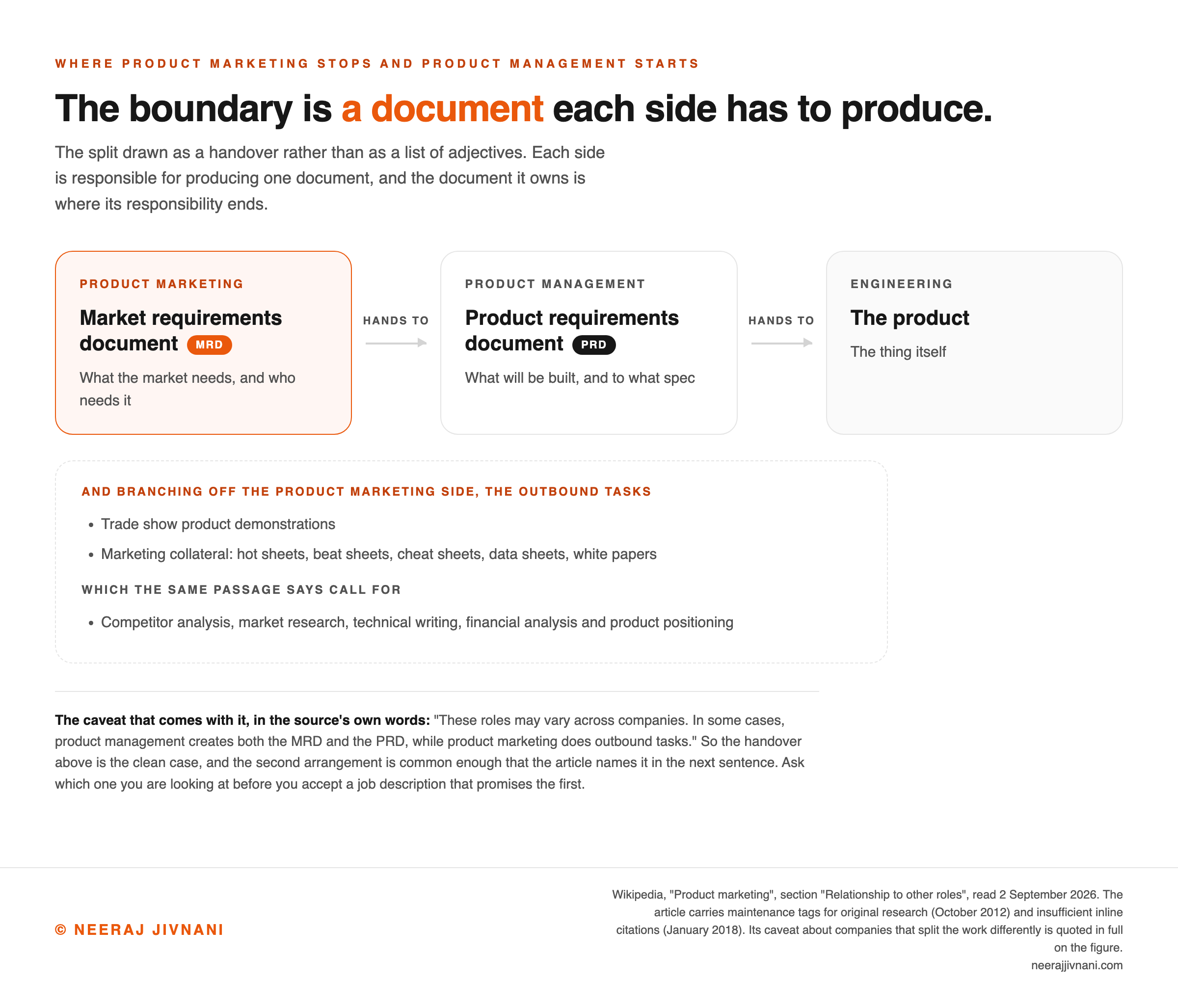
The cleanest version of that boundary is not a definition at all. It is a pair of documents.
The product marketing manager creates a market requirements document, or MRD, and gives it to the product managers. That is Wikipedia's account of the split, and it is a mechanical one.
The product manager then gathers the product requirements and creates a product requirements document, or PRD, which goes to the engineering team.
So the boundary is an artifact each side is responsible for producing. One document says what the market needs, and the other says what will be built.
The Caveat That Comes With It
The two roles may vary across companies, and that qualification matters more than the rule. Wikipedia prints it in the same passage.
In some cases product management creates both documents while product marketing does the outbound tasks.
Those tasks include trade show demonstrations and marketing collateral such as data sheets and white papers.
The outbound tasks call for competitor analysis, market research, technical writing, financial analysis and product positioning. That is the same passage's own list.
Product managers are responsible for creating a product, and product marketers are responsible for bringing it to market. Acquia puts it in those words.
Where the Two Roles Genuinely Overlap
Both roles research market needs, develop plans and work across departments, and both use personas, stories and journey maps. Acquia sets both lists out.
That shared toolkit is where your confusion comes from. Two people can produce a persona document from the same interviews and mean different things by it.
The product manager's persona feeds a build decision. The product marketer's persona feeds a sentence that has to work on a landing page.
The Other Marketing Roles It Gets Confused With
Three neighboring functions get confused with this one, and the differences are about scope rather than seniority.
Brand marketing works on what the company means over years, and demand generation works on filling the pipeline this quarter.
Field marketing works on a region or a segment, close to the sellers in it.
Product marketing cuts across all three on one axis, the product. It supplies the words the brand team dresses, the demand team spends against, and the field team localizes.
Use this chart — embed code and citation
<a href="https://neerajjivnani.com/blog/product-marketing/"><img src="https://neerajjivnani.com/infographics/product-marketing/two-documents.png" alt="Flow diagram of the boundary between product marketing and product management drawn as two documents, showing the market requirements document written by product marketing and handed to product management, the product requirements document written by product management and handed to engineering, with the outbound tasks of trade show demonstrations and marketing collateral branching off the product marketing side alongside the skills the article says those tasks call for, and a footnote carrying Wikipedia's own caveat that in some companies product management writes both documents while product marketing does the outbound tasks." width="1200"></a>
<p>Chart: <a href="https://neerajjivnani.com/blog/product-marketing/">Neeraj Jivnani</a></p>Neeraj Jivnani, "What Product Marketing Owns, Where It Stops, and Who Actually Does It", neerajjivnani.com, https://neerajjivnani.com/blog/product-marketing/Free to republish with a link back to this page.
Positioning Comes First, and One Document Carries It
Positioning is the first piece of work because everything downstream quotes it. Your launch plan, your sales deck and your website all repeat whatever the messaging document says, correct or not.
The work runs on three documents, and Bessemer Venture Partners names them:
- The messaging document explains a product's audience, market trends, benefits and differentiation.
- The persona document covers the audience: the core buyers, some of their titles, and their key priorities.
- The campaign document is a project brief giving a campaign's objective and purpose, its key performance indicators, and the channels it will live on.
Notice where two of them start. The messaging document opens on the audience, and the persona document is about nothing else.
Benefits, Not Features, and What That Means in Practice
The oldest rule in this part of the job is to lead with benefits rather than features, and it survives because teams keep breaking it.
A feature is what the thing does. A benefit is what changes for the person once it does that, said in words they already use.
The literacy publisher's posting makes the translation a duty, asking the holder to turn product features into clear, outcome-driven benefits.
The translation is harder than it sounds. Your buyer's words are rarely your product team's words.
That is why the persona document exists, and why it comes from research and not from a workshop.
Competitive Intelligence, and the Win-Loss Interview
Competitive intelligence is the second half of where a message comes from, and fewer teams own it than you would expect. The alliance puts customer and market research at 69.7% and competitive intelligence at 65.2%.
Both sit in the band where the employer decides. Three in ten teams do not own customer and market research, and the survey never says whether they are the same teams writing the positioning.
The work starts with customer development, before any positioning is written, and that is step one of Salesloft's eight-step strategy.
The three postings agree on this more than on anything else. The literacy publisher asks for market research and competitive analysis, and for customer feedback synthesized into insight.
The agency asks its product marketing manager to learn about the buyers, their key pains and the language they use. The hardware maker asks the role to engage power users, beta testers and application experts.
Reading Deals You Already Lost
Win-loss work is the same research pointed at deals that have closed, and the alliance treats it as the headline measure of whether your positioning is landing.
By analyzing why deals are won or lost, and looking at the competitive reason recorded against them, a team can see whether the messaging is resonating or whether the competition is out-positioning it.
An interview with a buyer who chose somebody else can tell you more about your positioning than another feature comparison will. They have already decided, so they have nothing left to sell you.
The reason this often goes undone is not difficulty. It is that the interview belongs to nobody by default, and on three teams in ten the research sits outside the product marketing brief.
The Launch Sequence, and Where It Ends
Managing product launches sits at 80.9%, tied with sales collateral as the second most common duty. It is the go-to-market stretch of the job, or GTM, and it is the part with a published sequence you can follow.
The sequence runs to eight steps, worth taking in order because each one feeds the next. Salesloft publishes them like this:
- Customer development. Talk to buyers before anything is written.
- Positioning and messaging. Decide what the product is and who it is for.
- Sharing the positioning and messaging. Get the rest of the company saying the same thing.
- Making a launch plan. Dates, owners, channels.
- Creating launch content. The assets the plan needs.
- Preparing the team. Sales and support know what is coming and what to say.
- The launch itself.
- Post-launch. Set up a retrospective to look back at what could have been done better.
Step seven is the one people picture when they picture the job.
The two steps around it, preparing the team and the retrospective after it, are where your work is either kept or lost.
Why the Measurement Starts After the Announcement
Measure a launch by feature adoption at 30, 60 and 90 days afterwards, which is a different question from whether your announcement went out on time. That is where the alliance puts the bar.
The literacy publisher's posting measures launch success by timeline adherence and adoption targets together, not by the timeline alone.
Customer onboarding, at 37.5%, is the row that shows what happens in those weeks. The alliance says it has close to doubled since 2024, and describes it as making sure the value promised during the sale is realized in the first 90 days of use.
That is the quiet shift in the role. The launch used to end at the announcement, and on more teams than before it now ends when the feature is being used.
What Sales Is Given, and Whether Any of It Is Used
Sales collateral sits at 80.9% and sales enablement at 78.7%, which the alliance calls the fastest-growing area of impact after a rise from 64% in 2024. Both numbers describe supply, and neither describes use.
Sales gets battlecards, proof points and storytelling, plus training on competitive shifts.
The list also runs to older and more physical things: trade show product demonstrations, hot sheets, beat sheets, cheat sheets, data sheets and white papers. That set is Wikipedia's.
Somebody also has to teach the sales team how and when to use any of it, which the agency posting writes in as a duty alongside developing the tools and collateral themselves.
The hardware maker's advert names no enablement duty at all. Sales appears in it once, as the direction a business case is meant to inform, which puts this product marketer upstream of the sellers rather than beside them.
The Measures That Catch What Goes Unused
Three cheap measures catch whether any of it lands, and you could run all three this quarter.
The literacy publisher tracks asset utilization rate, which it defines as sales enablement usage. That is a direct count of whether the deck anybody built is being opened.
Often it is a quarterly internal survey that gives you a sales confidence score: how confident the team feels pitching the product and handling objections.
Recorded sales calls give you messaging consistency, meaning how often reps use the official talk tracks and value pillars in live conversations. The alliance suggests both the confidence score and the call analysis.
Where Product Marketers Come From
There is no single route into product marketing.
People arrive from product management, from other marketing roles, from consulting, from analyst work, and from customer-facing jobs like account management and support. ProductPlan names that spread.
The list is long because the job sits between four departments, in what Pragmatic Institute calls the gray area between product management, marketing, sales and customer experience.
That is the honest picture: four departments feed the role, and none of them is a prerequisite.
What the Postings Ask For
The three adverts ask for three different backgrounds, which follows from their asking for three different jobs.
- The literacy publisher asks for three to five years of product marketing experience, prefers education technology, and wants a bachelor's degree in marketing, business, communications or a related field.
- The agency asks for four or more years of software product marketing experience and treats an undergraduate degree as a requirement.
- The hardware maker asks for a master's or bachelor's degree in engineering management, and for the ability to translate technical topics into user-friendly language.
Read across them and the pattern is not a qualification.
It is domain knowledge, in whichever domain your buyer sits.
The Skills Underneath the Job Titles
Two kinds of skill run through every version of this job, and the split is more useful to you than either list alone.
The hard skills are market research, product positioning, marketing strategy with channel knowledge, and data analysis. The soft ones are project management, budget allocation, communication and collaboration, and Pragmatic Institute draws the split that way.
A shorter list works too: communication, creativity, empathy, and both qualitative and quantitative ability, which is ProductPlan's five.
Empathy reads like filler. It is not, because your persona document depends on it.
What the Job Pays
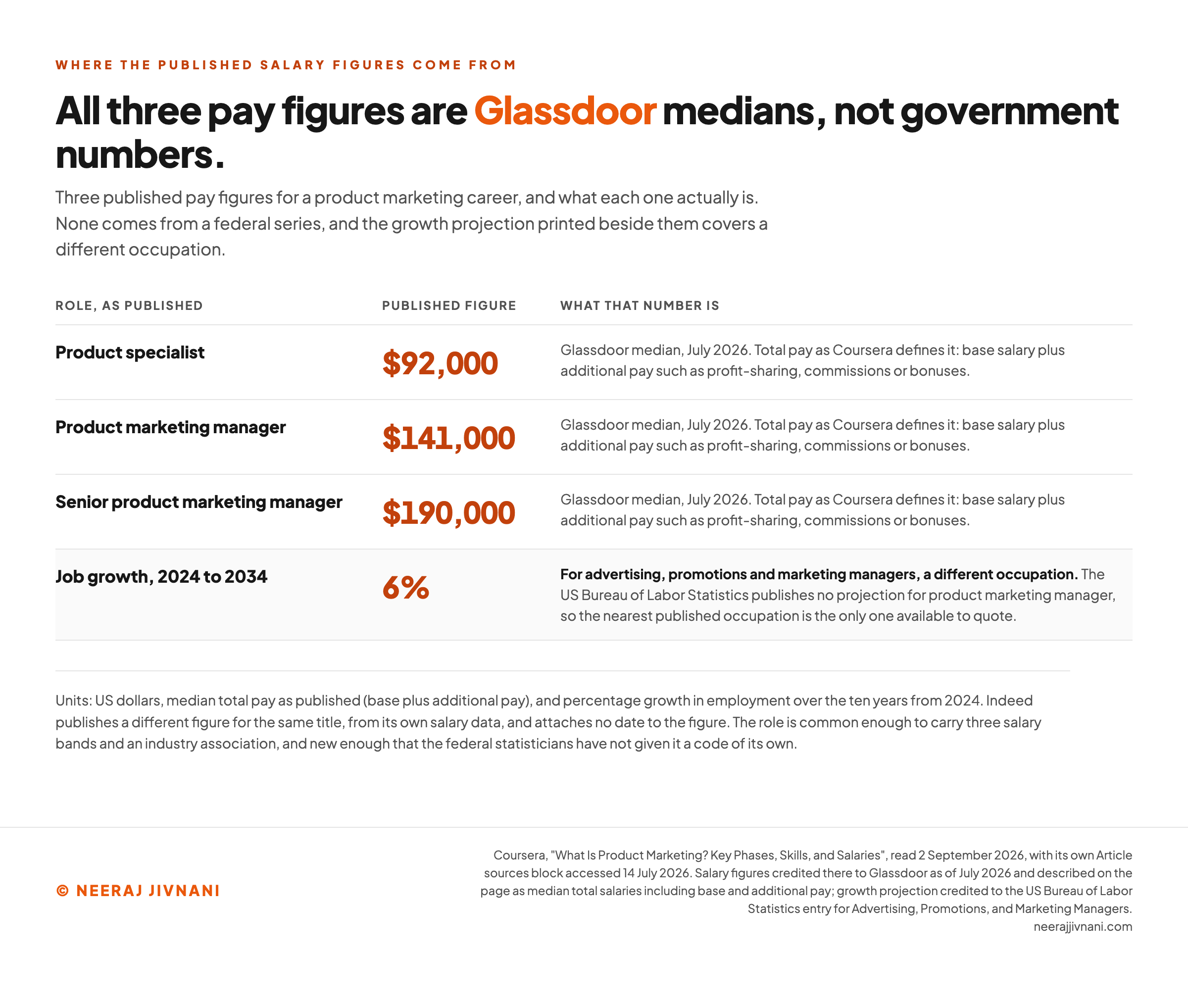
Three published figures, and what kind of number each one is matters as much as its size.
Coursera publishes $92,000 for a product specialist, $141,000 for a product marketing manager and $190,000 for a senior product marketing manager. All three are Glassdoor medians as of July 2026.
Those are total salaries, base pay plus additional pay that may include profit-sharing, commissions or bonuses, as Coursera defines them.
So the figure is an aggregator's, not an employer's and not a government's.
Indeed publishes a different figure for the same title, from its own salary data, and attaches no date to it.
Whether the Field Is Growing
No federal projection is published for this job title, so the growth number you will see quoted covers a wider occupation than this one.
The US Bureau of Labor Statistics expects employment of advertising, promotions and marketing managers to grow 6 percent from 2025 to 2035, faster than the average for all occupations.
Read that 6 percent as a direction of travel rather than a forecast for the role you are taking.
That absence tells you something real. Product marketing is common enough to have three salary bands and an industry association, and new enough that the government statisticians have not given it a code of its own.
The answer to what a product marketer does has two parts. One duty is on nearly every team, and the six least common duties are your employer telling you which version of the job this is.
Take the job description in front of you and mark which of the ten rows it names.
That list, and not the average of every employer, is the job you would be doing.
Use this chart — embed code and citation
<a href="https://neerajjivnani.com/blog/product-marketing/"><img src="https://neerajjivnani.com/infographics/product-marketing/pay-provenance.png" alt="Table of the three Glassdoor pay figures republished by Coursera for product marketing roles, product specialist at 92,000 dollars, product marketing manager at 141,000 dollars and senior product marketing manager at 190,000 dollars, each labeled as a Glassdoor median as of July 2026 covering base pay plus additional pay, set beside the Bureau of Labor Statistics projection of 6 percent job growth from 2025 to 2035 which the figure labels as covering advertising, promotions and marketing managers rather than product marketing managers because no federal projection is published for this job title." width="1200"></a>
<p>Chart: <a href="https://neerajjivnani.com/blog/product-marketing/">Neeraj Jivnani</a></p>Neeraj Jivnani, "What Product Marketing Owns, Where It Stops, and Who Actually Does It", neerajjivnani.com, https://neerajjivnani.com/blog/product-marketing/Free to republish with a link back to this page.