User-Generated Content: Getting Enough of It, and Being Allowed to Use It
A customer tagging you hands over nothing you may republish. What a permission has to say, what a credit does not buy you, and how to collect more of it.

/ On this page12 sections
User-generated content is anything about your product that your customers made and you did not: reviews, photos, an unboxing video, a comment under somebody else's post. A customer tagging you in one hands over nothing you may republish.
Copyright stays with whoever pressed the shutter, and that is where most of the practical trouble in this subject sits.
The other half is supply. Almost nobody posts about a product unprompted, so everything turns on how and when you ask.
What Counts as User-Generated Content
User-generated content is content about a brand, made by somebody outside it and published by them, that the brand did not pay for. Your customers doing your marketing without being on your payroll.
Almost everyone shortens user-generated content to UGC, or user generated content without the hyphen, and all three mean the same thing.
Three tests settle what counts. The content is made publicly available over the internet, it reflects a certain amount of creative effort, and it is created outside of professional routines and practices.
They come from the OECD (an intergovernmental economic research body), which set them out in a 2008 paper on measuring user-created content after finding no widely accepted definition to use.
The middle test earns its keep. A five-star click with no words attached is a rating rather than content, and it gives a reader nothing to weigh.
The third test is where the modern confusion begins.
Something a brand commissioned and paid for was made inside professional routines, whatever it looks like on screen.
What Does Not Count
Four things get filed here and do not belong.
- Your own posts, ads and product photography. You made them. That is brand content, and different rules apply to it.
- A star rating with nothing written under it. It moves an average and persuades nobody.
- A press mention. Somebody was at work.
- A generated review. No experience produced it, so there is nothing behind the opinion.
Six Kinds, and the Doubt Each One Settles
There are six kinds worth telling apart, and each one settles a different doubt a buyer has.
Reviews and ratings. The written verdict on a product page or a marketplace listing. This is the workhorse, and the kind with the strongest evidence behind it.
Photos and video from customers. What the thing looks like in a normal room, on a normal person, in normal light. It answers the question your own photography cannot, which is whether the studio shot was honest.
Social posts and branded hashtags. A customer posting on their own account, sometimes tagging you, sometimes not. Low control, wide reach, and the hardest to get permission for afterwards.
Questions and answers on a product page. A shopper asks, another shopper or you answer. Cheap to run and badly underused, because it captures the objections nobody thought to write copy about.
Community and forum writing. Longer, more detailed, and mostly not yours to move. Its value is what it tells you rather than what you can republish.
Long-form: blog posts, videos, tutorials. Rare, and worth having when it happens, because somebody spent hours on you for nothing.
The Ones Worth Asking For First
Start with reviews on the things you sell, then customer photographs attached to those reviews.
Both live on the page where somebody is deciding, both are yours to display without chasing anyone across a platform, and both are the two kinds a buyer looks for by name.
Everything else is worth having and none of it is worth building first.
Who Makes User-Generated Content
Four groups produce nearly all of it. Their output is wildly uneven.
Ordinary customers, once. The largest group by headcount and the smallest by output.
The small group who post anyway. Every product has a handful of people who write reviews, film themselves opening boxes and answer strangers' questions for nothing.
They are worth knowing by name, because they will do it again.
Employees. Sometimes filed separately as employee-generated content, and it works with one condition. It has to be visibly them, saying where they work, or it reads as a brand doing an impression of a person.
Hired creators. Somebody paid to produce content that looks like the first group's. That is a different transaction.
Free and Paid, and Why the Hired Creator Blurs Them
Free UGC, also called organic UGC, is what your customers make on their own schedule. A review somebody left, a photograph they posted, a question they asked under a listing.
Paid UGC is what you commission from a creator, made to look like the unpaid kind, and handed to you rather than published by them.
Both get called the same thing. Only the first is doing the job the word was coined for.
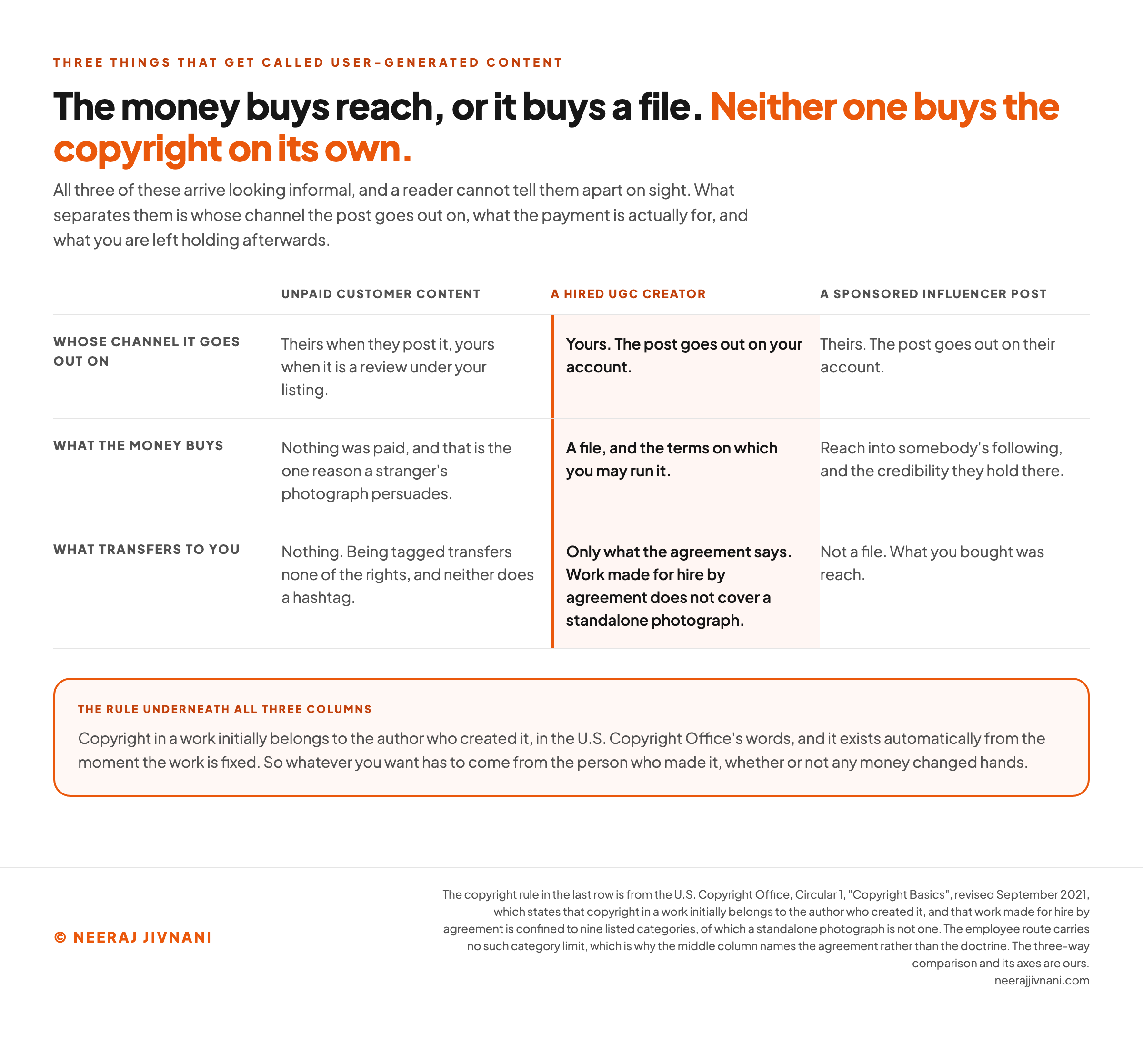
The hired creator sits between a customer who was never paid and an influencer who is paid for their audience, and that is where nearly all of the confusion about this word now lives.
What Separates This From Influencer Marketing
The difference is whose audience is involved.
An influencer is paid because people follow them, and the post goes out on their account. A UGC creator is paid for the file, and the post goes out on yours.
So you are paying for two unlike things. One is reach into somebody's following and the credibility they hold there.
The other is a file and the terms on which you may run it. Treating that as anything but a production job is how the money gets misjudged.
Paid Is Not a Recent Arrival
Paid UGC is not a corruption of the term. The industry has always used the word more loosely than the definition does.
A source of UGC can be compensated with money or other types of rewards, or the content can be holistically sourced and not paid. That is the Interactive Advertising Bureau describing where UGC comes from, in 2015.
What has changed is the proportion, not the vocabulary.
The commissioned kind has grown into a category of its own, with its own creators and its own marketplaces. It does not carry the property that made the unpaid kind valuable.
A stranger's photograph persuades for one reason, which is that nobody paid for it.
That does not make commissioned work useless. It makes it advertising that looks informal, which is a reasonable thing to buy, provided you know that is what you bought.
Use this chart — embed code and citation
<a href="https://neerajjivnani.com/blog/user-generated-content/"><img src="https://neerajjivnani.com/infographics/user-generated-content/reach-or-a-file.png" alt="A three column table comparing unpaid customer content, a hired UGC creator and a sponsored influencer post, with the hired creator column tinted and marked out as the middle case. The first row asks whose channel the post goes out on: theirs when a customer posts it and yours when it is a review under your listing, yours for the hired creator, theirs for the influencer. The second row asks what the money buys: nothing was paid for the customer's, and that is the one reason a stranger's photograph persuades; a file and the terms on which you may run it from the hired creator; reach into somebody's following and the credibility they hold there from the influencer. The third row asks what transfers to you: nothing at all from the customer, because being tagged transfers none of the rights and neither does a hashtag; only what the agreement says from the hired creator, since work made for hire by agreement does not cover a standalone photograph; and not a file at all from the influencer, because what you bought was reach. The title states that the money buys reach or it buys a file, and that neither one buys the copyright on its own. A band across the foot gives the rule underneath all three columns, that copyright in a work initially belongs to the author who created it and exists automatically from the moment the work is fixed, so whatever you want has to come from the person who made it, whether or not any money changed hands." width="1200"></a>
<p>Chart: <a href="https://neerajjivnani.com/blog/user-generated-content/">Neeraj Jivnani</a></p>Neeraj Jivnani, "User-Generated Content: Getting Enough of It, and Being Allowed to Use It", neerajjivnani.com, https://neerajjivnani.com/blog/user-generated-content/Free to republish with a link back to this page.
What It Is Worth
The measurable worth is concentrated in one place, which is reviews on a product page.
What has been measured there is bigger and shallower than the headline suggests.
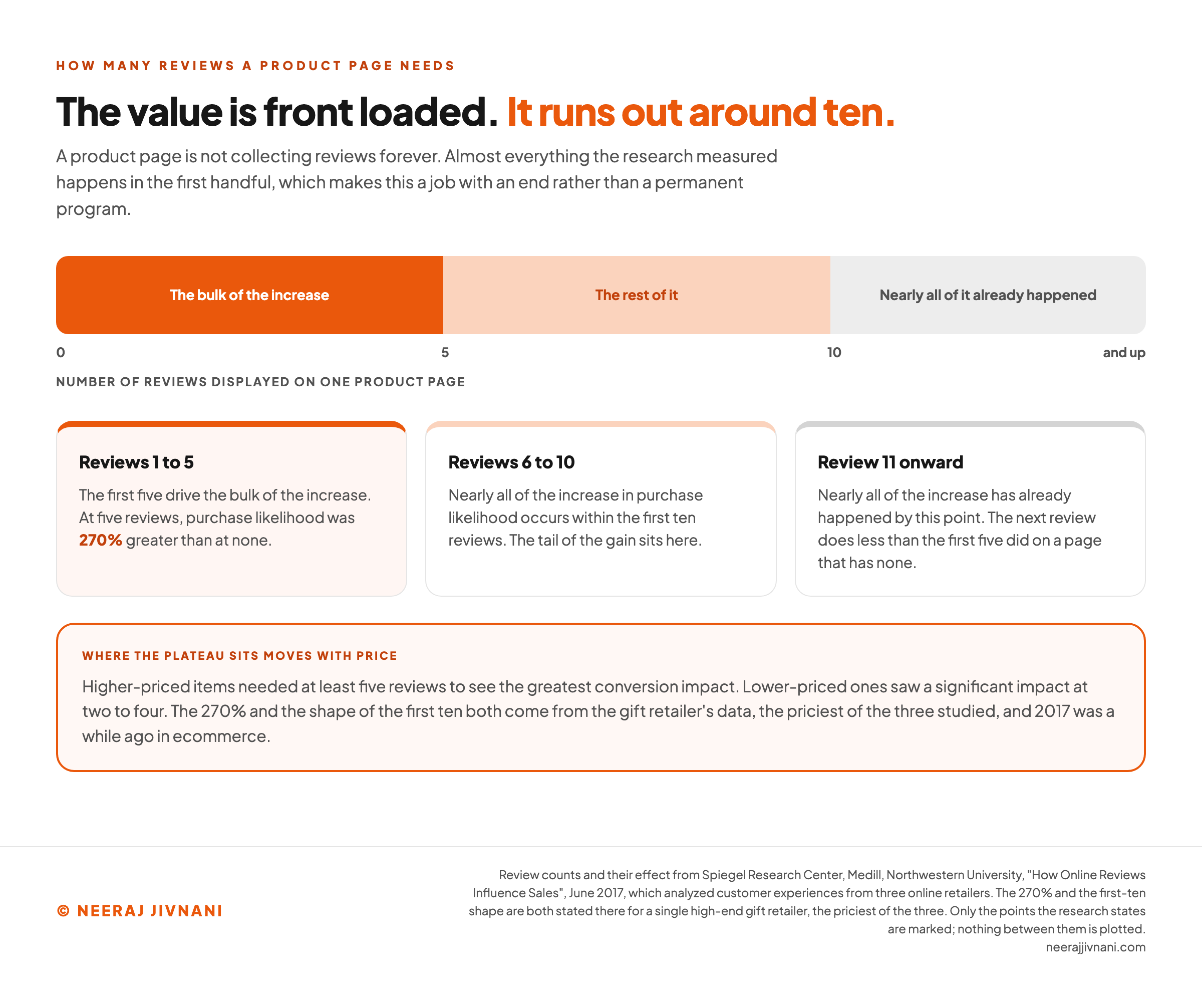
A product displaying five reviews had a purchase likelihood 270% greater than the same product with none. That is Northwestern University's Spiegel Research Center, June 2017, from one of the three online retailers it studied.
That percentage travels a long way without its footnotes. It came from the gift retailer alone, the priciest of the three, and 2017 was a while ago in ecommerce.
The more useful numbers are the ones underneath it.
The Plateau, and Where Price Moves It
Nearly all of the increase in purchase likelihood occurs within the first ten reviews, the same retailer's data showed, and the first five drive the bulk of it.
Price moves where the plateau sits. Higher-priced items needed at least five reviews to see the greatest conversion impact, while lower-priced ones saw a significant impact at two to four.
Read that as a target rather than a benchmark.
You are not trying to accumulate reviews forever. You are trying to get every product page to five, or to the top of that lower band if the item is cheap.
That is a far smaller job than building a content engine.
It points at where to start, too, and it is not the obvious place. Work on the products with the thinnest coverage rather than the ones that already sell.
A Perfect Score Is Not the Target
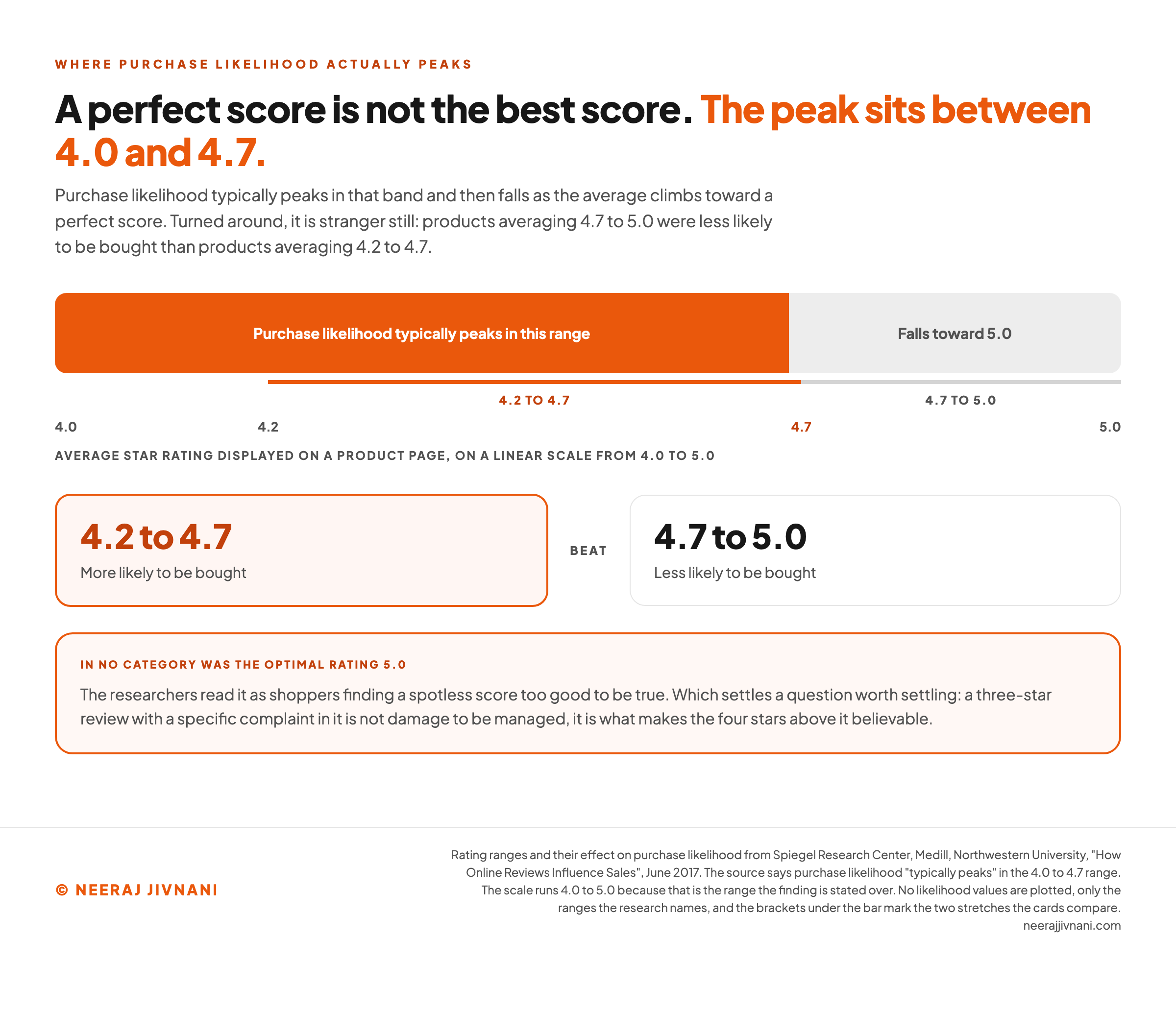
Purchase likelihood typically peaks at ratings between 4.0 and 4.7 and then falls as the average climbs toward 5.0, the same report found.
Turn that around and it is stranger. Products averaging 4.7 to 5.0 were less likely to be bought than products averaging 4.2 to 4.7, and in no category was the optimal rating 5.0.
The researchers read it as shoppers finding a spotless score too good to be true.
Which settles a question worth settling. A three-star review with a specific complaint in it is not damage to be managed, it is what makes the four stars above it believable.
The Ones You Ask For Read Differently
Prompted and unprompted reviews are not the same population, and the difference shows up in the ratings.
Verified buyers, meaning people sent a post-purchase email asking them to review, averaged 4.34 stars in the Spiegel data. Anonymous reviewers, whose purchase could not be confirmed, averaged 3.89.
The explanation the researchers give is friction.
Somebody who seeks out a review form unasked has usually had an experience strong enough to be worth the trouble, and strong experiences run negative more often than they run positive.
So asking does not manufacture praise. It reaches the customers who would otherwise have said nothing.
How many you actually need
Take one product page you already sell from and put its two numbers in. The point of this is the moment it tells you to stop, because the job this section describes has an end.
1. Which kind of thing is on this page
Your catalog decides which of these you are. Nobody else can draw that line for you, and the target moves depending on where you draw it.
2. Reviews showing on that page today
Your target
?
Pick a price band above. There is no single answer to how many reviews a page needs, which is the reason this box will not fill itself in.
3. The star average on the same page
This one is read on its own. A high average on a page with two reviews is not a page doing well, it is a page nobody has reviewed yet.
Add the average showing on the page and it is read against the range where purchase likelihood typically peaks.
4. Where the next hour goes
Fill in the two boxes above and this says whether this page is the one to work on.
A three-star review with a specific complaint in it is not damage to be managed. It is what makes the four stars above it believable, so nothing here is improved by removing one.
The review counts and the rating range this reads against are from Northwestern University's Spiegel Research Center, June 2017.
Use this chart — embed code and citation
<a href="https://neerajjivnani.com/blog/user-generated-content/"><img src="https://neerajjivnani.com/infographics/user-generated-content/first-five-do-the-work.png" alt="A horizontal band running along an axis of the number of reviews displayed on one product page, ticked at zero, five, ten and beyond. The stretch from zero to five is solid orange and labeled as the bulk of the increase, the stretch from five to ten is pale orange and labeled as the rest of it, and everything past ten is grey and labeled as the point at which nearly all of it has already happened. Three cards underneath explain each stretch: the first five reviews drive the bulk of the increase, and at five reviews purchase likelihood was 270% greater than at none; nearly all of the increase in purchase likelihood occurs within the first ten reviews, which is where the tail of the gain sits; and from review eleven onward the next review does less than the first five do on a page that has none. A band across the foot says where the plateau sits moves with price, that higher-priced items needed at least five reviews to see the greatest conversion impact while lower-priced ones saw a significant impact at two to four, and that the 270% and the shape of the first ten both come from the gift retailer's data, the priciest of the three studied, with 2017 being a while ago in ecommerce." width="1200"></a>
<p>Chart: <a href="https://neerajjivnani.com/blog/user-generated-content/">Neeraj Jivnani</a></p>Neeraj Jivnani, "User-Generated Content: Getting Enough of It, and Being Allowed to Use It", neerajjivnani.com, https://neerajjivnani.com/blog/user-generated-content/Free to republish with a link back to this page.
Use this chart — embed code and citation
<a href="https://neerajjivnani.com/blog/user-generated-content/"><img src="https://neerajjivnani.com/infographics/user-generated-content/not-five-point-zero.png" alt="Titled to say a perfect score is not the best score and that the peak sits between 4.0 and 4.7. A horizontal bar drawn on a linear scale of the average star rating displayed on a product page, running from 4.0 on the left to 5.0 on the right and marked at 4.0, 4.2, 4.7 and 5.0. The stretch from 4.0 to 4.7 is solid orange and labeled as the range in which purchase likelihood typically peaks; the remaining stretch from 4.7 to 5.0 is grey and labeled as falling toward 5.0. Brackets under the bar mark off the two stretches the cards below compare, 4.2 to 4.7 in orange and 4.7 to 5.0 in grey. Below them, two cards set those ranges against each other: 4.2 to 4.7, in orange, is more likely to be bought, and it beat 4.7 to 5.0, which is less likely to be bought. A band across the foot states that in no category was the optimal rating 5.0, that the researchers read it as shoppers finding a spotless score too good to be true, and that a three-star review with a specific complaint in it is not damage to be managed but what makes the four stars above it believable. No purchase likelihood values are plotted, only the ranges the research names." width="1200"></a>
<p>Chart: <a href="https://neerajjivnani.com/blog/user-generated-content/">Neeraj Jivnani</a></p>Neeraj Jivnani, "User-Generated Content: Getting Enough of It, and Being Allowed to Use It", neerajjivnani.com, https://neerajjivnani.com/blog/user-generated-content/Free to republish with a link back to this page.
Permission, and What Yours Has to Say
You need permission to republish a customer's photograph, and you almost certainly do not have it.
Copyright in a work initially belongs to the author who created it, and it exists automatically from the moment the work is fixed, in the U.S. Copyright Office's words.
Nobody has to register anything, or write anything, or add a notice, for that to be true.
The rights that sit inside it are exactly the ones you want: reproducing the work, distributing copies of it, and displaying it publicly.
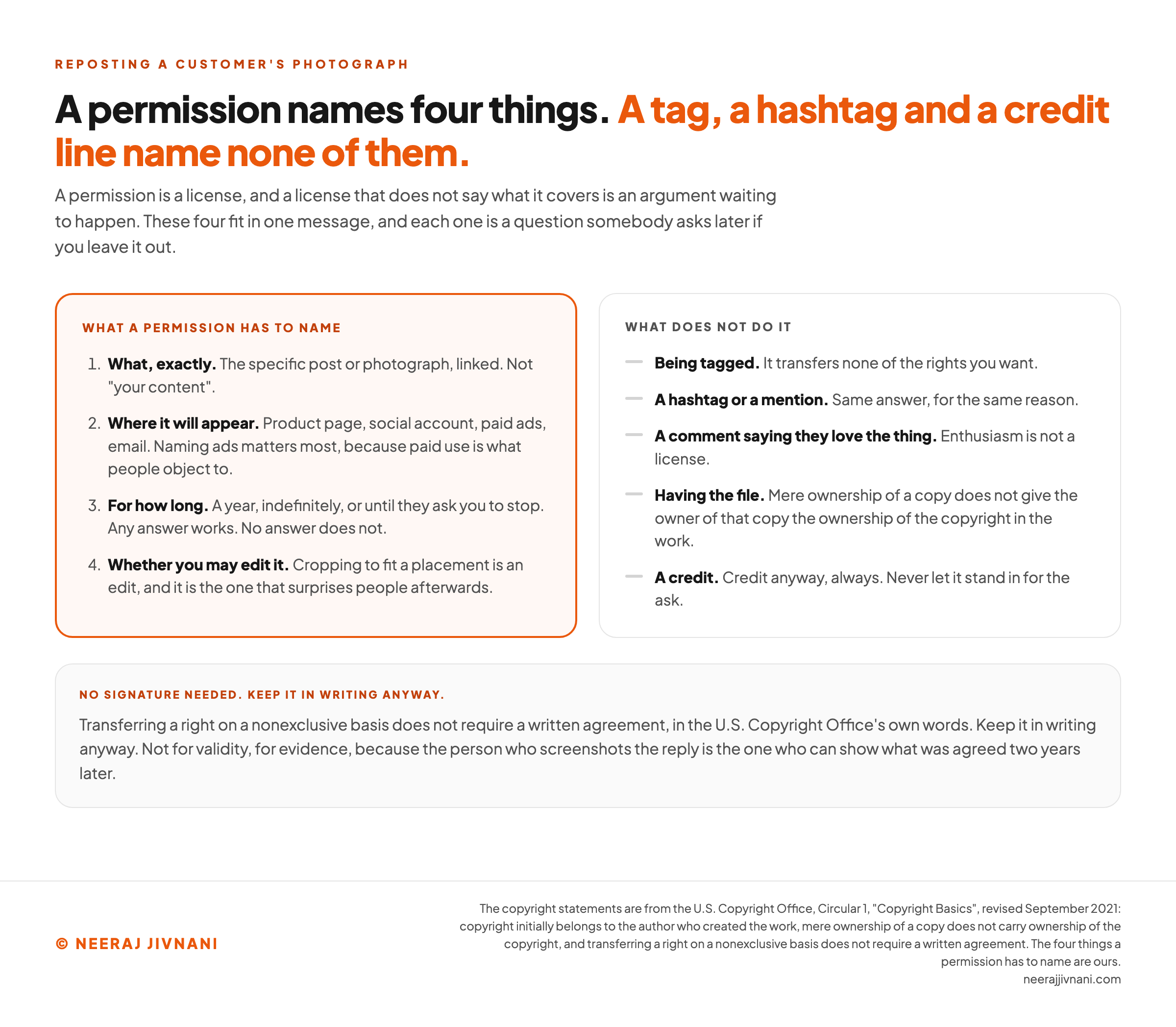
Being tagged transfers none of them. Neither does a hashtag, a mention, or a comment saying they love the thing.
Having the file does not do it either. Mere ownership of a copy does not give the owner of that copy the ownership of the copyright in the work, as the Copyright Office puts it.
Whatever you want has to come from the person who made it.
Crediting Is Not Permission
Crediting somebody and getting their permission answer two different questions, and most of the trouble here is that they get asked as one.
Permission is whether you may use the work at all. A credit says who made it.
Credit anyway, always, and visibly enough that a reader sees it without hunting. It is the decent thing and it makes the next ask easier.
Never let it stand in for the ask.
What to Put in the Message
A permission is a license, and a license that does not say what it covers is an argument waiting to happen.
Four things settle it, and they fit in one message:
- What, exactly. The specific post or photograph, linked. Not "your content".
- Where it will appear. Your product page, your Instagram account, your paid ads, your email. Naming ads matters most, because paid use is what people object to when they object.
- For how long. A year, indefinitely, or until they ask you to stop. Any answer works. No answer does not.
- Whether you may edit it. Cropping to fit a placement is an edit, and it is the one that surprises people afterwards.
A reply saying yes to a message like that is the ordinary way a nonexclusive license gets given, and transferring a right on a nonexclusive basis does not require a written agreement, in the Copyright Office's own words.
Keep it in writing anyway. Not for validity, for evidence, because the person who screenshots the reply is the one who can show what was agreed two years later.
At a handful of photographs a month that is a folder of screenshots. Past that it is somebody's job or a piece of software, and the thing to look for is whether it stores the ask and the reply together.
A yes with no record of what was asked is not evidence of anything.
One route does not work the way people expect it to.
If you are commissioning a creator, writing "work made for hire" into the agreement does not hand you a photograph. That route is confined to nine listed categories of work, and a standalone photograph is not among them.
What you want there is a written assignment or a plainly worded license. Say which one, and say what it covers.
Use this chart — embed code and citation
<a href="https://neerajjivnani.com/blog/user-generated-content/"><img src="https://neerajjivnani.com/infographics/user-generated-content/four-things-a-permission-names.png" alt="Two panels side by side. The left panel, outlined in orange, is headed what a permission has to name and carries four numbered items: what exactly, meaning the specific post or photograph, linked, and not your content; where it will appear, naming the product page, the social account, paid ads and email, with the note that naming ads matters most because paid use is what people object to; for how long, whether a year, indefinitely, or until they ask you to stop, since any answer works and no answer does not; and whether you may edit it, because cropping to fit a placement is an edit and it is the one that surprises people afterwards. The right panel is headed what does not do it and lists five things: being tagged, which transfers none of the rights you want; a hashtag or a mention, which is the same answer for the same reason; a comment saying they love the thing, since enthusiasm is not a license; having the file, because mere ownership of a copy does not give the owner of that copy the ownership of the copyright in the work; and a credit, which you should give anyway, always, but never let stand in for the ask. A band across the foot, headed no signature needed and keep it in writing anyway, says that transferring a right on a nonexclusive basis does not require a written agreement, in the U.S. Copyright Office's own words, and that you keep it in writing not for validity but for evidence." width="1200"></a>
<p>Chart: <a href="https://neerajjivnani.com/blog/user-generated-content/">Neeraj Jivnani</a></p>Neeraj Jivnani, "User-Generated Content: Getting Enough of It, and Being Allowed to Use It", neerajjivnani.com, https://neerajjivnani.com/blog/user-generated-content/Free to republish with a link back to this page.
Getting It When Almost Nobody Sends Anything
Getting it comes down to the asking. Everything else is administration arranged around the moment you ask.
Telling customers they ought to post does not move many of them.
What moves them is being asked at the right moment, in a way that makes it easy, and that reaches the small share who would have written something anyway.
Ask While It Is Still Fresh
The moment is a few days after the thing has arrived and been used once.
Ask at checkout and there is nothing to say yet. Ask a month later and the feeling has faded, along with any impulse to bother.
Automate that one email and most of a UGC program already exists. What follows is refinement.
Most ecommerce platforms have review software that will send it for you, and the choice between them matters far less than whether the email goes out at all.
Say Exactly What You Want Back
A request for feedback gets you a sentence. A request for a photograph of the thing in the room it now lives in gets you a photograph.
Be specific about the format and the subject, and say where it will be used, which is the permission conversation happening early rather than late.
Three more, in rough order of effort:
- Answer questions on the product page. A shopper asks, you or another customer answers, and the answer becomes content on the page where the decision is being made.
- Reply to everything you already get. A customer who gets a reply posts again. One who does not, does not.
- Run a contest only when you want volume rather than persuasion. A hashtag competition produces a burst of entries, and few of them say anything about your product being good.
Incentives work, and they carry one duty. If somebody was given anything of value for a review, that connection should usually be disclosed clearly, somewhere a reader will see it, under the Federal Trade Commission's endorsement guides.
Offering one also shifts the average, which is worth knowing in advance. Points and prize draws bring in people who would not otherwise have written, which is exactly who you were trying to reach.
Where to Put It
Where it earns most is the product page, ahead of every other surface put together. Three others are worth the effort after that.
The product page. Reviews, customer photographs and answered questions, in front of somebody who is deciding. It is also the page all of the review evidence was gathered on.
Paid advertising. A customer's own footage as ad creative. The most common use of commissioned work, and the use that most needs the permission in writing.
Email. A photograph from a real buyer beats a studio shot inside a message about an abandoned basket.
Your own social accounts. Reposting, credited and permitted, which keeps the account fed and shows other customers the kind of thing you would like more of.
Where it does nothing is a page where nobody was deciding anything. A wall of customer photographs across a homepage looks busy and moves almost nothing, because nobody arrives there in doubt about a specific product.
What Goes Wrong
Five things go wrong, and the first is by far the most common.
Nothing arrives. The plan assumed a flow of content that was never going to arrive on its own. It is the default outcome of any program that skips the asking.
What arrives is unusable. Dark, blurry, badly cropped, somebody else's logo in the frame. Expect a hit rate, not a submission count.
A bad one shows up. Answer it in public, fix what it names if it is fixable, and leave it there. Removing every critical review is how a page stops being believed.
The rights you never got. The expensive failure, because it usually surfaces after the asset is already running in a campaign.
Volume. Once collection works, somebody has to read everything before it goes live. That person has to be paid, and almost nobody budgets for them at the start.
What to Watch
Submission volume is the number everyone reports, and it is the one that answers least. Three others are worth watching instead.
- Coverage. The share of your products carrying at least five reviews. Move this one first, because it is the number the research is about.
- Conversion on covered pages against thin ones. Crude, and honest enough to act on.
- Response rate on the ask. The share of prompted customers who write something. It tells you whether the moment and the wording are right, and it is the one number here you can move directly.
A thousand hashtag entries alongside forty uncovered product pages is a failure with a good-looking dashboard.
If You Want to Be a UGC Creator
A UGC creator makes advertising that does not look like advertising and sells it to the brand rather than publishing it.
Nothing else is being bought. You are not building an audience, you are producing an asset, which is why the size of your following matters far less here than the quality of what you hand over.
Four steps to start, and there is no trick in any of them:
- Make three or four pieces for products you already own. That is your portfolio, and nobody will ask whether you were paid for them.
- Pick one format and one platform's shape, and get genuinely good at it rather than being adequate at four.
- Approach brands directly. Smaller ones answer, and they are the ones with unsolved content problems.
- List yourself where brands go looking, once there is work to show.
What Sets the Rate
The thing worth understanding is what sets the price, because the headline rates move constantly and the mechanism does not.
You are selling a file and the right to use it. So the rate follows two things: what the piece costs you to make, and how widely and for how long the brand may run it.
The second is where most of the money sits. A video licensed for one organic post is a different price from the same video licensed for paid advertising for a year.
Creators who quote a single number for both are the ones who end up feeling underpaid.
Can you make a living at it? Yes, and it is production work rather than fame.
The people who do well run it as a service business with repeat clients, which is a different pursuit from going viral.
Where This Leaves You
For a business, then: user-generated content is still worth doing, and the part of it that has been shown to work is smaller than the enthusiasm around it.
What the research shows is concentrated. Reviews and photographs on the pages where somebody is deciding, and roughly the first five of them per product.
That is a finite job with an end, not a permanent program.
The commissioned version is advertising. Price it as production plus usage rights, and do not expect it to carry the credibility the unpaid kind carries, because that came from the absence of a payment.
So the place to start is dull and small. Find the products carrying fewer than five reviews, write to the customers who bought them, and keep one permission message you can send without rewriting it each time.