What Digital Marketing Is, the Ten Types, What They Cost, and Where to Start
Ten channels, and the one you begin with decides whether any of it works. We would pick it on what you can sustain, not on what looks best.


/ On this page12 sections
Digital marketing is marketing that reaches people through digital channels: search engines, websites, email, social platforms, phones and connected devices.
The work splits into ten channels, and the one you begin with decides whether any of it works.
We would pick that channel on what you can sustain rather than on what looks best, which usually means the one you will still be working in six months.
The other half of the answer is money: what a channel costs to run, and what the work pays once it becomes somebody's job.
What Digital Marketing Is
Digital marketing covers every marketing activity that runs through a digital channel. That includes search engines, a website, email, social platforms, mobile messaging, apps and connected devices such as televisions.
The mechanism is simple enough to state in one sentence. You put something where the attention already is, and the channel reports back what happened.
Digital marketing stopped being a sideline some time ago. E-commerce alone was $340.2 billion in the second quarter of 2026, or 17.1% of all US retail sales, on seasonally adjusted US Census Bureau figures.
And that counts only what gets ordered online. Reaching the person who compares prices on a phone and then buys in a store is digital marketing too, and none of that shows up in the number.
Digital Marketing Versus Traditional Marketing
The difference is not the medium. It is that a digital channel can target a defined group and report what that group did, while a billboard can do neither with any precision.
Traditional marketing still reaches people, and for some audiences it reaches them better. What it cannot do is tell you which half of the spend worked, which is why budgets moved.
Digital Marketing Versus Online Marketing
In everyday use these mean the same thing, and treating them as different terms creates confusion rather than clarity.
If you want the strict distinction, digital is the wider word: it includes channels that do not need the internet, such as text messaging (SMS) and some in-app and television advertising.
Digital Marketing Versus Inbound Marketing
Inbound is a strategy, digital is a set of channels, and they are often confused because they overlap heavily.
Inbound means earning attention with something useful so people come to you. Digital marketing includes plenty of outbound work too, such as cold email and display advertising that interrupts rather than attracts.
The Channels, and What Each One Is Actually For
There are ten channels worth knowing, and learning what each one does takes an afternoon.
Group them by whether you own the channel, pay for it, or earn it. Lists of the types vary in length, and the grouping holds whichever list you use.
- Owned channels are the ones you control outright: your website, your blog, your email list, your app.
- Paid channels are rented attention: search ads, display, social ads, sponsorships.
- Earned channels are what other people give you: coverage, reviews, shares and mentions.
That distinction matters because it tells you what happens when the money stops: an owned asset is still there, and a rented one is not.
Search Engine Optimization
Search engine optimization (SEO) is the work of making pages a search engine can find, understand and rank.
It is slow to start and durable once it works, which makes it a poor choice when you need customers this month and a strong one when you are building something that has to compound.
The same pages now also feed the AI answers search engines assemble, so the channel covers more ground than its name suggests.
Content Marketing
Content marketing means publishing material people want, so that finding you is worth their time. It is the fuel most other channels run on, because search, email and social all need something to point at.
Its economics are the same as search: slow to start, durable once it works, and cheap per visitor only after the volume arrives.
The common failure is not quality but supply. Search and social keep pointing at whatever you last published, so when the publishing stops, the channels built on top of it go quiet too.
Email Marketing
Email is the only major channel where you own the audience outright. No algorithm sits between you and the list, which is why it survives the platform changes that wipe out reach elsewhere.
That ownership is the whole argument for building a list early, even while other channels are doing the work of filling it.
The constraint is permission: the list is only an asset while people want it, and the cost of sending to people who do not is paid in deliverability rather than in money.
Social Media Marketing
Social platforms are where attention is cheapest to reach and hardest to keep. The audience is rented, the reach is set by an algorithm you do not control, and a change to that algorithm can remove most of your distribution without notice.
Which platform is right is decided by where the people you sell to already are, and that is checkable rather than a matter of preference.
Posting well on a platform your buyers do not use is effort spent reaching the wrong room.
Paid Search, PPC and SEM
Search engine marketing (SEM) covers the paid side of a search results page, and depending on who is using the word, the unpaid rankings as well. The paid side is pay-per-click advertising, or PPC: you set a bid and pay only when somebody clicks.
That is what makes it the fastest way to find out whether a message sells.
It is also the purest form of rented attention. Nothing accumulates, which is the trade for the speed.
Use it to test demand before you build anything slower. If a message cannot sell when you are paying for closely matched attention, it will not sell when you have spent months earning the same attention.
Display and Native Advertising
Display advertising places visual ads on other people's sites and apps, which makes brand safety, the question of what your ad lands beside, part of the buy. Native advertising is the same purchase wearing the clothes of the page it sits on, so it reads as content instead of an interruption.
Both buy attention that was aimed somewhere else, and that is what decides where they work. They are effective for awareness, for reminding people who already know you, and for reaching an audience defined by interest rather than by intent.
They are weak at capturing demand that already exists, because somebody actively looking for what you sell is on a search results page, not on an article.
Affiliate Marketing
Affiliate marketing pays other people a commission for sales they send you. The appeal is that you pay for results rather than exposure.
The commission rate you publish is what recruits the partners, and you set it before any of them talk to you. Set it too low and the ones worth having never apply.
Influencer Marketing
Influencer marketing rents somebody else's audience and, more importantly, their credibility with it. A follower count is on the profile and the number of people it reaches is not, so the two get priced as though they were the same thing.
It suits products that need demonstrating or vouching for, and it suits categories where a recommendation carries more weight than a claim.
It is a poor fit where the purchase is driven by price or urgency, because a recommendation does not shorten a decision that is already made on cost.
Mobile and SMS Marketing
Mobile marketing covers reaching people on a phone: text messages, in-app messaging and push notifications. It is worth treating separately from the rest because the constraints are different, not because the ideas are.
SMS in particular is opened quickly, and readers have little patience for it.
That makes it strong for time-sensitive and transactional messages, such as a delivery update or an appointment reminder, and weak for persuasion. Consent rules govern it tightly, so the permission you collected matters as much as the message you send.
Marketing Automation
Marketing automation is not a channel so much as the plumbing between them. It sends a message when a condition is met, so that work which would otherwise need somebody watching a list happens on its own.
A rule built on the wrong condition keeps running perfectly while doing nothing useful, and nothing on a dashboard looks broken.
Where Conversion Rate Optimization Fits
Conversion rate optimization is a multiplier on the ten channels rather than an eleventh one.
It changes what happens after the traffic arrives instead of bringing any of it.
Improving the page everyone already lands on raises the return of every channel pointing at it at once, which usually costs less than buying more visitors, and it is the first thing worth doing when traffic is healthy and sales are not.
How to Choose Between Them
Choosing between the channels is the hard part, and a list of what exists cannot do it for you.
Five things decide it. Answer them in this order, because each one narrows what the next has to consider.
- Who you sell to, and where they already are. The channel follows the audience, not your preference. If the people who buy from you are not on a platform, no amount of skill on that platform helps.
- How they buy. A considered purchase with a long decision needs channels that hold attention over months, such as search, content and email. An impulse purchase can be won in a single ad. Business buyers differ here in emphasis rather than method: they take longer, involve more people, and respond to material that helps them justify a decision internally.
- How fast you need the first result. Paid ads can produce a sale within days. Search and content usually take months. If you need revenue this quarter, a channel that pays off next year is the wrong first move whatever its economics.
- What you already own. An existing email list, an audience, or a site that already gets traffic is a head start that changes the answer. It is easy to overlook, because starting something new is more interesting than working what you already built.
- What you can sustain. The channel you can keep doing every week beats the better one you abandon in six.
Which channel to start with
Answer four of the five criteria and the ten channels sort themselves. The fifth, who you sell to, is the one only you can answer. Every reason shown is the channel’s own row from the table above, applied to what you just said. It filters rather than ranks: nothing here is the “best” channel, because which one fits is conditional.
- Weeks
Social media marketing Fits now
Right when your buyers are demonstrably on a platform.
- Weeks
Email marketing Not yet
It runs on a list that gave you permission, which you said you do not have yet.
- Days
Mobile and SMS marketing Not yet
It runs on a list of numbers that opted in, which you said you do not have yet.
- Weeks
Marketing automation Not yet
It automates a channel that already works. Nothing is working yet.
- Months
Search engine optimization Wrong fit
First result takes months, and you need one sooner.
- Months
Content marketing Wrong fit
First result takes months, and you need one sooner.
- Days
Paid search, PPC and SEM Wrong fit
You pay for this in media, per click, and there is no money for media.
- Days
Display and native advertising Wrong fit
You pay for this in media, per impression, and there is no money for media.
- Months
Affiliate marketing Wrong fit
First result takes weeks to months, and you need one sooner.
- Weeks
Influencer marketing Wrong fit
You pay for this in a fee, per placement, and there is no money for media.
The Channels Against the Criteria
Applying the five criteria to the ten channels gives the table below.
| Channel | First result | What you pay for | Right when | What it needs from you |
|---|---|---|---|---|
| Search engine optimization | Months | Time and labor | You are building something that has to compound | Patience, and pages worth ranking |
| Content marketing | Months | Time and labor | You can publish at a steady rate | A rate you can hold for a year |
| Email marketing | Weeks | Tooling, by list size | You have a list, or a way to build one | Permission, and something worth sending |
| Social media marketing | Weeks | Time, or ad spend | Your buyers are demonstrably on a platform | Knowing which platform that is |
| Paid search, PPC and SEM | Days | Media, per click | You need demand now, or you are testing a message | Budget, and a page that converts |
| Display and native advertising | Days | Media, per impression | You want awareness, or to remind people who know you | An audience you can define by interest |
| Affiliate marketing | Weeks to months | Commission, per sale | You would rather pay for results than exposure | A published rate good partners will accept |
| Influencer marketing | Weeks | A fee, per placement | A recommendation carries more weight than a claim | The right creator, and their real reach |
| Mobile and SMS marketing | Days | Per message sent | The message is time-sensitive or transactional | Consent, collected properly |
| Marketing automation | Weeks | Tooling | A channel already works when run by hand | Conditions that are genuinely correct |
The first-result column is where most arguments start. A business that needs a result within days has three rows to choose from, and one that can wait a few months has all ten.
Read the last column before you trust the first. Time to first result tells you when a channel could pay off; what it needs from you tells you whether you will still be there when it does.
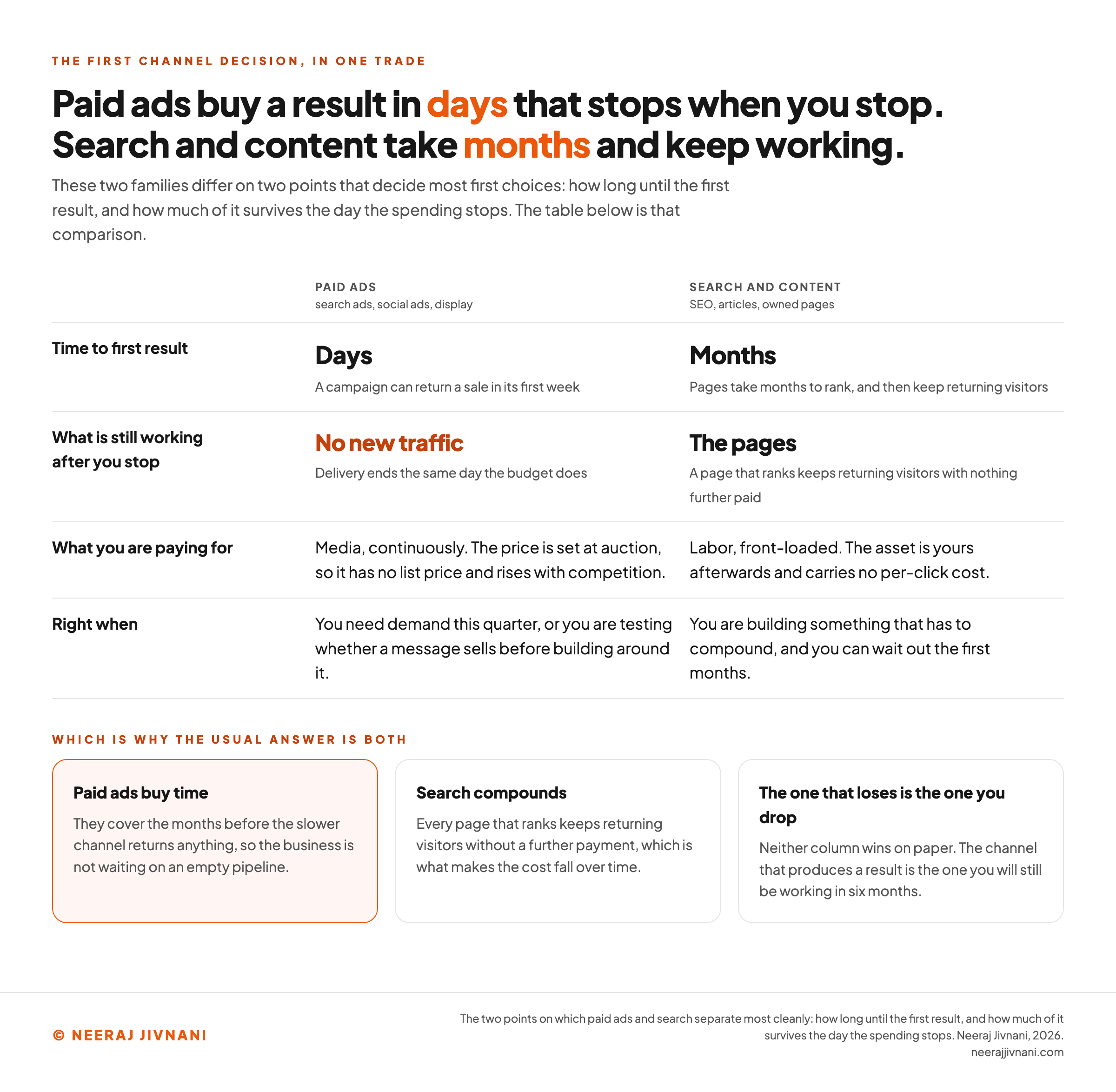
Paid Ads Against Search and Content, and Why Most Run Both
Set the two families side by side and the decision stops being a matter of taste. The comparison below is paid advertising, meaning search, social and display ads, against search and content.
| Paid ads | Search and content | |
|---|---|---|
| First result | Days | Months |
| What happens when you stop | Traffic stops the same day | A page that ranks keeps returning visitors with nothing further paid |
| Main cost | Media spend, ongoing | Time and labor, front-loaded |
| Best when | You need demand now, or you are testing a message | You are building something that has to compound |
For a business that needs customers now, the honest answer is usually to run both: paid buys the time the slower channel needs to mature.
Use this chart — embed code and citation
<a href="https://neerajjivnani.com/blog/digital-marketing/"><img src="https://neerajjivnani.com/infographics/digital-marketing/the-channel-trade.png" alt="A two column comparison of paid ads, meaning search, social and display ads, against search and content across four rows, showing time to first result as days for paid ads and months for search, no new traffic once paid spending stops against the pages continuing to return visitors for search and content, media bought continuously at auction against labor paid once up front, and the conditions each one suits, with three cards explaining why most businesses run both." width="1200"></a>
<p>Chart: <a href="https://neerajjivnani.com/blog/digital-marketing/">Neeraj Jivnani</a></p>Neeraj Jivnani, "What Digital Marketing Is, the Ten Types, What They Cost, and Where to Start", neerajjivnani.com, https://neerajjivnani.com/blog/digital-marketing/Free to republish with a link back to this page.
The Three Costs, and the One You Cannot Look Up
Digital marketing has three costs, and only one of them cannot be looked up before you commit. It gets sold as the cost-efficient option, and that is true of starting it and not of running it.
Labor is the largest cost you can predict, and usually the largest of all once the work is somebody's job. That job pays $78,760 a year at the analyst end and $166,790 at the manager end, on US Bureau of Labor Statistics medians for May 2025.
Media is an auction, so it has no list price. What a click costs depends on what competitors will pay for the same click, which varies by industry and by season and cannot be quoted in advance.
With no list price, the only budget that survives contact is a share of revenue you can hold for a year, set before the channel is chosen rather than after.
Tools are the smallest of the three. Email, analytics and scheduling software all have free tiers, and the upgrade prompts arrive long before those limits bind.
The practical read is that the entry cost is low and the sustained cost is a salary. Cost efficiency stops being automatic the moment the work becomes somebody's job.
What You Get, and What You Do Not
Each of the seven benefits below has a limit, and the limit is what decides whether the benefit is real for you.
| The benefit | The limit worth knowing |
|---|---|
| Reach beyond your geography | Reaching people is not the same as being noticed by them |
| Precise targeting | Only as good as the data behind it, and you do not decide what a platform lets you collect |
| Measurable results | Measurable is not the same as attributable, and the credit for a sale is contested |
| Lower cost of entry | Low to start, not low to sustain, because the sustained cost is labor |
| Personalization | Requires data you have to collect properly and store responsibly |
| Speed of change | You can change a campaign today, and so can everyone competing with you |
| Conversion is close at hand | The buy button sits beside the message, but a short path does not fix a weak reason to act |
The one that causes the most disappointment is measurement. A digital channel reports far more than a billboard, which is a real advantage, but knowing which touch caused a purchase remains an unsolved problem rather than a setting to switch on.
How to Build a Strategy
A digital marketing strategy is six decisions taken in order. Set the budget before choosing channels rather than after, because the budget rules out options that would otherwise be debated for weeks.
- Define the goal. One number that would tell you this worked, decided before anything is built.
- Identify the audience. Who buys, what they are trying to do, and where they already spend attention.
- Set the budget, including the labor, which is the part most plans leave out.
- Select the channels, using the five criteria above rather than a list of what exists.
- Optimize for mobile, because a large share of what you make will be opened on a phone regardless of where it was designed.
- Launch, then refine. The first version is a hypothesis, and the refining is the actual work.
The failure we would expect is between steps four and six, where a channel is chosen and then not sustained long enough to produce evidence either way.
How to Measure It
Measure the numbers that could change a decision and ignore the rest. That is the whole test, and it is where marketing analytics gets stuck: if a number goes up and you would do nothing differently, it is a report and not a measurement.
| Metric | What it tells you | What it does not |
|---|---|---|
| Traffic | Whether anyone arrived | Whether they were the right people |
| Conversion rate | Whether the page does its job | Why the rest left |
| Cost per acquisition | What a customer costs to buy | What they are worth over time |
| Return on ad spend | Whether a campaign paid for itself | Whether it would have happened anyway |
| Email open and click rates | Whether the list is alive | Whether it buys |
Two habits make the difference. Decide the number before the campaign, so success cannot be redefined afterwards, and give a slow channel a fair window before judging it, because a decision made too early on search or content is nearly always the wrong one.
What Is Changing
What is changing is how the channels are operated, not what the channels are. Automation is moving inside the tools, which is what most AI marketing already amounts to; more of the work is read on a phone, and a growing share of questions gets answered without anyone opening a result at all.
That last one happens in two places. One is the AI summary a search engine now prints above its own list of links, and the other is the chat assistant somebody asks instead of searching at all.
We would not build anything separate for either of them, because what moved is where your material gets seen and not which channel you should have been building.
The Direction Underneath
Automation, the shift to the phone, and answers given without a click are not new channels.
Underneath all of them the digital side keeps pulling away. E-commerce grew 12.2% year over year in the second quarter of 2026, against 6.7% for retail as a whole, on US Census Bureau figures.
It is the rate of growth rather than the share that shows the direction, and those two rates are nearly two to one.
None of that moves the five criteria. We would not send a business that has yet to make one channel work chasing the newest one, and the fundamentals get automated long before they get replaced.
What a Digital Marketer Does, and What It Pays
A digital marketer's work divides into three broad jobs. Somebody decides what to say and to whom, somebody makes and places the material, and somebody measures what happened and changes it.
In a small business that is one person, and in a large one those are separate departments.
What the Roles Pay
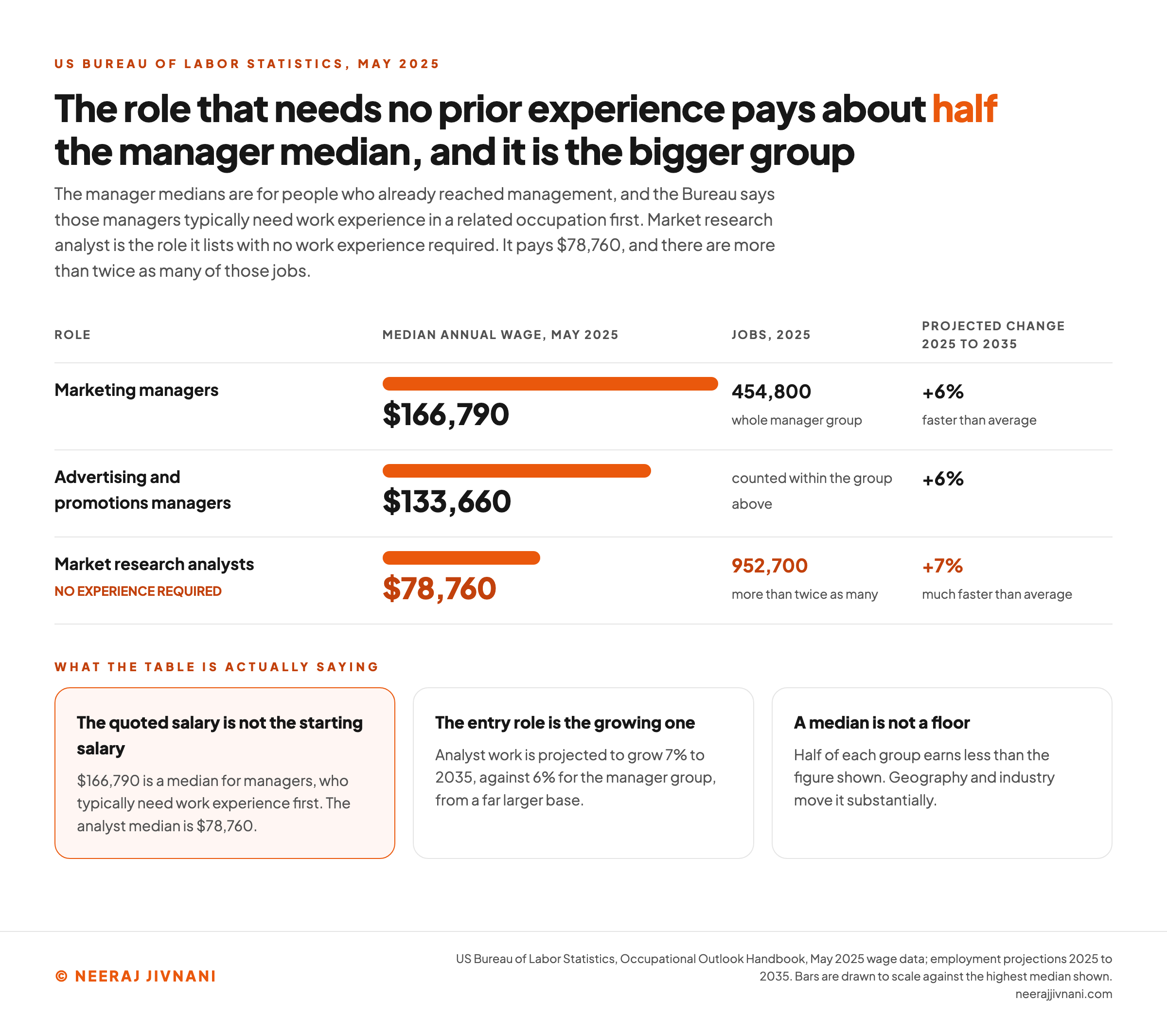
Pay divides sharply by role, on US Bureau of Labor Statistics medians for May 2025.
| Role | Median annual wage, May 2025 | Jobs in 2025 | Projected change, 2025 to 2035 |
|---|---|---|---|
| Marketing managers | $166,790 | 454,800 across the manager group | 6% |
| Advertising and promotions managers | $133,660 | Included above | 6% |
| Market research analysts | $78,760 | 952,700 | 7% |
The manager figures are not entry-level numbers. The route in typically runs through a related job in advertising, sales, promotions or marketing first, which is how the Bureau describes it.
The analyst role is the common entry point because it asks for none of that: the Bureau's quick facts for it list no prior work experience at all.
That role pays roughly half the manager median, and on the same counts it is both the larger group and the faster-growing one.
How People Get Into It
Neither the manager job nor the analyst job is tied to one degree subject. A bachelor's is typical and the field is open: business, communications and social science all sit alongside marketing across the Bureau's entry requirements for the two roles.
People commonly arrive from an adjacent job: writing, sales, support, or running a small business of their own.
The practical entry is one channel done publicly and well enough to show somebody. A portfolio of work that ran beats a certificate, because the work is checkable and the certificate is not.
The Skills the Work Needs
Three things carry most of the work: writing that people finish, comfort with numbers, and enough technical literacy to use the tools without being frightened of them. None of the three is exotic, and all three improve with practice, not certification.
Specialist skills follow from the channel you end up in. Paid work rewards a tolerance for arithmetic, search work rewards patience, and social work rewards knowing an audience well enough to predict it.
Not one of them is worth learning before you know which channel you are in.
Use this chart — embed code and citation
<a href="https://neerajjivnani.com/blog/digital-marketing/"><img src="https://neerajjivnani.com/infographics/digital-marketing/what-the-work-pays.png" alt="A table of Bureau of Labor Statistics May 2025 median annual wages with bars drawn to scale, showing marketing managers at $166,790, advertising and promotions managers at $133,660, and market research analysts at $78,760 highlighted as the role the Bureau lists with no work experience required, at roughly half the manager median, alongside 454,800 jobs in the manager group against 952,700 analyst jobs and projected growth of 6 and 7 percent from 2025 to 2035." width="1200"></a>
<p>Chart: <a href="https://neerajjivnani.com/blog/digital-marketing/">Neeraj Jivnani</a></p>Neeraj Jivnani, "What Digital Marketing Is, the Ten Types, What They Cost, and Where to Start", neerajjivnani.com, https://neerajjivnani.com/blog/digital-marketing/Free to republish with a link back to this page.
Picking the First Channel and Staying With It
Picking the first channel well is mostly a matter of doing one thing long enough to learn something from it.
- Pick one channel using the five criteria, and write down why you picked it.
- Write the goal down as one number, with the date you will judge it, before anything launches.
- Publish or launch something small within the first week, because the plan is not evidence.
- Give it a fair window, which for paid means weeks and for search or content means months.
- Read the result and change one thing. Then repeat, on the same channel, until it works or is ruled out.
No experience is needed to start a channel. What is needed is the patience to stay on one channel long enough for its result to mean something.
Those five criteria are the whole of the decision. We would weigh the last of them heaviest: what you can sustain is what decides whether the other four ever get tested.
The cost that lasts is a person rather than media, so the real question is not what a campaign costs but what a role costs.
The pay is real, and the manager and analyst medians sit far enough apart that only one of them describes where you would start.
The Questions That Come Up Most
Five questions come up more than the rest.
What exactly does a digital marketer do? Three jobs: choosing the message and the audience, producing and placing it, and reading the result well enough to change the next one. One person usually covers all three in a small business.
How do beginners start digital marketing? Choose one channel that fits your audience and your timeline, set one measurable goal with a date, launch something small quickly, then judge it after a fair window.
Do digital marketers make good money? Well at the top and solidly at the entry. Market research analyst, the entry role of the two, had a median of $78,760 in May 2025 against $50,980 for all US occupations, on US Bureau of Labor Statistics figures. The marketing manager median is more than twice the analyst figure.
What are 7 types of digital marketing? The count runs between seven and twelve depending on where the lines get drawn. The ten worth knowing are SEO, content, email, social, paid search, display and native, affiliate, influencer, mobile and SMS, and automation.
Is digital marketing the same as online marketing? In practice yes. Digital is technically wider, because it includes channels such as SMS that do not require the internet.