Keyword Stuffing Is Two Problems With One Name
Repeating your phrase is not the same as stuffing. See what the term covers, how to tell which kind you have, and what to change.


/ On this page9 sections
You used your phrase six or seven times, and now you are wondering whether that counts. It almost certainly does not.
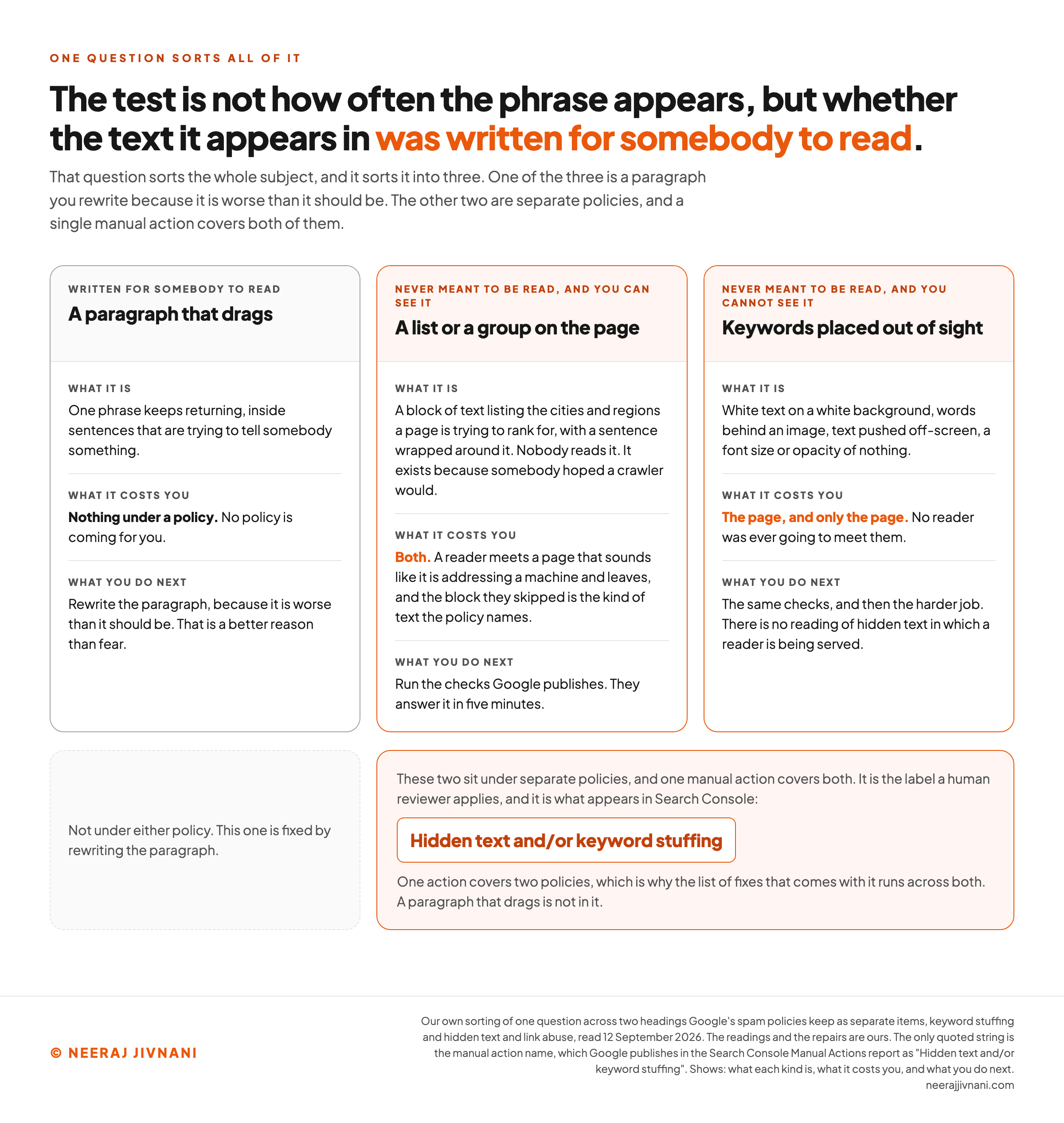
The test is not how often the phrase appears, but whether the text it appears in was written for somebody to read.
That question sorts the subject into three: a paragraph you rewrite because it reads badly, and two policies that a single manual action covers together.
Working out which one you have takes about five minutes.
What Keyword Stuffing Is
Keyword stuffing is loading a page with keywords or numbers to push it up the rankings in Google Search, in a way nobody would write if search engines did not exist.
The spam policies add one detail to that, and the detail is the useful part. Often, they say, the keywords "appear in a list or group, unnaturally, or out of context".
Read that as a description of shape, not of quantity. A list. A group. Words sitting somewhere they do not belong.
Nothing in it is a count.
Two of the three examples named alongside it say the same thing in a different way.
One is a list of phone numbers with no substantial added value. The other is a block of text listing the cities and regions a page is trying to rank for.
Neither is a sentence that someone overwrote. Both are content that was never meant for a person.
That distinction decides everything for the reader with a draft open. A paragraph that repeats a phrase and still says something is repetitive writing, and it is fixed by rewriting it.
A paragraph whose repetition has replaced whatever it was going to say is the thing the policy describes, and so is the list of town names with a sentence wrapped around it.
The Two Kinds, and Why It Matters Which One You Have
Keyword stuffing is one of two things: keywords a reader can see, or keywords a reader cannot.
The split is not academic. The two sit under separate policies, and they cost you different things.
Visible stuffing costs you both. A reader meets a page that sounds like it is addressing a machine and leaves, and the block they skipped is the kind of text the policy names.
Hidden keywords cost you only the page, because no reader was ever going to meet them.
There is no reading of hidden text in which a reader is being served, which is why it is the harder of the two to defend afterwards.
When You Can See It
The clearest example is the one Google publishes itself, inside the spam policies, as what unnatural repetition looks like:
Unlimited app store credit. There are so many sites that claim to offer app store credit for $0 but they're all fake and always mess up with users looking for unlimited app store credits. You can get limitless credits for app store right here on this website. Visit our unlimited app store credit page and get it today!
Four sentences, and every one is built around the phrase or a variation of it. Nothing in it is trying to tell you anything about app store credit.
The city block is the one that turns up in real work, and it rarely feels like cheating while you are doing it.
Say a plumber writes one good page about emergency callouts, then pastes every suburb in the county across the bottom so that the page covers them all.
Nobody reads that block. It exists because somebody hoped a crawler would.
The published definition turns on intent, and intent is the one thing nobody can audit from outside. What you can audit is what is on the page.
When You Cannot See It
Hidden keywords sit under a separate heading in the same policies, hidden text and link abuse, defined as content placed on a page "solely to manipulate search engines and not to be easily viewable by human visitors".
The techniques it names are specific:
- White text on a white background. The oldest one, and still the first thing anybody looks for.
- Text hidden behind an image. The words are in the HTML and the picture sits on top of them.
- CSS used to push text off-screen. It renders, nowhere a person will scroll to.
- Font size or opacity set to 0. Present, technically, and invisible in practice.
- A link hidden on one small character. The example given is a hyphen in the middle of a paragraph.
What matters as much is the list of things the same policy says do not violate it, because this is where people frighten themselves for no reason.
Accordion and tabbed content that toggles between hiding and showing is fine. So are sliders, tooltips that appear when somebody interacts with an element, and text written only for screen readers to improve their experience.
Hiding content as part of how a page works is not hiding content from the reader. The policy draws that line itself.
Use this chart — embed code and citation
<a href="https://neerajjivnani.com/blog/keyword-stuffing/"><img src="https://neerajjivnani.com/infographics/keyword-stuffing/two-kinds-two-repairs.png" alt="Three columns sorting a page by one question, whether the text was written for somebody to read: a paragraph that drags, which sits under no policy and is fixed by rewriting it; a list or group a reader can see, which costs you both the reader and the policy; and keywords placed out of sight, which cost you only the page. A band under the two on the right carries the single manual action label that covers both of those policies, Hidden text and/or keyword stuffing. Every row is set out in the paragraphs around it." width="1200"></a>
<p>Chart: <a href="https://neerajjivnani.com/blog/keyword-stuffing/">Neeraj Jivnani</a></p>Neeraj Jivnani, "Keyword Stuffing Is Two Problems With One Name", neerajjivnani.com, https://neerajjivnani.com/blog/keyword-stuffing/Free to republish with a link back to this page.
Keyword Density Is a Different Measurement
Keyword density is how often a phrase appears as a share of the total words on a page. It is arithmetic, and it can be run on any page ever published.
Keyword stuffing is a named policy violation. That is the whole difference between the two, and it is why one number cannot settle both.
Ask what a density figure can detect. It counts occurrences and divides.
It cannot see whether the words appear in a list, in a group, or out of context, which is the description the policy is built on.
So a page whose density reads high can be ordinary prose about a narrow subject. Say a page about hard water in kettles: it will say hard water constantly, because there is no other name for the thing.
A page whose density reads low can be carrying a hidden block of town names. The figure does not separate the two.
Percentage targets circulate anyway, and our position is that chasing one is not worth the trouble.
Chasing it is how a writer puts a phrase back into a sentence that did not want it, which makes the page worse in the one way that costs you something.
The One Honest Use for the Number
There is a case where counting helps, and it is diagnostic rather than regulatory.
If a page reads badly and you cannot see why, counting the phrase will often show you which paragraph the problem is concentrated in. That is a real use.
Use it to find the paragraph. Do not use it to set a target.
Find the paragraph, not a target
Paste a page you have written and put in the phrase you keep worrying about. This will show you where that phrase sits. It will not give you a percentage for the page, and the reason it will not is the whole of the section above.
And this only ever saw the half you can see. Every version of this is one of two things: keywords a reader can see, or keywords a reader cannot. Anything hidden on your page left no words in the box above to count, so nothing here could have found it. That half is what the seven checks are for, and they take about five minutes.
The Places It Turns Up That Nobody Checks
Six slots on a page carry keywords outside the body copy, and they are the easiest places to cross the line in, because nobody reads them back.
- The title tag. Variations of one phrase chained together is the common version. If it would not survive being read out, it is too much.
- The meta description. The same phrase three times leaves no room for the reason to click.
- The URL. A slug repeating the keyword that already sits in two folder names above it.
- Alt text. A description that names the keyword instead of describing the picture fails the blind reader and the crawler at once.
- The footer. The suburb list, the service list, the pile of anchor text nobody scrolls to.
- Anchor text. Every link on the page carrying the same loaded phrase, which reads as a pattern long before any one link does.
Take the six together and a page can sit squarely inside the policy while its paragraphs read perfectly well.
That is the case worth checking for, because nothing about writing the article would have warned you.
What Happens to a Page That Does It
What happens next takes one of two forms, and knowing which one you are looking at saves you from reading a slow month as a punishment.
The first is algorithmic. Systems assess the page, it does not come out well, and it ranks lower or stops appearing for the queries it used to hold.
Nobody tells you. There is no notice, and the page is not removed from anywhere.
The second is a manual action. A human reviewer looks at the site, decides it violates the policies, and applies a label to it.
You find out because the label appears in Search Console, and it stays there until you get it lifted.
That label combines both halves of the subject: Hidden text and/or keyword stuffing. One action covers two policies, which is why the list of fixes that comes with it runs across both.
So the honest answer to whether repetition is a ranking factor is that it is not one in either direction. It is a policy, and a page either falls under it or does not.
Why the Worry Is Older Than the Rule
The fear attached to this word has a history behind it, and the history is why it outlives the tactic.
In the early years of search, repetition genuinely worked. Ranking leaned heavily on how often a term appeared, so pages competed by saying the term more often than the page below them.
In 2011, Google announced a ranking change aimed at low-quality sites, and its own Search Central follow-up put the reach of that first change at almost 12% of US queries.
That is the change people still call Panda, and it gets the credit for ending the tactic.
What survived was the anxiety. Two decades on, people who have never seen a keyword-stuffed page still count their phrases.
Checking a Page You Already Published
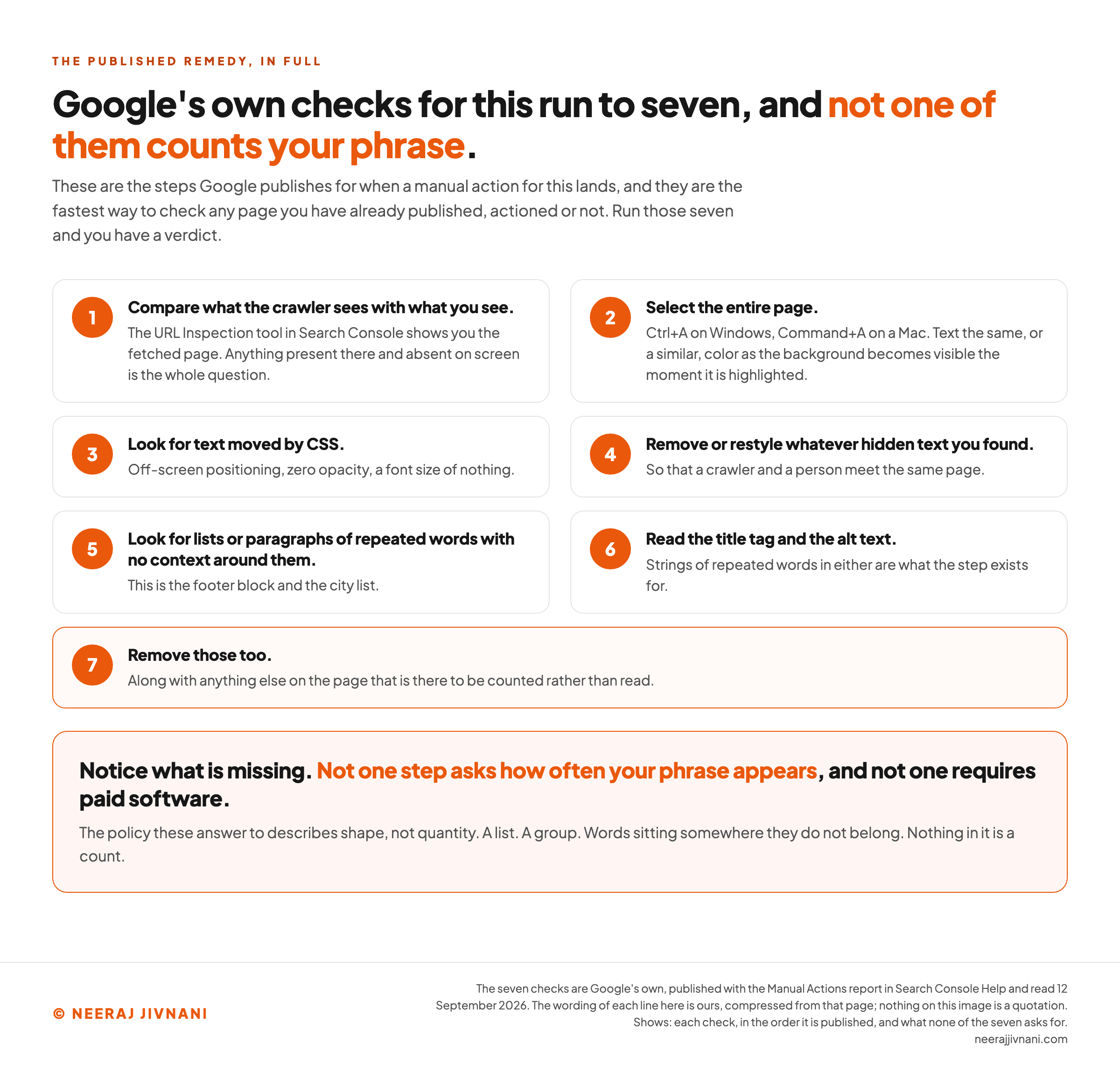
Google publishes the steps it wants taken when this manual action lands, and they are the fastest way to check any page you have already published, actioned or not. There are seven of them.
- Compare what the crawler sees with what you see. The URL Inspection tool in Search Console shows you the fetched page. Anything present there and absent on screen is the whole question.
- Select the entire page. Ctrl+A on Windows, Command+A on a Mac. Text the same, or a similar, color as the background becomes visible the moment it is highlighted.
- Look for text moved by CSS. Off-screen positioning, zero opacity, a font size of nothing.
- Remove or restyle whatever hidden text you found, so that a crawler and a person meet the same page.
- Look for lists or paragraphs of repeated words with no context around them. This is the footer block and the city list.
- Read the title tag and the alt text. Strings of repeated words in either are what the step exists for.
- Remove those too, along with anything else on the page that is there to be counted rather than read.
Run those seven and you have a verdict.
Notice what is missing from them. Not one step asks how often your phrase appears, and not one requires paid software.
If all seven come back clean and the page still reads badly, nothing here applies to you. Fix the prose because it deserves fixing.
Use this chart — embed code and citation
<a href="https://neerajjivnani.com/blog/keyword-stuffing/"><img src="https://neerajjivnani.com/infographics/keyword-stuffing/not-one-counts-your-phrase.png" alt="The seven checks Google publishes for this manual action, numbered one to seven, running from comparing what the crawler sees with what you see through to removing anything that is there to be counted rather than read. A panel underneath records that not one of the seven asks how often your phrase appears and not one requires paid software. All seven are set out in the numbered list above it." width="1200"></a>
<p>Chart: <a href="https://neerajjivnani.com/blog/keyword-stuffing/">Neeraj Jivnani</a></p>Neeraj Jivnani, "Keyword Stuffing Is Two Problems With One Name", neerajjivnani.com, https://neerajjivnani.com/blog/keyword-stuffing/Free to republish with a link back to this page.
If a Manual Action Has Already Landed
Open the Manual Actions report in Search Console. An empty report ends the question, and it costs thirty seconds to find out.
If an action is listed, the sequence is fixed. Fix every page the report names rather than the worst one, then ask for a review from inside the same report.
The request is a short piece of writing with a shape to it. Explain the quality issue, describe the steps you took, and document the outcome of those steps.
Then wait. Most reviews take "several days or weeks", in Google's own words, and some take longer.
Google asks you not to resubmit before a decision arrives.
One thing is worth doing while you wait. The reviewer is reading a site rather than your list, so the pages nobody flagged are worth a pass too.
Writing a Page So the Question Never Comes Up
Put the phrase where it carries meaning, then write the page and stop thinking about it.
The places worth using are the title, the first paragraph, and one heading if the heading wants it anyway. After that, let the words fall where the subject puts them.
Use the other words your subject comes with. A page that covers its topic properly is already full of the related terms, because you cannot explain the thing without them.
Reaching for synonyms deliberately is usually a sign that the page is thinner than it should be.
Then read it out loud. Every stumble is either a sentence that needs rewriting or a phrase you forced, and the ear finds both.
Reading the Page Instead of Counting It
The reason this question feels unanswerable is that there are two different problems underneath one name.
If the repetition sits inside sentences that are trying to tell somebody something, it is a writing problem. No policy is coming for you.
Rewrite the paragraph because it is worse than it should be, which is a better reason than fear.
If the text was never meant to be read, whether it is a block at the foot of the page or something nobody can see at all, that is the other question. The checks answer it in five minutes.
Everything else is counting. A number cannot see a list of towns pretending to be a paragraph, and a person can see it in a second.