What AI Can Do in SEO Work, and Where It Is Guessing
Ask yourself where the answer is sitting before you hand search work to a model. In its language, or in data nobody gave it. Only one comes back real.


/ On this page9 sections
Your prompt is not the problem. Every answer a model gives you about search sits in one of two places: in language, which it has, or in data nobody handed it.
AI SEO is two jobs sharing one name: using AI to do the search engine optimization, or SEO, and getting your pages quoted inside AI answers.
Most of your week goes on the first, so most of what follows is about that. The second job is covered further down.
What the Model Cannot See
A general model has two things: language, and whatever was in its training data up to a cutoff. That is the whole inventory.
It does not have the numbers SEO runs on. None of these is inside it:
- What people search for, and how often. Volume is a measurement somebody takes from clickstream and ad data. It is not a property of the phrase.
- How hard a phrase is to win. Difficulty is a score a tool computes from the pages currently ranking.
- Where your pages sit today. Position is a snapshot of a results page in a location on a date.
- Who links to whom. A link graph is a crawl somebody paid to run and keeps running.
- What your own visitors did. That sits in your analytics and your Search Console, behind your login.
- Whether your pages are indexed at all. Only the search engine knows, and it tells you through its own console.
Every one of those is a database that somebody maintains. A model reading text on the internet never saw any of them.
Why This Is the Only Distinction That Matters
Because the model does not know which kind of question you asked.
Ask it to rewrite six title tags and it does the job. Ask it what the search volume is for a phrase and it produces a number in the same tone, at the same speed, with the same air of having looked something up.
Nothing in the answer marks the second one as invented.
You have to know before you ask.
The Jobs That Are Only Language
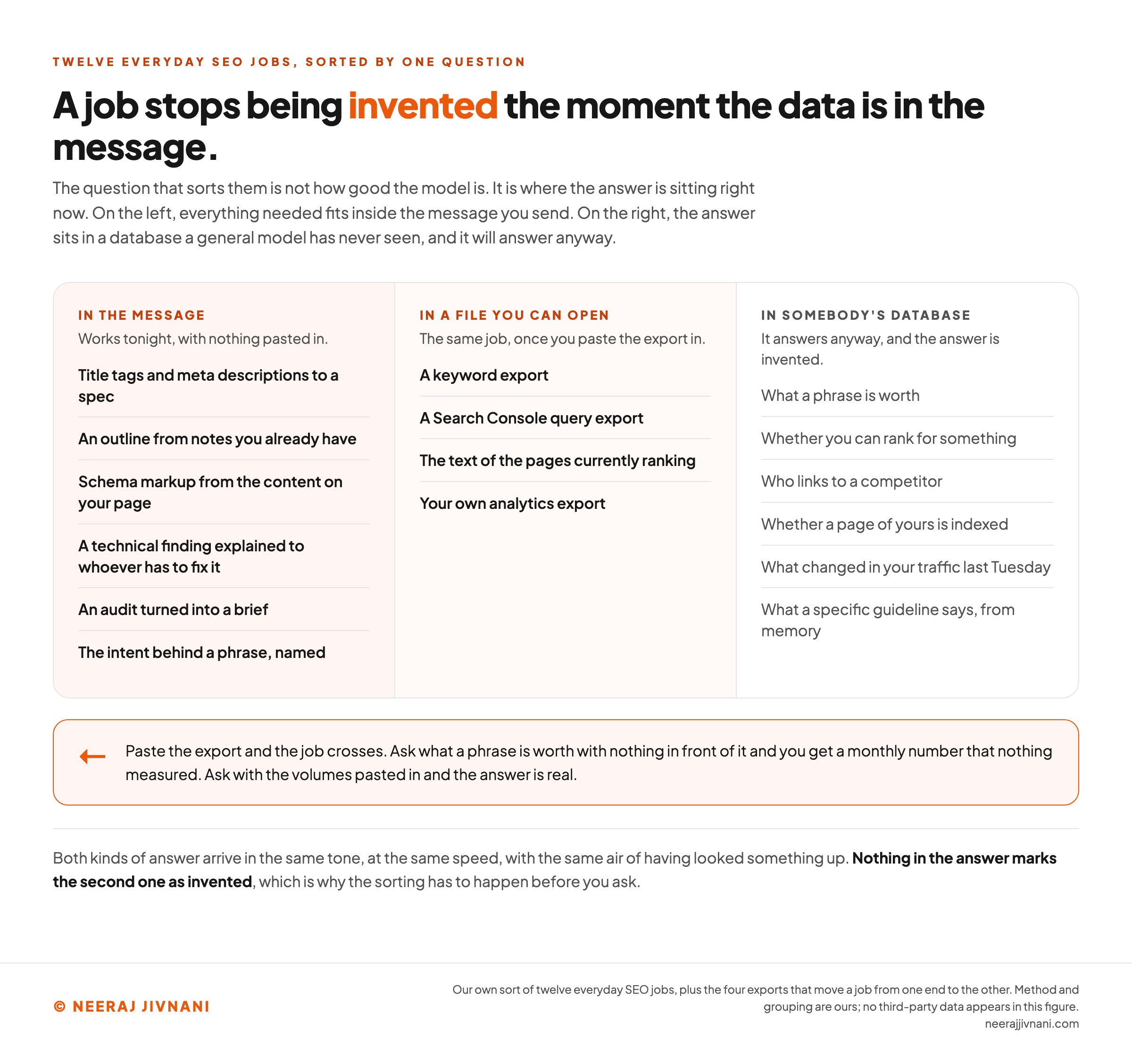
Six SEO jobs work tonight, with a chat window you already pay for and nothing pasted in. What they have in common is that everything the model needs fits inside the message you send it.
- Title tags and meta descriptions to a spec. Give it the page, the character band and the thing the page delivers. Read the six it returns and keep one.
- An outline from notes you already have. Hand over the research you have gathered and ask for the order the sections should run in. You will move two of them, and moving them takes a minute.
- Schema markup from the content on your page. Structured data is a mechanical translation of things the page already says, which is the kind of work a language model is built for.
- A technical finding explained to whoever has to fix it. Turning a crawl warning into two plain sentences a developer can act on.
- An audit turned into a brief. A long list of flagged issues becomes a short one, with a reason attached to each.
- The intent behind a phrase, named. Whether someone typing it wants to learn, compare or buy is a judgment about language, and it is one a model makes reasonably well.
Notice that none of the six asks the model to know anything about your site. That is why they work.
The Jobs That Need Your Data, and What to Paste In
The most useful SEO work needs numbers, and it moves onto the first list the moment you paste them in.
You are not upgrading the model when you do that. You are handing it the one thing it was missing, and the answer stops being a guess.
That move costs nothing, and it is the one worth learning before you price a single subscription.
The Four Exports Worth Having Open
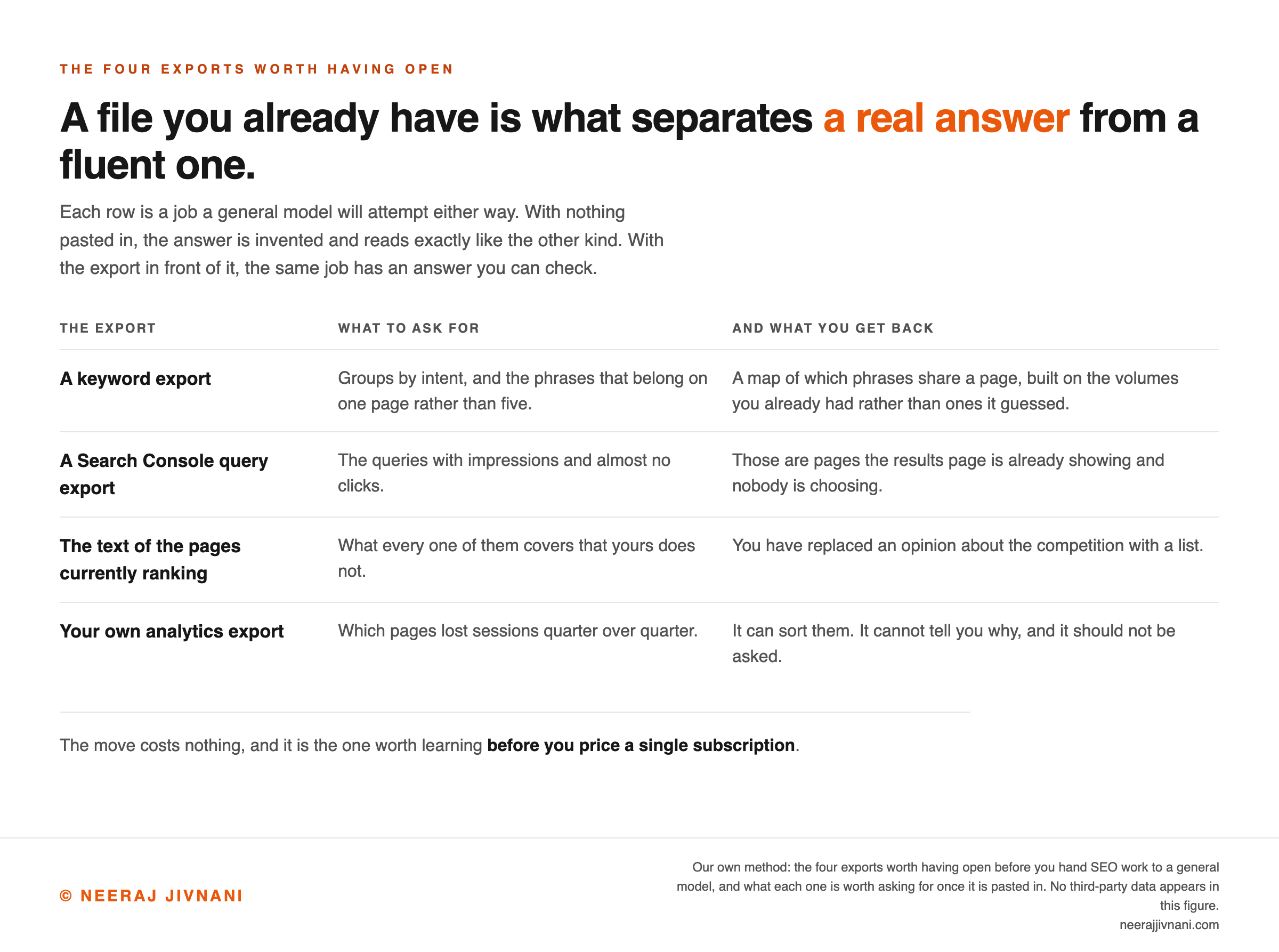
Each of these turns a question the model would have guessed at into one it can genuinely answer.
- A keyword export. You already have the volumes and the difficulty scores from wherever you got the list. Paste them in and ask for groups by intent, and for the phrases that belong on one page rather than five.
- A Search Console query export. Ask for the queries with impressions and almost no clicks. Those are pages the results page is already showing and nobody is choosing.
- The text of the pages currently ranking. Paste them and ask what every one of them covers that yours does not. You have replaced an opinion about the competition with a list.
- Your own analytics export. Ask which pages lost sessions quarter over quarter and it can sort them. It cannot tell you why, and it should not be asked.
The Test That Tells You in Advance
Before trying a job that is not on either list, ask one question: where is the answer sitting right now?
If it is inside the text you are about to paste, you will get a good answer. If it is in somebody's database, you will get a fluent one.
This is worth more than any list, because it works on jobs nobody has thought of yet.
Where is the answer sitting right now?
Write down what you are about to ask, break it into the parts the answer rests on, and say where each part is sitting. Nothing here is scored and no answer is corrected. What comes back is the one thing the model will not do for you, which is tell you which half of its answer it made up.
This stays in the box. Nothing reads it, and nothing is decided from it.
What does the answer rest on? Add the parts, then place each one.
What comes back
Nothing is placed yet, so there is nothing to separate. You have to know before you ask, because on the screen the two kinds of answer look identical.
Use this chart — embed code and citation
<a href="https://neerajjivnani.com/blog/ai-seo/"><img src="https://neerajjivnani.com/infographics/ai-seo/four-exports.png" alt="A four row table of the exports worth having open before handing SEO work to a general model, each row naming what to ask for once the file is pasted in and what comes back: a keyword export, for groups by intent and the phrases that belong on one page rather than five, because the volumes and difficulty scores are already in the list you got; a Search Console query export, for the queries with impressions and almost no clicks, which are the pages the results page is already showing and nobody is choosing; the text of the pages currently ranking, for what every one of them covers that yours does not, which replaces an opinion about the competition with a list; and your own analytics export, for which pages lost sessions quarter over quarter, which it can sort but cannot explain." width="1200"></a>
<p>Chart: <a href="https://neerajjivnani.com/blog/ai-seo/">Neeraj Jivnani</a></p>Neeraj Jivnani, "What AI Can Do in SEO Work, and Where It Is Guessing", neerajjivnani.com, https://neerajjivnani.com/blog/ai-seo/Free to republish with a link back to this page.
The Jobs Where It Will Answer Anyway
Six more SEO jobs will get an answer out of a model, and asked cold, every one of those answers is invented.
- What a phrase is worth. It will give you a monthly number. Nothing measured it.
- Whether you can rank for something. That needs the current results page and your own site's standing, and it has neither.
- Who links to a competitor. A plausible list of plausible domains, which is worse than no list.
- Whether a page of yours is indexed. It cannot see Google's index, and opening your page tells it the page exists, not that Google holds it.
- What changed in your traffic last Tuesday. It has no access to the before or the after.
- What a specific guideline says, from memory. It paraphrases fluently, and the wording lands close enough to sound right and wrong enough to act on.
The Obvious Objection: It Can Browse Now
Most assistants will fetch a live page if you ask, and that genuinely moves part of the list above.
Point one at a guideline and it can quote the current wording rather than paraphrase a remembered version. Ask for the passage, not the summary.
What browsing does not reach is everything that was never on the open web.
Volume, difficulty and a link index sit behind a paid subscription. Your analytics and your Search Console sit behind your login.
A page it can open is a page it can read. A database it cannot log into stays invisible.
There is a quieter problem underneath.
It browses sometimes and answers from memory the rest of the time, and the two replies look identical on the screen. So the habit worth keeping is asking what it opened.
No Prompt Fixes a Missing Number
No amount of context creates a number that was never measured, and a newer model does not either.
The honest fix is boring. Either bring the number, or go and look it up yourself, or accept that you are guessing and say so in your own notes.
Some of these stop being problems the moment you paste an export in. Ask what a phrase is worth with the volumes in front of it and the answer is real.
The difference between a useful answer and an invented one is rarely the question. It is whether you brought the data with you.
Use this chart — embed code and citation
<a href="https://neerajjivnani.com/blog/ai-seo/"><img src="https://neerajjivnani.com/infographics/ai-seo/where-the-answer-is-sitting.png" alt="Three lanes sorting twelve everyday SEO jobs, plus the four exports that move a job between them, by where the answer to each one is already sitting. In the message, needing nothing pasted in: title tags and meta descriptions to a spec, an outline from notes you already have, schema markup from the content on your page, a technical finding explained to whoever has to fix it, an audit turned into a brief, and the intent behind a phrase. In a file you can open: a keyword export, a Search Console query export, the text of the pages currently ranking, and your own analytics export. In somebody's database, where it answers anyway and the answer is invented: what a phrase is worth, whether you can rank for something, who links to a competitor, whether a page of yours is indexed, what changed in your traffic last Tuesday, and what a specific guideline says when it is asked from memory. An arrow across the bottom shows a job crossing from the right to the left the moment the export is pasted in." width="1200"></a>
<p>Chart: <a href="https://neerajjivnani.com/blog/ai-seo/">Neeraj Jivnani</a></p>Neeraj Jivnani, "What AI Can Do in SEO Work, and Where It Is Guessing", neerajjivnani.com, https://neerajjivnani.com/blog/ai-seo/Free to republish with a link back to this page.
What You Are Paying a Tool For
Once you sort the work this way, the question of which tool to buy changes shape.
A tool in this category is a data subscription with a chat window on the front. The chat window is nearly free.
The crawl, the clickstream, the rank checks and the link index are the expensive part, and they are the part you cannot reproduce.
So there are two questions worth asking a vendor, and neither is about the model.
What can it see that you cannot? If the answer is nothing, you are paying for the prompting.
What happens when its data is wrong? Volume is estimated, difficulty is a house formula, and rank is a sample. A confident interface on top of an estimate is still an estimate.
Which Tools the People Hiring Name
What teams are already paying for is a steadier signal than what is newest, and it is written down in the job adverts.
Only 22 adverts in a set of 643 named an AI visibility tool at all. Profound appeared in nine of them, BrightEdge in five and BlueFish in four, with one mention each for Peec.ai, Scrunch, Schema App and SparkToro.
Those counts come from Omniscient Digital's November 2025 analysis of SEO job postings, by Cate Dombrowski.
The list is also short, which tells you how young this category still is.
The Other Half: Being Quoted Inside AI Answers
Getting quoted inside an AI answer is the second job under this name, and it is the one that sounds most urgent.
ChatGPT, Perplexity, Gemini and Google's own AI Overviews all work the same way. A large language model, or LLM, reads pages and writes a summary, and yours can be one of the pages it reads.
It reads like a new discipline, and the work is mostly not new.
The pages that get quoted are pages that were already findable, already clear, and already said something specific enough to lift.
Google's own documentation on AI features, updated in December 2025, says there is no extra machinery to build for them. No special file, no new markup, no separate schema.
Which means the practical answer to the question of what to do about it is almost entirely work you would recognize.
The one thing genuinely worth doing differently is writing so that a single paragraph can be taken out and still make sense on its own.
Writing for the models themselves is the trap.
Nobody outside the model knows what it weighs, and a page written to please a guess reads badly to the person who does arrive.
What the Industry Calls It
The naming is confusing and it has a factual answer, which is what the people hiring for the job write in the advert.
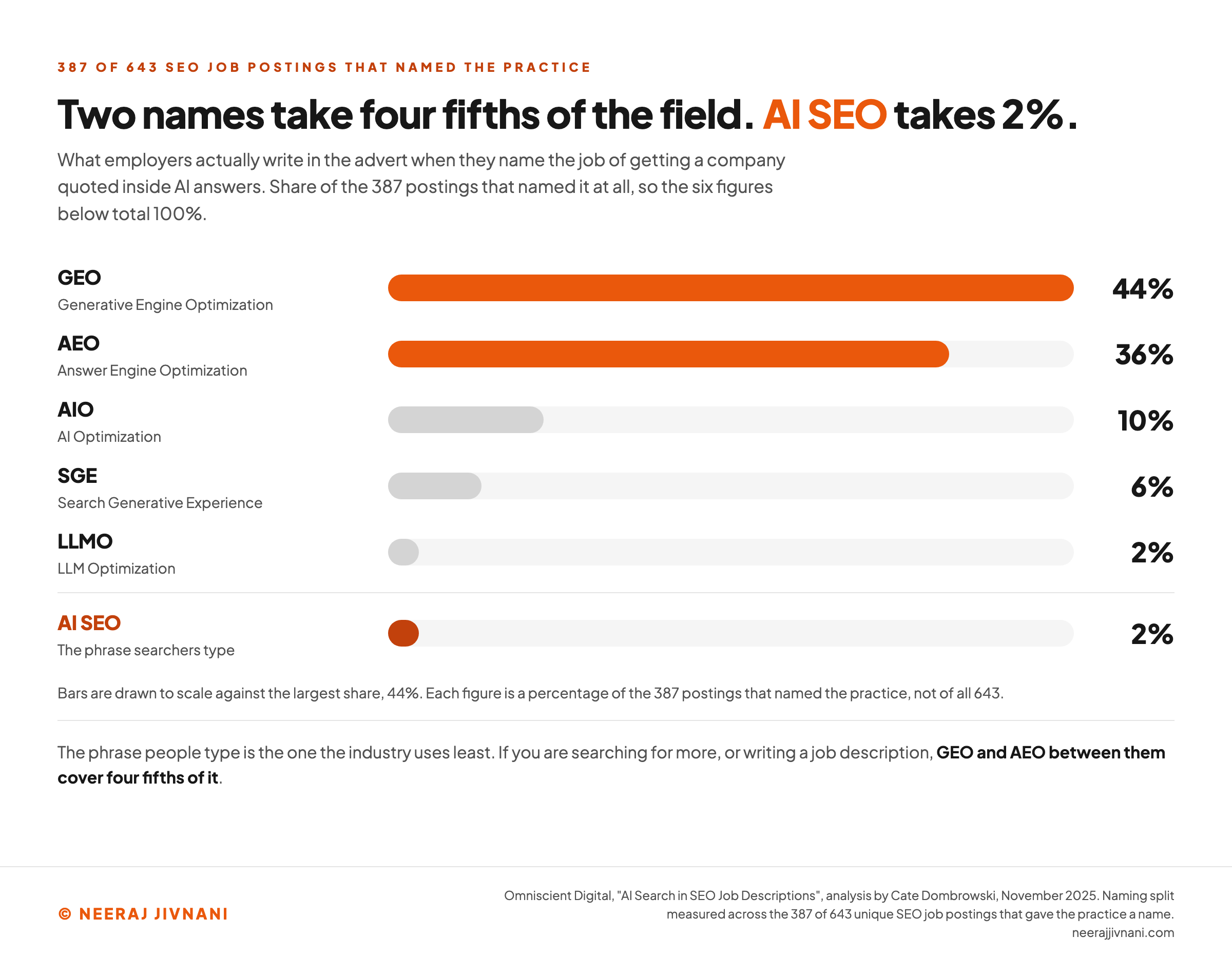
In that same set, 387 of the postings gave the practice a name. Generative Engine Optimization (GEO) took 44% of them and Answer Engine Optimization (AEO) 36%.
AI Optimization (AIO) took 10%, Search Generative Experience (SGE) 6%, and LLM Optimization (LLMO) 2%.
"AI SEO" itself took 2%.
So the phrase you typed to get here is not the phrase the industry uses for the second job. If you are searching for more, or writing a job description, GEO and AEO between them cover four fifths of the field.
The wider picture from the same 643 postings is that this is still a minority skill. 34.21% mention AI search requirements at all, and it climbs with seniority: 50% of executive roles against 29% of individual contributor roles.
Read that as a timing signal rather than a mandate. The people writing the strategy are being asked for it before the people doing the work are.
Use this chart — embed code and citation
<a href="https://neerajjivnani.com/blog/ai-seo/"><img src="https://neerajjivnani.com/infographics/ai-seo/what-the-adverts-call-it.png" alt="A horizontal bar chart of what employers write in a job advert when they name the practice of getting a company quoted inside AI answers, drawn as a share of the 387 of 643 SEO job postings that named it at all, so the six figures total one hundred percent. Generative Engine Optimization, GEO, takes 44 percent and Answer Engine Optimization, AEO, takes 36 percent, so the two together cover four fifths of the field. AI Optimization, AIO, takes 10 percent, Search Generative Experience, SGE, 6 percent, LLM Optimization, LLMO, 2 percent, and the phrase searchers type, AI SEO, 2 percent." width="1200"></a>
<p>Chart: <a href="https://neerajjivnani.com/blog/ai-seo/">Neeraj Jivnani</a></p>Neeraj Jivnani, "What AI Can Do in SEO Work, and Where It Is Guessing", neerajjivnani.com, https://neerajjivnani.com/blog/ai-seo/Free to republish with a link back to this page.
Measuring Any of This
Measuring the first job is ordinary.
You did the work faster or you did not, and the pages you shipped rank or they do not.
Measuring the second job is much harder, and the reason is structural rather than a gap in the tools.
A generated answer has no position.
There is no first place to hold, so there is nothing to look up the way you look up a rank.
And it does not repeat. Ask the same question twice and the answer can name different sources both times, which means one look tells you nothing.
So the honest method is sampling. Pick the ten questions a customer would type, ask each one several times in ChatGPT, Perplexity and Gemini, and write down how often you are named.
That costs real time every month, and what it produces is a rough percentage rather than a rank. Knowing that in advance is worth more than any tool, because it tells you how much precision you are entitled to expect.
What Does Count Cleanly
What arrives afterwards is the part you can measure properly.
Visits referred from ChatGPT or Perplexity show up in your analytics as a referrer like any other, in the Traffic acquisition report. They are not in Search Console, because that click never touched a Google results page.
Google's own AI features work the other way round. Clicks from AI Overviews and AI Mode are already inside your Search Console numbers, folded into overall search traffic and reported under the Web search type.
So the clicks never separate out. Search Console has a view for how often you turn up inside those features, and none at all for what turning up there costs you.
Either way, the number is yours and nobody has to sell it to you.
Short Answers to the Questions People Ask
Every one of these resolves the same way, which is why they are worth having ready: ask where the answer is sitting before you ask anything else.
If it is in language, hand the job over tonight. If it is in a database nobody has opened for the model, bring the file or expect an invention.
These are the ones you will be asked, in a form you can repeat to somebody else.
Can SEO Be Done by AI?
Parts of it. The parts where the answer lives in language, such as drafting, structuring, explaining and summarizing, are handled well.
The parts that decide whether SEO works, which keyword to target, whether you can win it, and what your pages are doing, need data the model does not have until you give it some.
Can ChatGPT Do SEO?
ChatGPT does the language half with nothing extra, and a surprising amount of the data half once you paste an export into it.
What it cannot do is fetch your numbers for you. Treat it as a fast analyst who has never seen your account.
Which AI SEO Tool Is the Best?
The one holding data you cannot get yourself, because that is the only part you are buying. Model quality is almost identical across the category.
If two products show you the same crawl and the same rank checks, the difference between them is the interface and the invoice.
The exception is a tool measuring something you cannot easily do by hand, such as how often a brand shows up across repeated questions to several assistants. That is real work you would otherwise do by hand.
Does Using AI for SEO Hurt Your Rankings?
Not by itself.
What gets a page marked down is thin, unedited work published at volume, and that has been true since long before any of this.
The practical risk is quieter than a penalty. It is publishing a plausible number that nobody checked, in your own voice, with your name on it.
Most of This Runs on Data You Already Have
The pattern worth taking away is that almost nothing here is a model problem. It is a question of what data you already have and whether you have put it in front of anything.
A chat window plus your own Search Console export answers more than you would guess, and it costs nothing. What a subscription sells is the crawl, the rank checks and the link index, which you cannot export.
And the half of the term that sounds most urgent, the part about being quoted inside AI answers, turns out to need the least new work. It needs pages that are findable, clear, and specific enough to be worth lifting a paragraph out of.
Everything else is a question about what you can show it.