What Dwell Time Measures, and Why No Report Will Ever Show You Yours
Your analytics does not measure it, and there is no target to hit. See what the term covers, what a fast exit means, and which number to open tonight.


/ On this page9 sections
Dwell time is the stretch between clicking a search result and arriving back at the results. Your analytics does not measure it.
So this is what the term covers, what a fast exit tells you, and which number to open instead.
What Dwell Time Measures
Dwell time is how long somebody stays on a page they reached from a search result before going back to that results page.
Two things about that definition do all the work.
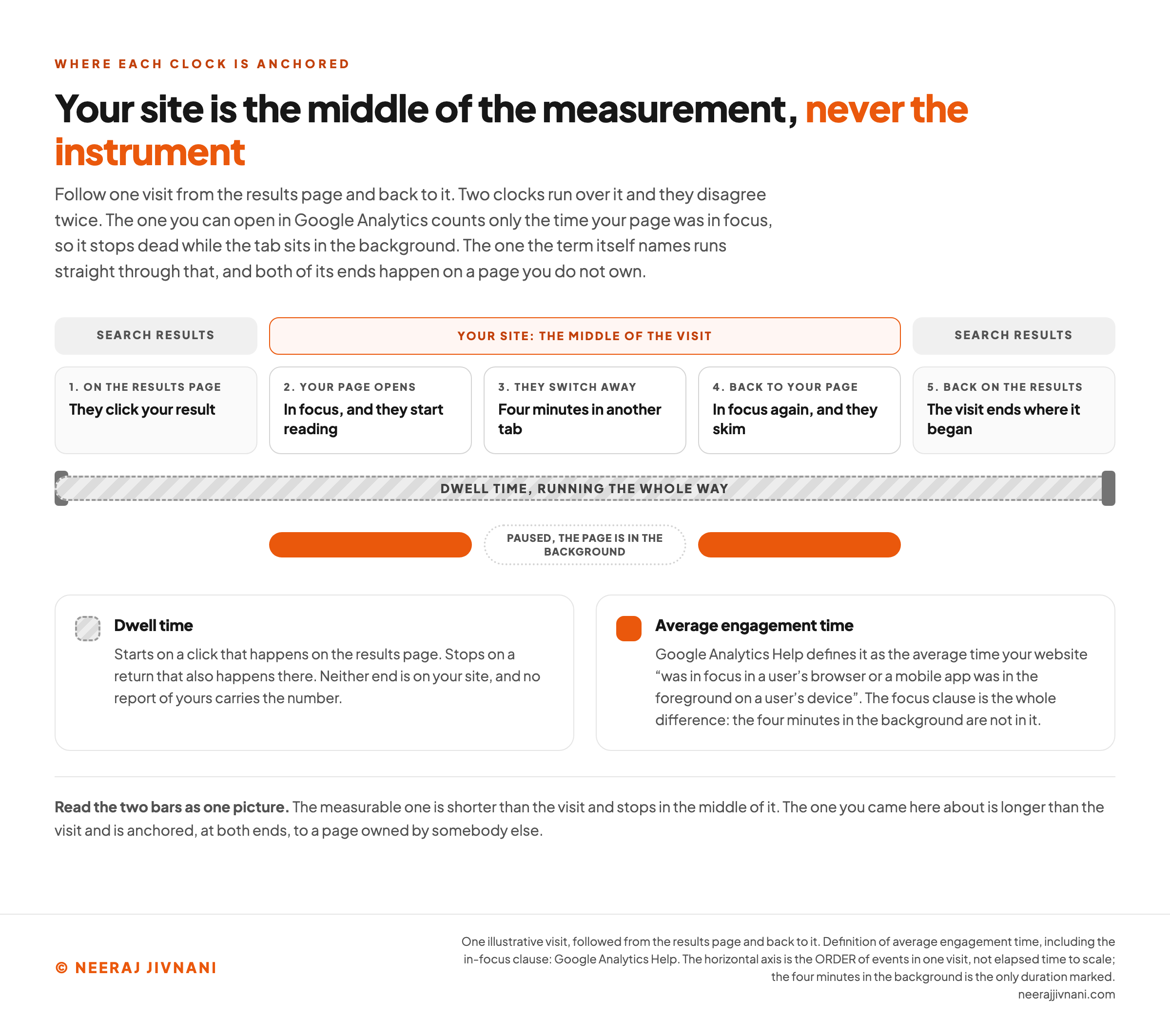
Both ends of the interval belong to the search engine. The clock starts on a click that happens on the results page, and it stops on a return that also happens there.
Your site is the middle of the measurement, never the instrument.
And it is one specific journey. A visitor arriving from a newsletter, a link or a bookmark is not accruing dwell time, because there is no results page for them to go back to.
Say two people spend the same four minutes on the same guide.
The one who found it through search has a dwell interval. The one who found it on social media has none at all.
The Other Meanings, Briefly
The word travels well beyond search, which is why the results you are looking at now seem so mixed.
Logistics uses it for cargo sitting still. Security teams use it for how long an intruder went unnoticed, retailers for time spent in front of a display.
In the military it means the time service members spend at home station between deployments.
Those senses share a shape and nothing else. They do not even point the same way.
A shipping line wants less of it and a retailer wants more, which is the clearest sign they are different measurements wearing one name.
Everything that follows is the search meaning only.
The Three Things People Call Dwell Time
Three different intervals get called dwell time, and they disagree about both ends of the journey.
Sorting them out takes one question: where does the clock start, and does the page have to be in focus for it to run?
Answer it for each of them and the confusion goes. Two are measured on your side of the click, one is not, and only one cares whether the tab is in front of the reader.
The table carries a fourth row as well, because bounce rate gets mixed into this comparison constantly. It is not a clock at all.
| where the clock starts | where it stops | who can see it | |
|---|---|---|---|
| Dwell time | a click on a search result | the return to that results page | the search engine, and nobody else |
| Average engagement time | the page coming into focus | the page leaving focus | you, in Google Analytics |
| Time on page | the pageview | the next recorded event | you, in most analytics tools |
| Bounce rate | not a duration at all | no clock runs | you, in your own property |
Why the Focus Clause Matters
Average engagement time is the one worth knowing properly, because it is the metric everybody reaches for as a stand-in.
Google Analytics Help defines it as the average time your website "was in focus in a user's browser or a mobile app was in the foreground on a user's device". The figure is that focused time divided by the number of active users.
Read the focus clause twice. It is the whole difference.
Somebody opens your page, switches to another tab for four minutes, comes back, skims, and returns to search.
Their dwell interval ran the entire time. Their engagement time paused the moment the tab went to the background.
The gap runs the other way too. A reader who keeps your page in focus and then goes to a different site rather than back to the results ends the dwell interval nowhere at all.
So the proxy is closer than nothing, and it is answering a slightly different question.
Use this chart — embed code and citation
<a href="https://neerajjivnani.com/blog/dwell-time/"><img src="https://neerajjivnani.com/infographics/dwell-time/both-ends-on-a-page-you-do-not-own.png" alt="One visit drawn left to right in five steps. The first and last steps are shaded as the search engine's results page and the three middle steps are shaded as your own site. The reader clicks a result, the page opens in focus and they start reading, the tab spends four minutes in another tab, the page comes back into focus and is skimmed, and the visit ends back on the results page. Beneath the steps, a hatched gray bar labeled dwell time runs the full width of the picture and its two end caps sit under the results-page steps, outside the site entirely. Beneath that, average engagement time is drawn as two solid orange segments covering only the two in-focus steps, with a dotted empty pill where the background stretch is, labeled paused, the page is in the background." width="1200"></a>
<p>Chart: <a href="https://neerajjivnani.com/blog/dwell-time/">Neeraj Jivnani</a></p>Neeraj Jivnani, "What Dwell Time Measures, and Why No Report Will Ever Show You Yours", neerajjivnani.com, https://neerajjivnani.com/blog/dwell-time/Free to republish with a link back to this page.
Why Nothing Reports It to You
The only channel through which a search engine reports anything back to a site owner is Search Console, and it does not report durations.
The Performance report returns four things: clicks, impressions, click-through rate and average position. Google Search Console Help names those four and stops.
Not one of them is a length of time.
That is not an oversight. The term never came from a search engine's reporting in the first place.
It reached search marketing out of information-retrieval research, popularized for the web by Duane Forrester at Bing in 2011. The vocabulary is the industry's, not the product's.
The Report to Open Instead
What you can look at tonight is the engagement report, filtered to search traffic.
The filter is the part that matters. Set session source and medium to google / organic, so you are left with only the people who arrived the way a dwell interval requires.
In Google Analytics that view lives under Reports, in the Engagement group, on the Pages and screens report. Average engagement time sits beside each page.
It is the closest honest instrument available, and the filter is what makes it honest.
Two workarounds get suggested in place of it, and both measure something else.
- Click tracking records that a click happened, not how long anybody stayed.
- Scroll depth records how far down the page a person got, which is a real signal about your page and says nothing about the interval.
One visit, three clocks, and what each one was doing
Think of one visit to one of your pages. Describe its shape below, not its length, and each of the three clocks reports what it did with that visit: where it started, where it stopped, and which of your four answers it ignored completely. Nothing is typed in and nothing comes out as a number.
1. How did they arrive?
2. Did your page ever go to the background?
3. Did they open a second page of yours?
4. How did the visit end?
Answer all four and the three readings appear here. None of them will be a duration, because you have not been asked for one and no report is going to hand you one.
Is Dwell Time a Ranking Factor?
No, not as a ranking lever you can pull. On your side of the click it is an outcome, never a control.
The honest picture has two halves and they do not contradict each other.
Search engines do study how long people stay on a result. Microsoft researchers have published on it, working from a large commercial search engine's own click logs.
Meanwhile Search Console tells you four things about your own performance, and none of them is a duration.
Put those together and the practical answer falls out. Whatever a search engine does with the behavior, you have no reading, no setting and no dial.
You can raise a bid. You can rewrite a title tag and watch the click-through rate move. You cannot do anything of that shape here.
You can only change the page, and then the behavior is whatever it is.
Which makes the ranking question less useful than it looks. Build a page so the interval comes out long and you have built a page that delays the answer, which is the thing the reader was trying to avoid.
How Long Is Long Enough?
Long enough is not a fixed number of seconds, and that is a measured finding rather than the usual shrug.
The field did have a rule of thumb. A click counted as satisfied once the dwell time reached about 30 seconds, and a great deal of published research rested on that line.
Then somebody tested it. Microsoft researchers Kim, Hassan, White and Zitouni examined the assumption in 2014, using 104,000 click instances drawn from a large commercial search engine's own logs.
Their objection was structural. A single threshold "assumes that users need a fixed amount of time to be satisfied with any result click, irrespective of the page chosen".
What Moved When the Page Changed
So they measured the threshold against the reading level of the page people landed on.
Sorted that way, the point at which a click became more likely satisfied than dissatisfied landed at around 160 seconds for an easy page and around 175 seconds for a moderate one.
A difficult page needed more than 200 seconds. A technical segment ran to about 210 seconds.
Their conclusion was that a single satisfaction threshold across all pages "may be insufficient".
Read what that does to the question of how long is long enough. A visit of three minutes clears the bar on an easy page and falls short of it on a difficult one, and what moved was the page.
So the target is not unknown. It is not a fixed quantity in the first place, which is a different thing and a more useful one.
Ask instead how long your page needs to be understood.
A one-line answer needs seconds. A specification with worked examples needs minutes, and a reader giving it minutes is the system working.
What a Short Dwell Tells You
A short dwell does not tell you the page failed. It often means the reader found the thing and stopped, and assuming otherwise will send you rewriting pages that worked.
Three ordinary situations produce a short dwell and a satisfied reader.
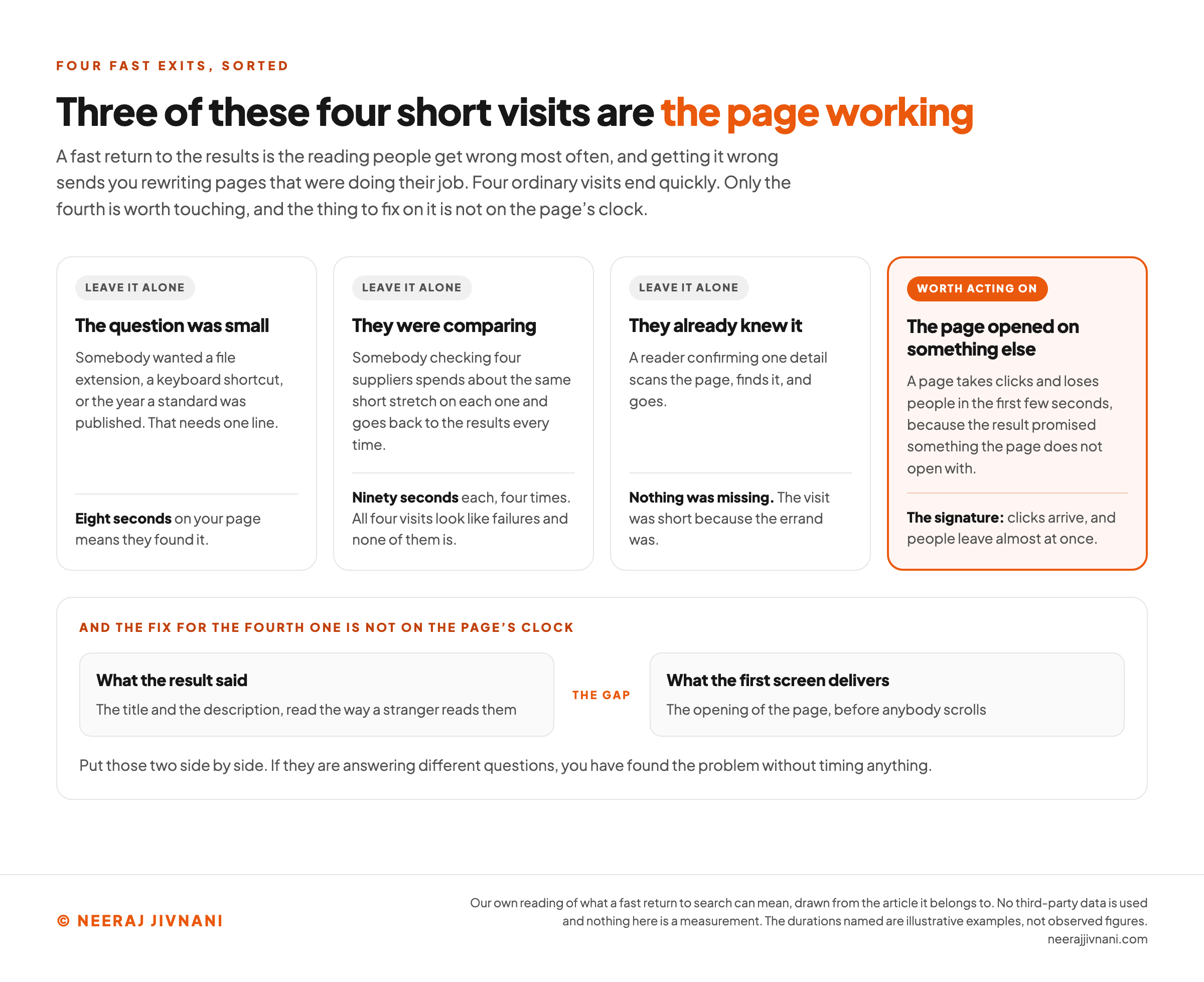
- The question was small. Someone searching for a file extension, a keyboard shortcut or the year a standard was published needs one line. Eight seconds on your page means they found it.
- They were comparing. Someone checking four suppliers spends ninety seconds on each and returns to search every time. All four visits look like failures and none of them is.
- They already knew it. A reader confirming one detail scans, finds it, and goes.
One case is worth acting on, and it has a signature you can check.
A page takes clicks and loses people in the first few seconds, and the reason is that the result promised something the page does not open with.
That fix is not on the page's clock. It is the gap between what the title and description said and what the first screen delivers.
Use this chart — embed code and citation
<a href="https://neerajjivnani.com/blog/dwell-time/"><img src="https://neerajjivnani.com/infographics/dwell-time/three-of-these-are-the-page-working.png" alt="Four cards describing visits that end quickly. The first three are tagged leave it alone: a small question that needs one line, where eight seconds on the page means they found it; somebody comparing four suppliers who spends ninety seconds on each and goes back to the results every time, so all four visits look like failures and none of them is; and a reader confirming one detail, who scans, finds it and goes. The fourth card is outlined in orange and tagged worth acting on: a page that takes clicks and loses people in the first few seconds because the result promised something the page does not open with. Below the four cards, two panels sit side by side, what the result said and what the first screen delivers, with the gap marked between them." width="1200"></a>
<p>Chart: <a href="https://neerajjivnani.com/blog/dwell-time/">Neeraj Jivnani</a></p>Neeraj Jivnani, "What Dwell Time Measures, and Why No Report Will Ever Show You Yours", neerajjivnani.com, https://neerajjivnani.com/blog/dwell-time/Free to republish with a link back to this page.
The Two Things That Move It
Two things move the interval, and everything that works is a version of one of them.
Keep the promise the result made. Somebody read a title and a description, decided your page would answer them, and clicked. Open on something adjacent and you lose them in the first screen, whatever the rest of the page is like.
Put the answer near the top. A reader who has to scroll past a preamble to reach what they came for is deciding whether to stay while they scroll. Lead with the answer, then explain it.
Everything else on the usual lists sits underneath those two.
A page that loads slowly delays the answer. A page that opens on a consent dialog delays the answer.
A page that buries the point under four paragraphs of context delays the answer. Three doors, one failure.
That changes what you do with a page you suspect is losing people. You are not hunting for a tactic to add.
You are looking for whatever sits between the click and the answer, and removing it.
Three Tactics That Do Less Than They Look Like
Three familiar moves aim at the interval directly, and knowing where the clock stops is enough to see through all three.
Adding internal links so people stay on the site. Go back to where the clock stops: at the return to the search results, not at the edge of a page.
A reader who clicks through to a second page of yours is still inside the same interval. It was already running, it keeps running, and nothing about the measurement has changed.
Those internal links are worth adding when the next page genuinely helps. They are not a dwell tactic, because there is no dwell effect to have.
Writing longer so the page takes longer to read. Length follows from what a topic needs. Reverse that and you push the answer further from the top, which is the failure the section above describes.
Embedding a video to run the clock. A video that explains something better than the paragraph would is a good video. A video placed to add ninety seconds is ninety seconds the reader did not want to spend.
And there is a problem the three share that no other metric has. You cannot check whether any of them worked.
With a figure you can read, a bad idea at least announces itself afterwards. Here you would be guessing at a number nobody will show you, through a proxy that times a different interval.
Stop Looking for the Number
Dwell time is real, you cannot see it, and you should stop looking for it.
It describes something that happened, in the same family as "people liked it". Useful for thinking about a page, useless as a target, and available to you at no point ever.
There is a check that needs no metric at all. Put the search result and the page side by side.
Read the title and description the way a stranger would, then open the page and read the first screen. If those two are answering different questions, you have found the problem without timing anything.
Most of the time you will find one of three things.
- The page answers a different question than the result implied.
- The answer is on the page but nowhere near the top.
- The page is fine, and the visits were short because the question was small.
Only the first two are problems, and neither of them needed a stopwatch to find.