An SEO Strategy Is Four Answers, and Each One Rules Something Out
Most SEO plans are task lists. Write down four answers instead and you will know what to work on this week, and what you get to ignore.

/ On this page11 sections
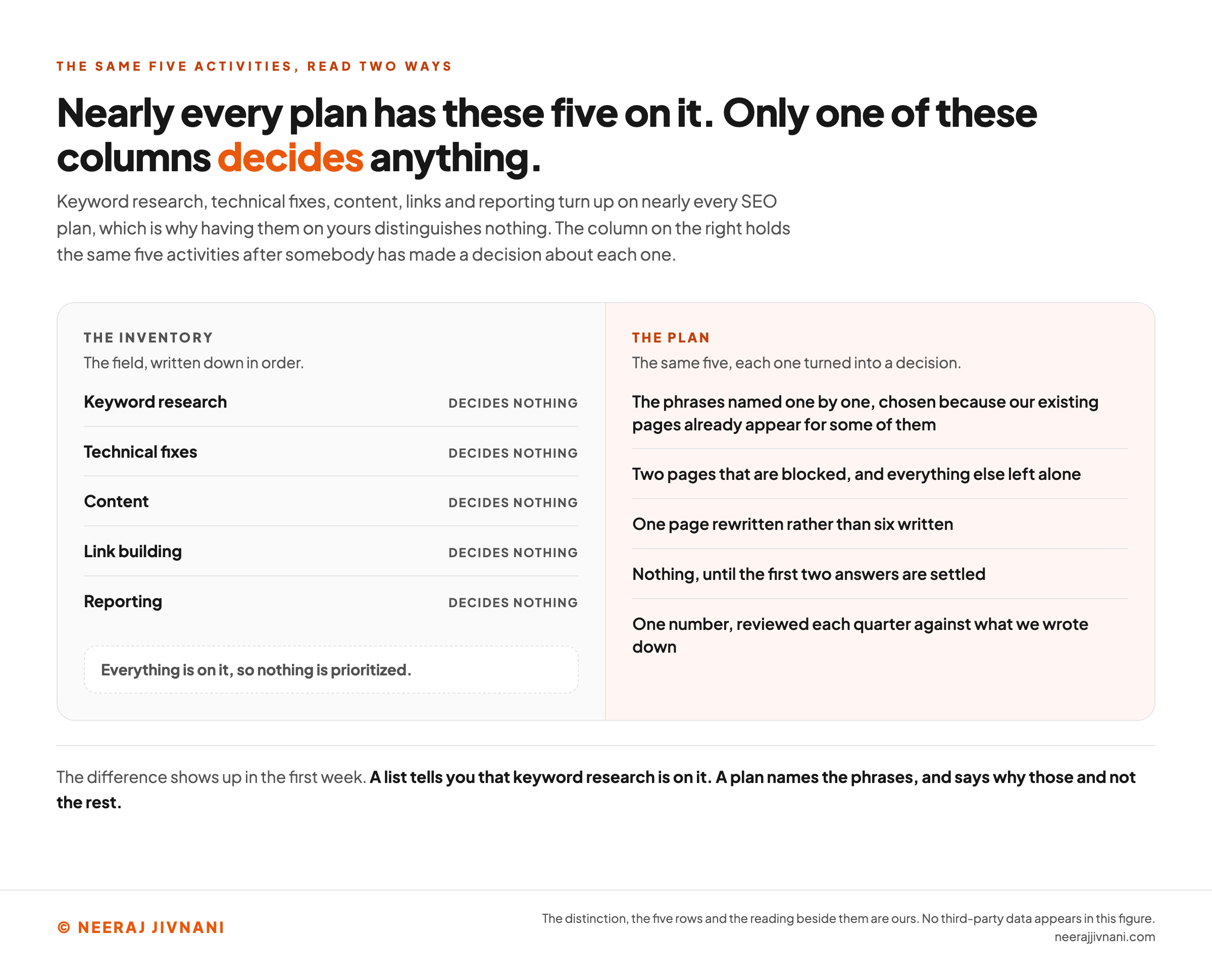
Most SEO plans are inventories. They list keyword research, technical fixes, content, links and reporting, which is the whole field written down in order, and they decide nothing.
A strategy is the opposite. It is four answers you write once, and each one closes off work you are now not doing this quarter.
Answer them in order and you will know what to open on Tuesday morning.
What an SEO Strategy Settles
An SEO strategy is a written set of decisions: what the work is for, which searches you will compete for, which of your pages will do it, and how you will know whether it worked.
That is a plan.
What usually gets called a strategy is that same inventory: search engine optimization, or SEO, broken into its five familiar parts and written out in order.
Nearly every plan has those five on it. That is why having them on yours distinguishes nothing.
The difference shows up in the first week.
A list tells you that keyword research is on it. A strategy names the phrases, and says why those and not the rest.
Tactics are the things you do. Strategy is the set of choices that made those things the right ones to do.
The same tactic can be excellent or pointless depending on which strategy sits above it.
Rewriting a batch of page titles is real work. Whether it is the right work this month depends entirely on an answer nobody wrote down.
The four answers below are the plan. Nothing else belongs in the document.
Use this chart — embed code and citation
<a href="https://neerajjivnani.com/blog/seo-strategy/"><img src="https://neerajjivnani.com/infographics/seo-strategy/list-versus-plan.png" alt="A two column comparison headed the same five activities, read two ways. The left column, labeled the inventory, lists keyword research, technical fixes, content, link building and reporting as five undifferentiated tasks, each marked with the note decides nothing, and a band underneath reading everything is on it, so nothing is prioritized. Its headline reads that nearly every plan has these five on it and only one of the two columns decides anything, and its subtitle says that is why having them on yours distinguishes nothing. The right column, labeled the plan, converts the same five into decisions: the phrases named one by one, chosen because our existing pages already appear for some of them; two pages that are blocked, everything else left alone; one page rewritten rather than six written; nothing until the first two answers are settled; one number reviewed each quarter against what we wrote down. A band across the foot states the difference a reader can test: a list tells you keyword research is on it, a plan names the phrases and says why those and not the rest." width="1200"></a>
<p>Chart: <a href="https://neerajjivnani.com/blog/seo-strategy/">Neeraj Jivnani</a></p>Neeraj Jivnani, "An SEO Strategy Is Four Answers, and Each One Rules Something Out", neerajjivnani.com, https://neerajjivnani.com/blog/seo-strategy/Free to republish with a link back to this page.
The Four Answers Depend on Each Other
The four answers are a chain. Each one is unanswerable until the ones above it are settled, and that is the part almost nobody writes down.
Take the first two. You cannot choose which searches to compete for until you know what the work is meant to produce.
A shop that wants orders of one product and a clinic that wants one phone call a week are shopping for completely different phrases. Nothing about the phrases tells you which set is right; the objective does.
The same holds further down. You cannot decide which pages carry the strategy until you know the searches.
And you cannot pick a measure until the first answer is settled, because the measure counts what that answer asked for and nothing else.
So the order is not a style choice.
An answer written out of order is a guess dressed as a decision, and it will sit in the document for months, because nothing about it looks wrong.
The usual version of that mistake is a keyword list built in week one. It fills a spreadsheet, it took two days, it looks like progress, and nobody in the room can say which rows the business would miss.
Four answers, and what each one takes off next month
Put next month's work in first, in your own words. Then write the four answers, and point each one at whatever it removes. An answer that points at nothing is a description of the field rather than a decision about your site.
Whatever is genuinely queued. The page rewrites, the crawl report, the guest posts, the report nobody reads.
Answer one
What is this for
The business result you want, in a form somebody outside marketing would recognize.
Nothing sits above this one. Every other answer waits on it.
What this one takes off the list
Put next month's work in above, or the refusal has nothing to point at.
Answer two
Who it is for, and what they type
The situation somebody is in when they go looking, and the words that person types.
You cannot choose which searches to compete for until you know what the work is meant to produce.
What this one takes off the list
Put next month's work in above, or the refusal has nothing to point at.
Before the page work
Confirm that every page you are about to plan around is in the index at all.
It is not one of the four answers, so it has nothing to take off the list. It is a precondition, and it is the only thing in the document that can quietly invalidate everything under it. A page held out of the index serves perfectly to everyone who visits.
Answer three
Which pages carry it
One search, one page, written down.
You cannot decide which pages carry the strategy until you know the searches.
What this one takes off the list
Put next month's work in above, or the refusal has nothing to point at.
Answer four
What would tell you it worked
One signal, and the date you will look at it.
You cannot pick a measure until the first answer is settled, because the measure counts what that answer asked for.
What this one takes off the list
Put next month's work in above, or the refusal has nothing to point at.
Four lines on one page
The finished document is four lines and a short list of refusals. Write the four above and they read back here.
There is a fifth thing, and it is not an answer. It is a check, and it comes before any of the page work.
Answer One: What Is This For
The first answer names the business result you want, in a form somebody outside marketing would recognize.
Orders of a specific product. Inquiries from a particular kind of buyer.
Applications to one course. Fewer support calls, because the answer is now findable.
Write it as a sentence rather than a number, and make it specific enough to exclude something. "More traffic" excludes nothing, so it cannot guide a single decision.
The Two Wrong Answers
The first wrong answer is a ranking. The second is a traffic number.
Both feel concrete, and neither is an objective.
A ranking is wrong because nobody can promise you one. Google's own starter guide says plainly that there is "no guarantee that any particular site will be added to Google's index", let alone placed at a given position in it.
An objective you cannot be given is a wish. Build a plan on it and the plan has no floor under it.
A traffic number is wrong for a different reason. It is achievable, and it can rise while the thing you wanted falls.
A page can rank first, draw thousands of visits and produce nothing, because the people arriving wanted something you do not sell.
That is not a near miss. It is the plan working perfectly on the wrong target.
What Answering It Rules Out
Once the objective is written down, whole categories of work stop being candidates.
Take an objective of five new inquiries a month from company directors. The broad definitional phrases everyone tells you to chase are now off the list, however large their volume, because nobody typing them is close to hiring anyone.
Say the objective is orders instead. The blog is not the priority and the product pages are.
That is the test for whether the first answer is finished. Name one thing you had planned for next month that it now rules out, and if you cannot, the objective is too vague to use.
Answer Two: Who It Is For, and What They Type
The second answer is two halves that only work together: who you are trying to reach, and the words that person types.
The who half is not a demographic profile. It is the situation somebody is in at the moment they go looking, because the situation is what decides their wording.
Somebody comparing two suppliers types something different from somebody who has already chosen and is checking a specification.
Same person, same week, different search, different page.
The what half is the searches themselves. You want a modest list, not a spreadsheet, and every phrase on it should be one you can imagine that person saying out loud.
Where the Phrases Come From, Free
Three free places give you almost all of them.
- The search box itself is the first, with its autocomplete and its related searches.
- The questions boxes on a results page are the second, and they are a direct transcript of what else people wanted to know.
- The third is Search Console, on any site you can verify. It hands back every search that has already put one of your pages in front of somebody, and whether they clicked.
That third one is the one people skip, and it is the best of the three. It is the only source that tells you what search engines already associate with you, rather than what a tool has guessed.
Reading Whether You Could Win It
A phrase is only yours if you could beat the pages already answering it.
That is a judgment, and you make it by opening the results page and reading. A difficulty score is somebody else's shortcut for the same read, and you are about to do the read yourself.
Two things decide it: the kind of page that is winning, and how good the best three of them are.
Start with the kind. If the results are videos, forum threads or software, the demand is being met by something you may not make at all, and a better article does not enter you into that contest.
And if the best three results are thorough, current and written by somebody with a decade of citations behind them, the honest answer for this quarter is no.
Say it out loud and move down the list. Most of the skill here is being willing to.
What Answering It Rules Out
A written list of searches is a refusal to chase anything not on it.
That sounds obvious, and it belongs in the document anyway, because the requests will come. Somebody will forward an article about a phrase with enormous search volume, and the list is the reason you do not spend a fortnight on it.
It also rules out the two or three phrases you opened and decided you could not win.
Those are not gone forever. They come back onto the list at a review, once something you have built has changed the answer.
Before the Page Work: One Check You Cannot Skip
Confirm that every page you are about to plan around is in the index at all. That is the whole check.
It is not one of the four answers. It is a precondition, and it is the only thing in this document that can quietly invalidate everything under it.
It belongs here, between the second answer and the third, because the third answer is where you start assigning work to named pages.
The reason to run it now rather than discover it later is that this failure is invisible from where you sit.
A page held out of the index serves perfectly to everyone who visits, so nothing in your own use of the site will ever raise the question.
A strategy naming six pages without that check has some chance of resting on one that was never eligible to compete. Check first, then plan.
Google Search Console answers it for one page at a time and costs nothing, and the answer for each page is a yes or a no rather than a score.
Answer Three: Which Pages Carry It
The third answer assigns the searches to pages. One search, one page, written down.
This is where a strategy stops being a document and becomes a list of things to open. It is also where most plans quietly go wrong, because the instinct is to write new pages and the evidence says otherwise.
One Search, One Page
The map holds one row per search, and each row names a single page. Two rows may point at the same page; two pages may not point at the same search.
Two pages chasing one search is common, and nobody ever decided it. It is what a site looks like after a few years of publishing without a map.
The strategy's job is to settle it on paper: which page keeps the search, what becomes of the other one, written into the map rather than left to a tidy-up nobody ever schedules.
Start From What the Engines Already Believe About You
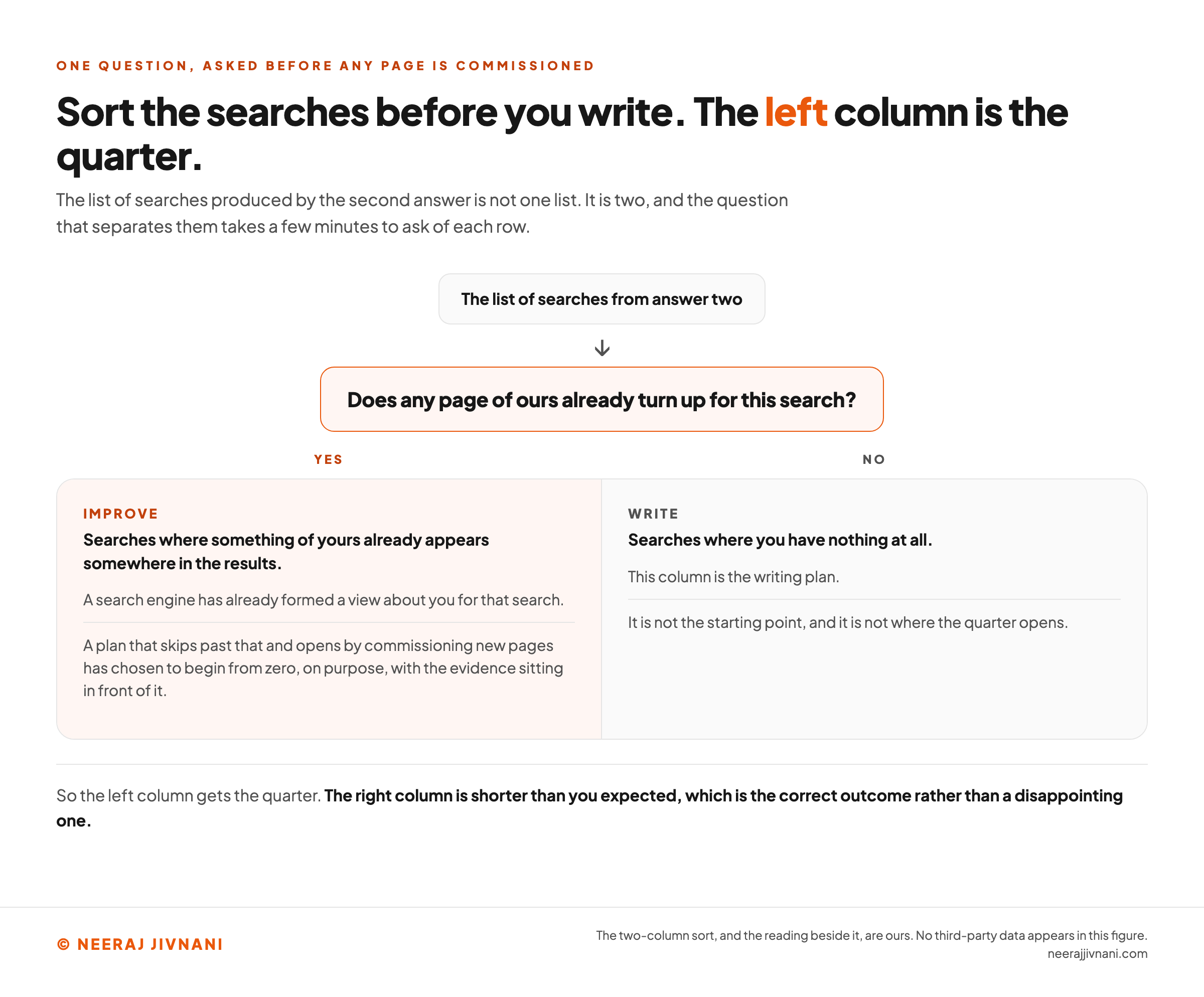
Before you plan anything, sort the list of searches into two columns. Searches where a page of yours already turns up somewhere, and searches where you have nothing at all.
The left column is not a minor advantage.
A page already in the results is a search engine having formed a view about you for that search.
A plan that skips past that and opens by commissioning new pages has chosen to begin from zero, on purpose, with the evidence sitting in front of it.
So the left column gets the quarter. The right column becomes the writing plan, and it is shorter than you expected, which is the correct outcome rather than a disappointing one.
The Three Places the Work Can Go
Whatever you decide to do to a page falls into one of three places, and they are not equally available to you.
The page itself is yours. The heading, the title, the description, what the page says, whether it answers the search in its first paragraph.
That is where a small site gets most of its wins, and it costs nothing but attention.
The site around it is also yours: how your pages link to each other, and whether this one loads on a phone.
The third place is other people's sites, and it is the only one that is not yours.
What you govern there is narrow: whether the page carries anything somebody else would have to quote rather than paraphrase. Everything past that is somebody else's editorial judgment, arriving on somebody else's schedule.
Which is why a target number of backlinks is not a plan. It is a forecast of other people's behavior, entered into your document as though it were a commitment of yours.
What Answering It Rules Out
The page map stops the most expensive habit in SEO, which is reflexive publishing.
Every new page is now a claim that no existing page could serve that search. Make that claim out loud a few times and you will find that most of the time one could.
The map also gives you an answer to give people. When a request arrives for a page nobody searched for, the reply is not a judgment about the request; it is a row that does not exist.
Use this chart — embed code and citation
<a href="https://neerajjivnani.com/blog/seo-strategy/"><img src="https://neerajjivnani.com/infographics/seo-strategy/sort-before-you-write.png" alt="A sorting diagram in two stages. The input at the top is the list of searches produced by answer two. The first stage splits that list by a single question, does any page of ours already turn up for this search, into two columns. The left column, highlighted in orange and headed improve, holds the searches where something of yours already appears somewhere in the results, annotated that a search engine has already formed a view about you for that search and that a plan ignoring it has chosen to start from zero with the evidence in front of it. The right column, in gray and headed write, holds the searches where you have nothing at all, annotated that this column is the writing plan rather than the starting point. A band across the foot gives the consequence for the quarter: the left column gets the quarter's work, the right column is shorter than expected, and that is the correct outcome rather than a disappointing one." width="1200"></a>
<p>Chart: <a href="https://neerajjivnani.com/blog/seo-strategy/">Neeraj Jivnani</a></p>Neeraj Jivnani, "An SEO Strategy Is Four Answers, and Each One Rules Something Out", neerajjivnani.com, https://neerajjivnani.com/blog/seo-strategy/Free to republish with a link back to this page.
Answer Four: What Would Tell You It Worked
The fourth answer names the one signal you will look at, and the date you will look at it.
One signal. Not a dashboard.
A dashboard of nine numbers is a reporting habit, and reporting is not measurement, because nothing on it is going to change a decision.
The signal has to sit close to the objective from the first answer. If the objective was inquiries, count inquiries; if it was orders of one product, count those orders.
Setting the Review Window Before You Start
Pick the date now, while you are still calm about it.
The temptation to look next Thursday is enormous, and next Thursday has nothing in it. A position is a reading taken from a contest that keeps moving on its own, and two people running the same search are shown different pages.
A quarter is the shortest window that tells you anything. A fortnight tells you nothing at all.
Writing the date into the document does two jobs. It stops the weekly panic, and it stops the opposite failure, which is never looking again because nobody agreed when to.
The Measures That Move and Mean Nothing
Three numbers rise reliably and tell you almost nothing. All three are popular for exactly that reason.
Total keyword count. A site can add hundreds of ranking phrases nobody searches, and the number looks like progress.
A third-party authority score. It has no line to the objective you wrote in the first answer, so a rise in it is not a reading on anything you decided to want.
Impressions. The most seductive of the three, because it arrives from a real report rather than a vendor.
It counts how often a result appeared, which is a fact about the results page rather than about your business.
The number you agreed to watch is the one from the first answer, and this is not it.
What Answering It Rules Out
A named signal and a named date rule out the two conversations that eat SEO programs.
They rule out arguing about which report is right, because the strategy already said which number was the one.
And they rule out abandoning the plan in week five, because week five was never a decision point.
Writing Down What You Will Not Do
The last thing in the document names the work you are not doing this quarter, and it is the part that makes the other four real.
Writing down a refusal is not a rhetorical flourish. Google's own starter guide, a document written to help you, says that "some of the suggestions might not even apply to your business".
When the engine's own guide says that a share of it is not for you, deciding which share is the job.
What Usually Goes on It
The five entries below are scope decisions rather than tactics. Each is real work, and each is work a small site can postpone for a quarter without losing anything it would notice.
The searches you read and could not win. You found these during the second answer. Write them down as postponed rather than leaving them off the page entirely, because an unlisted phrase comes back as somebody's suggestion in week six.
Everything that is not on the page map. A crawl report will hand you a long list of items ranked by its own idea of severity. If an item does not sit on a page carrying one of your searches, it is not this quarter's problem.
A second search engine, a second language, a second country. Each one is a separate contest with its own pages and its own measure. None of them is an extension of the plan in front of you; each is another plan.
A rebuild of the site. This is the largest thing that gets pulled into an SEO document and the least likely to belong there. A redesign changes everything at once, which makes the fourth answer unreadable for two quarters.
Anything that would breach the spam policies. Bought links, doorway pages, hidden text. Not on moral grounds but on planning grounds, because a penalty is the one item on the list you cannot reverse inside a quarter.
The list gets a date rather than a deletion. At the review, the question is whether any of it has become worth doing, and usually one item has.
What the Four Answers Cost
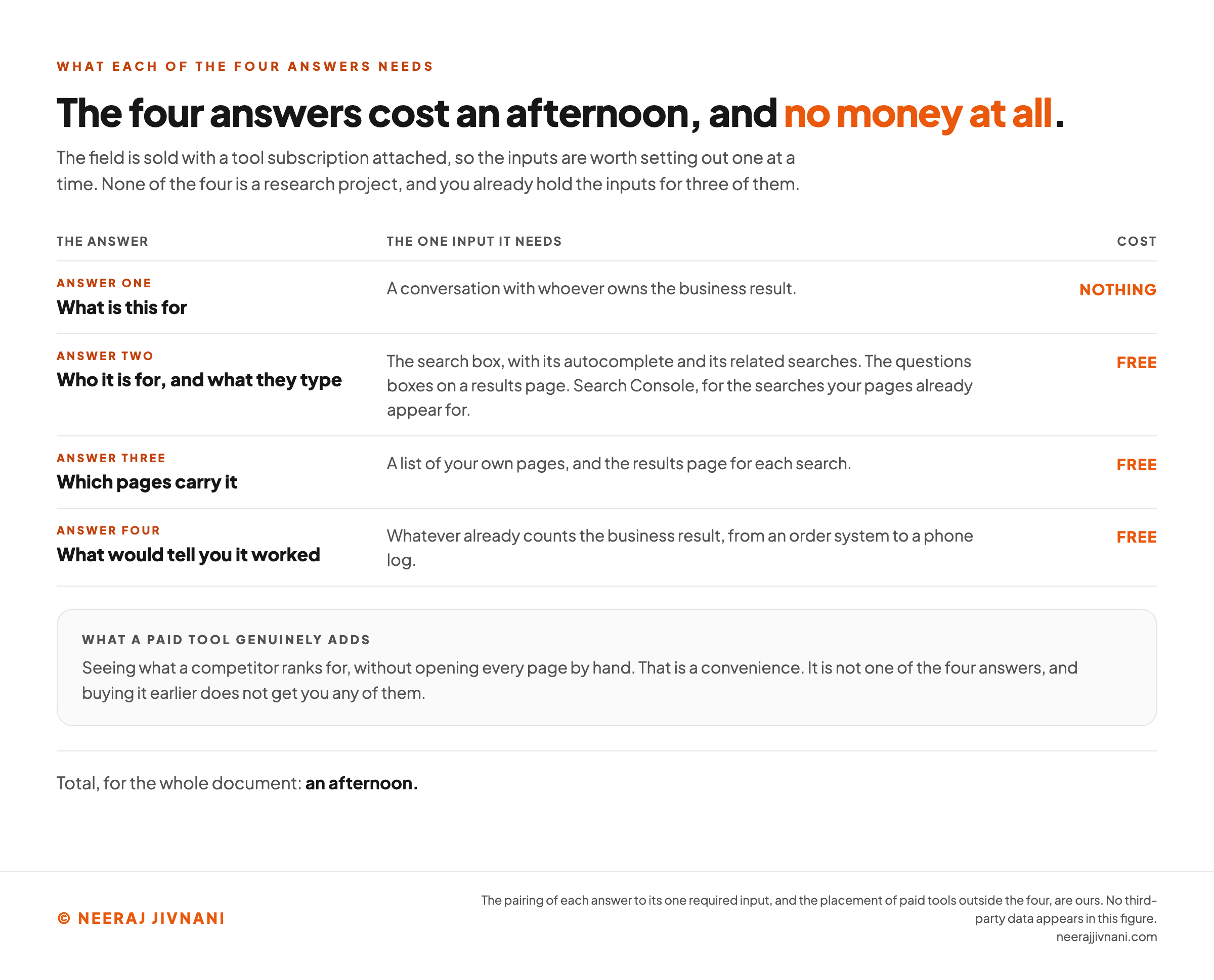
The four answers cost an afternoon, and no money at all.
That surprises people, because the field is sold with a tool subscription attached. None of the four is a research project, and you already hold the inputs for three of them.
Where evidence is needed, the evidence is free.
The search box gives you real phrases. A results page tells you what format wins and how good the competition is.
Search Console reports which searches are already showing your pages, and which pages Google could not use at all.
A paid SEO tool is genuinely useful later, for one thing: seeing what a competitor ranks for without opening every page by hand.
That is a convenience. It is not one of the four answers, and buying it earlier does not get you any of them.
There is one case where the answer is not to write this at all.
If nobody is searching for what you do, in any wording, then search is the wrong channel. A strategy for it is a way of postponing that conclusion.
You find that out during the second answer, and finding it out in an afternoon is a good result.
Use this chart — embed code and citation
<a href="https://neerajjivnani.com/blog/seo-strategy/"><img src="https://neerajjivnani.com/infographics/seo-strategy/what-each-answer-needs.png" alt="A four row table pairing each of the four answers with the single input it requires and the cost of that input. Row one, what is this for, requires a conversation with whoever owns the business result, and costs nothing. Row two, who it is for and what they type, requires the search box with its autocomplete and related searches, the questions boxes on the results page, and Search Console for the searches your pages already appear for, all free. Row three, which pages carry it, requires a list of your own pages and the results page for each search, free. Row four, what would tell you it worked, requires whatever already counts the business result, from an order system to a phone log, free. A fifth row set apart in gray records the one thing a paid tool genuinely adds, which is seeing what a competitor ranks for without opening every page by hand, and marks it a convenience rather than one of the four answers. A band across the foot gives the total, an afternoon." width="1200"></a>
<p>Chart: <a href="https://neerajjivnani.com/blog/seo-strategy/">Neeraj Jivnani</a></p>Neeraj Jivnani, "An SEO Strategy Is Four Answers, and Each One Rules Something Out", neerajjivnani.com, https://neerajjivnani.com/blog/seo-strategy/Free to republish with a link back to this page.
Top Fives, Three C's, and Where a Beginner Starts
Four questions get asked alongside this one often enough to answer directly.
Two of them ask for a shortlist. That is a reasonable thing to want, and a dangerous thing to act on without the four answers sitting above it.
One asks about a memory aid that circulates widely and is not a method. Another asks where a beginner should put their first hour, and it has the most useful answer of the four.
What Are the Top 5 SEO Strategies?
Five decisions survive contact with a real week. Settle what the work is for, and pick the searches you could win.
Then confirm those pages are in the index, improve the ones already appearing before writing anything new, and choose one number to judge it by.
All five are decisions you can finish. Lists of five tactics are easy to find and harder to act on, because a tactic with no decision above it is a guess.
What Are the 3 C's of SEO?
Content, code and credibility. Treat it as a memory aid rather than a method, because that is all it is.
Content is whether the page answers the search. Code is whether a search engine can reach and read it.
Credibility is whether anything outside your own site suggests you are worth believing.
The three are useful for remembering that the work has three different homes. None of them tells you what the work is for, which is the answer every other one waits on.
How Do I Learn SEO as a Beginner?
Pick a single page that already matters to the business, and run the four answers on that page alone.
Learning the vocabulary first is the slower route. The terms only make sense attached to a decision you have already had to make.
Settle what that page is meant to produce, find the search it should own, confirm it is indexed, and come back in a quarter.
What Are Examples of SEO Strategies?
Three illustrative sketches, each a finished set of four answers rather than a list of activities.
Take a small architecture practice that wants five inquiries a month from local developers. The searches are service phrases with a town name attached, the pages are four existing service pages rather than a blog, and the number is inquiries logged in the inbox.
Say an online shop selling one category of equipment wants orders of its higher-margin range. The searches are specific product and comparison phrases, the pages are product and category pages already sitting on page two, and the number is orders of that range.
Say a charity wants applications to one program. The searches are the eligibility questions applicants ask before they apply, the page is a single improved eligibility page, and the number is completed applications.
None of the three names a tactic. That is what makes them strategies.
Four Lines on One Page
The finished document is four lines and a short list of refusals. It fits on one page.
Anything longer has stopped being a set of decisions and gone back to being an inventory. If your version runs to six pages, the extra five are activities, and activities were never the thing that was missing.
The test that it is real is not whether it reads well. It is whether it removed something.
Read back what you were going to do next month.
If the four answers took nothing off that list, you have written a description of the field rather than a plan for your own site. The fix is to make the first answer more specific until it starts refusing things.