What Branded Search Is, and How to Read Your Own Number Before You Spend on It
See what counts as one, how to split your own traffic in two without breaking the totals, and whether paying for your own name buys you anything.

/ On this page7 sections
A branded search is somebody typing your name. What counts as one is your decision, and it is wider than you think.
Splitting your own traffic in two takes an afternoon with a free tool. The same filter quietly breaks your totals, which is how a branded share ends up too low.
Then there is the question that costs money: whether paying for your own name buys you anything you do not already have.
A Branded Search Is Somebody Typing Your Name
A branded search is a query that contains your brand. Everything else is non-branded, and the line between the two is the whole subject.
"running shoes" is non-branded, because somebody is shopping and has not chosen yet.
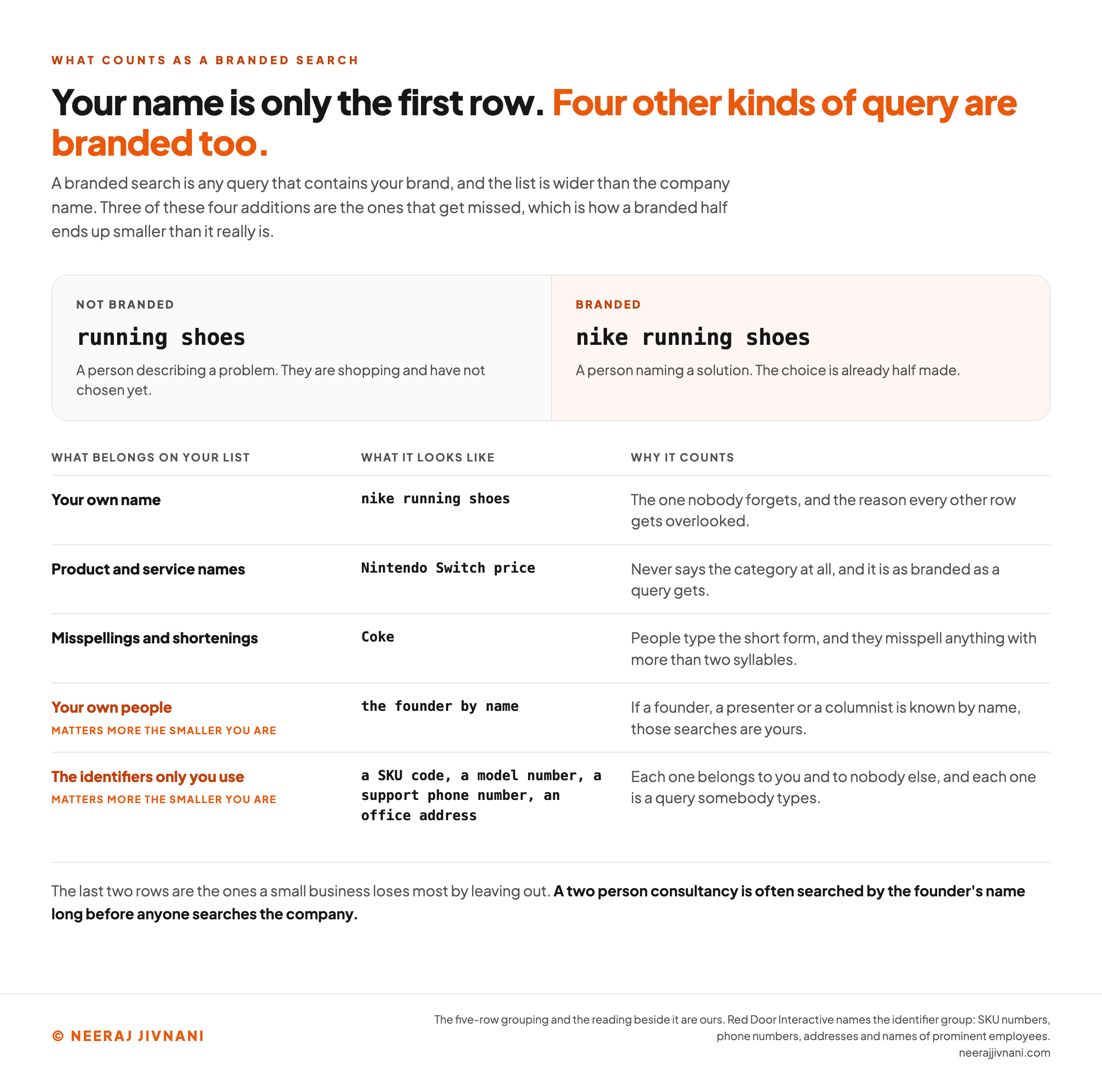
"nike running shoes" is branded, and the choice is already half made. A non-branded search is a person describing a problem; a branded search is a person naming a solution.
Your name is only the start of the list. Four other kinds of query belong in it. Three of them get missed.
- Product and service names. "Nintendo Switch price" never says Nintendo's category, and it is as branded as a query gets.
- Misspellings and shortenings. People type Coke rather than The Coca-Cola Company, and they misspell anything with more than two syllables.
- Your own people. If a founder, a presenter or a columnist is known by name, searches for that name are branded searches for you.
- The identifiers only you use. A stock keeping unit (SKU) code, a model number, a support phone number or an office address belongs to you and to nobody else. Red Door Interactive makes the point in its own guide, and this row is what widens the list furthest.
Leave three of those four off your list and your branded half comes out short, which is the first of the two ways this number goes wrong.
The last two rows matter more the smaller you are, and a two person consultancy is often searched by the founder's name long before anyone searches the company.
Use this chart — embed code and citation
<a href="https://neerajjivnani.com/blog/branded-search/"><img src="https://neerajjivnani.com/infographics/branded-search/what-counts-as-one.png" alt="A five row table headed what counts as a branded search, above a two panel contrast that sets the query running shoes, marked not branded and glossed as a person describing a problem, against nike running shoes, marked branded and glossed as a person naming a solution. The table gives what belongs on your brand list with an example and a reason for each row: your own name, shown as nike running shoes; product and service names, shown as Nintendo Switch price, which never says the category at all; misspellings and shortenings, shown as Coke, because people type the short form and misspell anything over two syllables; your own people, shown as the founder by name, covering a founder, presenter or columnist known by name; and the identifiers only you use, shown as a SKU code, a model number, a support phone number and an office address. The last two rows are flagged as mattering more the smaller you are, and a band at the foot states that a two person consultancy is often searched by the founder's name long before anyone searches the company." width="1200"></a>
<p>Chart: <a href="https://neerajjivnani.com/blog/branded-search/">Neeraj Jivnani</a></p>Neeraj Jivnani, "What Branded Search Is, and How to Read Your Own Number Before You Spend on It", neerajjivnani.com, https://neerajjivnani.com/blog/branded-search/Free to republish with a link back to this page.
What the Number Is Telling You
Branded search volume proves one thing. Somebody produced your name from memory, unprompted. That is all it proves, and almost nothing else on a dashboard proves that much.
Nobody types your name because a results page suggested it. They arrived already holding it.
Which is why the number behaves like a thermometer: it reports the temperature of the room and does not change it.
That gets inverted constantly in practice. Branded search is treated as a channel to grow, when it is a reading on work that happened somewhere else, usually weeks earlier.
Somebody recommends you in a group chat this week, and the line moves next month.
Nothing you did on the results page moved it.
The Two Things That Move It, and Only One Is You
The number rises for two different reasons, and mistaking one for the other is the common error.
The first is memory: more people know your name than knew it last quarter. That is the reading you want.
The second is demand: more people want the category at all, whoever supplies it. A tax software company's branded volume climbs every January whether or not anybody built anything.
Geckoboard names this confound on its metrics page and gives the remedy, which is to compare a period against the same period last year rather than against last month.
A branded number with no matching period beside it is a snapshot of a season.
There Is No Correct Share
The obvious next question is what share of your search traffic should be branded. It is the wrong question, because the answer moves with things that say nothing about how well you are doing.
A twelve year old brand in a small category will read high. A new entrant in a large one will read low. Both can be doing everything right.
We would go further. A published industry range is actively harmful here, because the reader most likely to reach for one is the reader holding a single number with nothing to compare it against.
Your own previous reading, taken the same way, is the only comparison that carries information. Which makes how you take it the decision that matters.
Splitting Your Own Traffic in Two
Splitting your traffic into branded and non-branded means filtering your own query data, and that data lives in Google Search Console, which reports the searches that showed your site and costs nothing.
The work has three parts: decide what counts, apply the filter, then understand what the filter does to your totals.
The third part is where a branded number usually goes wrong.
Writing Down What Counts as Your Name
Open a document and list every query pattern that belongs to you. The list from the section above is the starting point, and half an hour of autocomplete will finish it.
Then go and find the combinations you would never have guessed. Type your name into Google and work through the alphabet after it, one letter at a time, writing down whatever the suggestions hand back.
Then stop, and write the list down somewhere permanent.
This unglamorous decision is what the whole measurement rests on. If the list changes between January and April, the two readings answer different questions and the trend between them is noise.
One rule keeps it honest: add a pattern only if you would have added it last quarter too. New products are the legitimate exception, and they get noted with the date they joined.
The Filter, and What It Is Exactly
In the Performance report, add a filter on Queries and choose Custom (regex). Google's documentation says to separate multiple values with a vertical bar and wrap the whole expression in parentheses, which is how a dozen spellings of your name become one filter.
Two details from the same documentation save an afternoon.
Query filtering is not case sensitive, so capitalized variants do not need listing. And the match is partial by default, so each spelling you list will be found anywhere inside a query rather than only at the start.
Run it once on Matches regex and once on Doesn't match regex. You now have both halves.
Why Your Two Numbers Will Not Add Up
Your two halves will not sum to your unfiltered total, and the gap is not a rounding error.
The report hides the rarest searches from you, for privacy reasons, and those hidden clicks are inside the headline figure at the top of the screen. Applying any query filter takes them back out again.
Google states the consequence on its own help page: when you filter by query, the "match" and "does not match" totals "may not add up to the unfiltered total".
So the obvious sum is the wrong one. Branded clicks over total clicks puts a filtered number on top of an unfiltered one, and the answer comes out low every time.
Use branded over branded plus non-branded instead, with both halves read off filtered views. Now the two figures were produced under the same conditions, which is the only way a share means anything.
Run it both ways once, on the same month, and keep the difference in mind. It is the size of the error you would have carried into every future comparison.
Run it both ways, once, on the same month
Three figures off one report. The first is your headline total; the other two are the same month with the query filter set each way. Put them in and the two halves will not meet the total, which is the part that decides whether your share is readable.
Nothing is being divided yet. All three figures have to come off the same report, because the whole argument is that the two halves and the total disagree, and one missing box leaves nothing to disagree with.
What the AI Report Does Not Split
Times your links were shown inside an AI answer are counted in the same Web data the filter above runs on, so they are already sitting in both halves of your split.
Google's separate report for those appearances is grouped by page rather than by query, and Search Console Help lists no query dimension in it at all. Without one, there is no way to ask which of those appearances came from somebody searching your name.
Which leaves the ordinary query report doing the whole job, as before.
Paying for Clicks You Might Already Have
The received advice is to bid on your own brand, because if you do not, a competitor will, and their ad will sit above your free result.
That advice is not wrong. It is incomplete, and the missing half is what the bid buys.
You already rank first for your own name in most cases. The paid click and the free click lead the same person to the same page, so the real question is what happens when the ad is not there.
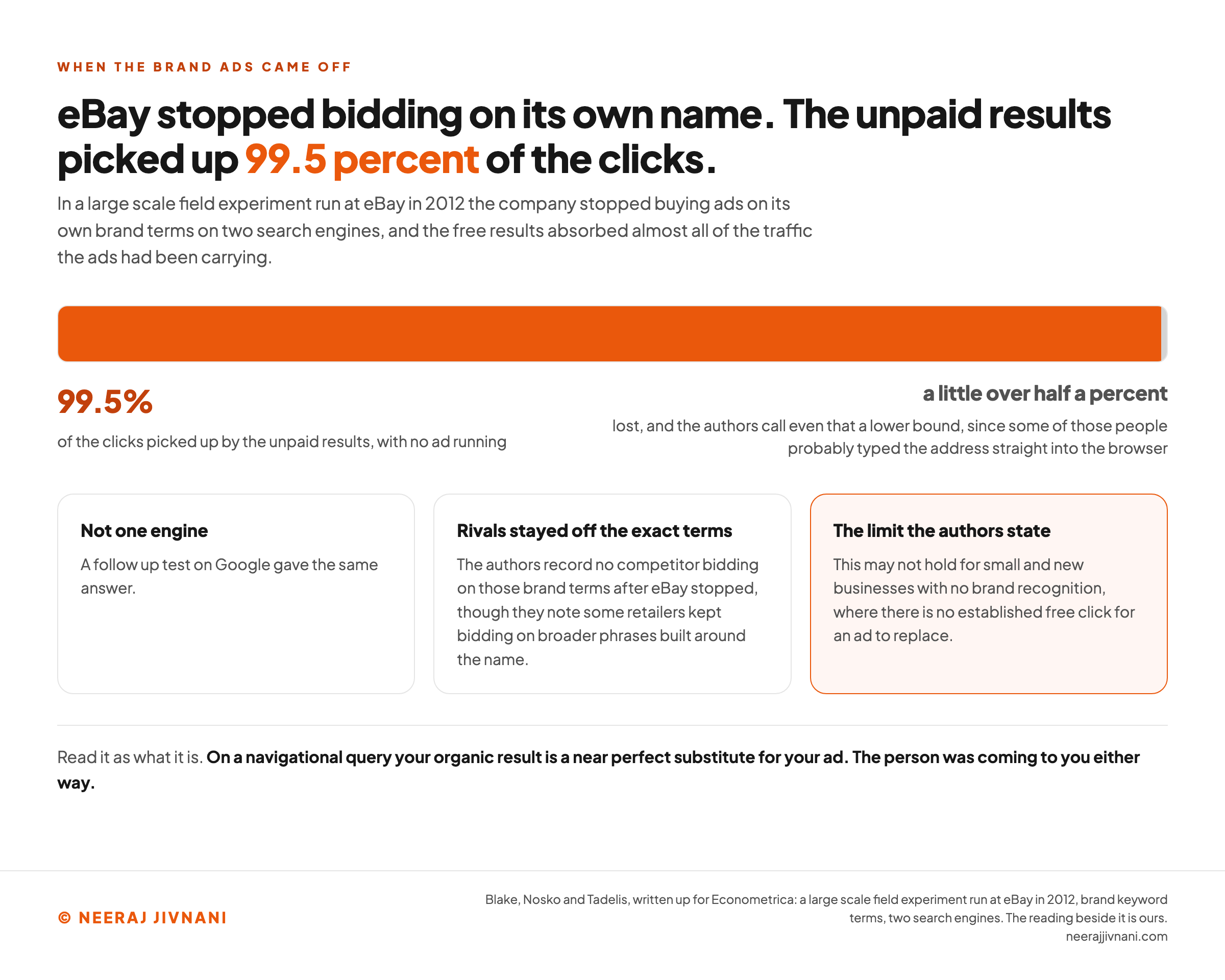
Somebody measured it. In a large scale field experiment run at eBay in 2012, written up by Blake, Nosko and Tadelis for Econometrica, the company stopped buying ads on its own brand terms on two search engines and watched what the unpaid results picked up.
They picked up 99.5 percent of the clicks.
A little over half a percent were lost, and the authors call even that a lower bound, since some of those people probably typed the address straight into the browser. A follow up test on Google gave the same answer.
Read that as what it is. On a navigational query your organic result is a near perfect substitute for your ad, because the person was coming to you either way.
The work is done by the intent, not by any feature of the page, which is why a result measured on a 2012 results page has outlived the page it was measured on.
So What Does the Bid Buy
One thing: the space above your result, and specifically the absence of somebody else's ad in it.
That is a real purchase and sometimes an urgent one. It is also conditional, and the condition takes two minutes to check.
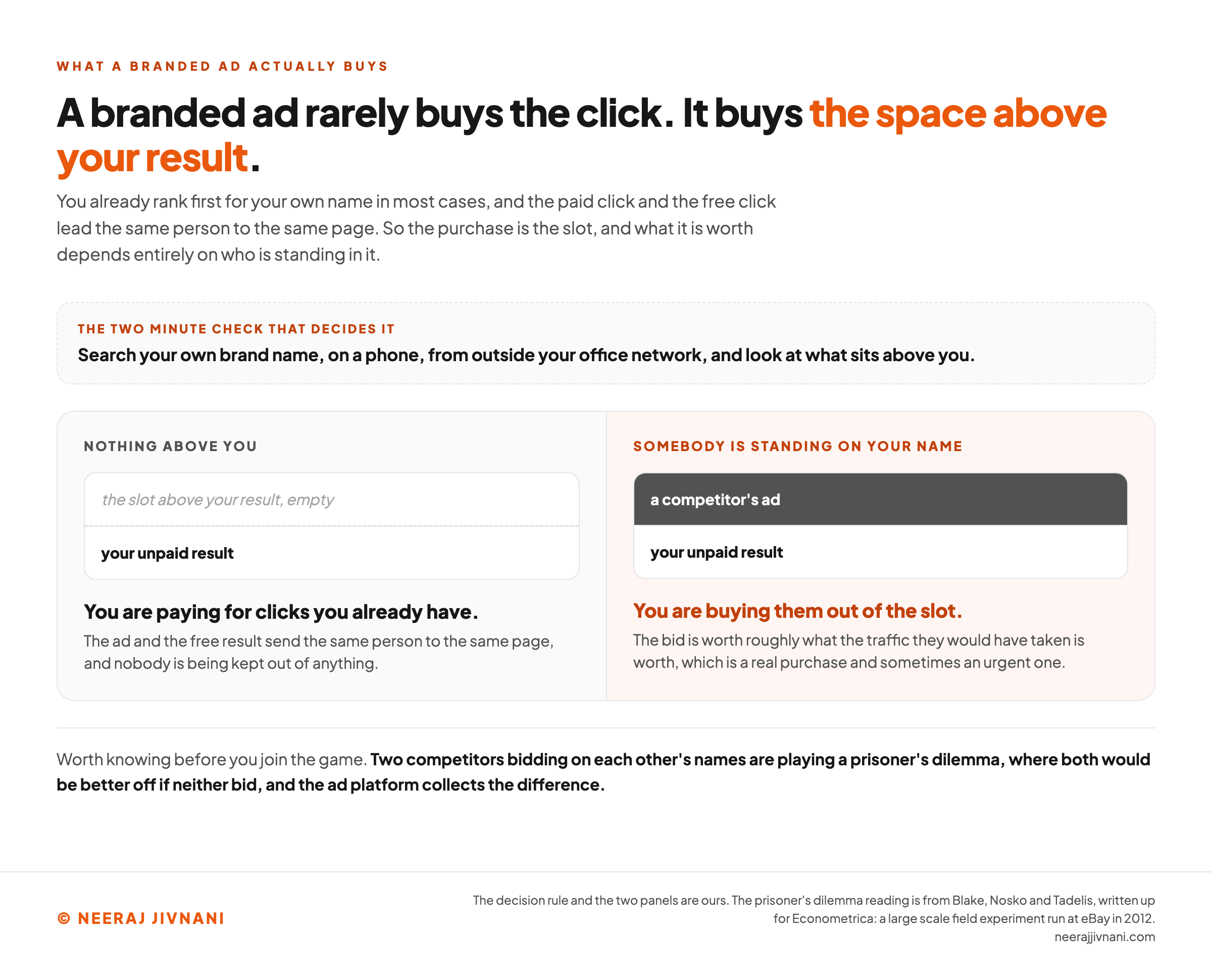
Search your own brand name, on a phone, from outside your office network, and look at what sits above you.
The same paper puts the strategic shape of this plainly. Two competitors bidding on each other's names are playing a prisoner's dilemma, where both would be better off if neither bid, and the ad platform collects the difference.
Worth knowing before you join that game. After eBay stopped bidding on its own brand terms, the authors record that competitor bidding on them was not observed, though they note some retailers kept bidding on broader phrases built around the name.
So the decision rule is short. If nobody is bidding on your name, you are paying for clicks you already have.
If somebody is, you are buying them out of a slot, and the bid is worth roughly what the traffic they would have taken is worth.
The experiment's own limit belongs here too, and the authors state it themselves: this may not hold for small and new businesses with no brand recognition. Where almost nobody searches your name, there is no established free click for an ad to replace.
If You Do Bid, Two Settings Matter
Two account settings do most of the work, and both are about keeping the branded spend readable.
Use exact or phrase match on brand terms, never broad. Broad match pulls your ad into searches that merely resemble your name, which is how an ad for a company called Amazon ends up showing to somebody reading about a rainforest.
Then keep branded and non-branded in separate campaigns.
Mixed together, the brand terms flatter every average in the account, and automated bidding chases them because they look cheap and convert well. Separated, you can see what each half costs.
That separation is also what makes the test below readable.
The Test That Settles It for Your Own Account
The argument above rests on an experiment, and a smaller version of the same one is available to you.
Turn the branded campaign off for two weeks. Watch total sales or total leads rather than paid ones, and watch your unpaid clicks on branded queries over the same fortnight.
If the total holds while the paid clicks disappear, the organic result absorbed them and the spend was buying little. If the total drops, you have your answer the expensive way, and you can switch it back on knowing why.
Pick a quiet fortnight with no campaign running, and write down what you expect to see before you start.
Use this chart — embed code and citation
<a href="https://neerajjivnani.com/blog/branded-search/"><img src="https://neerajjivnani.com/infographics/branded-search/the-ads-came-off.png" alt="A single full width bar drawn to scale showing what happened in a large scale field experiment run at eBay in 2012, when the company stopped buying ads on its own brand terms on two search engines. Ninety nine and a half percent of the bar is filled in orange and labeled as the clicks picked up by the unpaid results with no ad running, and the remaining sliver at the right edge is labeled a little over half a percent lost, with the note that the authors call even that a lower bound because some of those people probably typed the address straight into the browser. Three cards underneath record that a follow up test on Google gave the same answer, that no competitor bidding on those brand terms was recorded after eBay stopped though some retailers kept bidding on broader phrases built around the name, and that the authors state the result may not hold for small and new businesses with no brand recognition. A band at the foot reads that on a navigational query your organic result is a near perfect substitute for your ad." width="1200"></a>
<p>Chart: <a href="https://neerajjivnani.com/blog/branded-search/">Neeraj Jivnani</a></p>Neeraj Jivnani, "What Branded Search Is, and How to Read Your Own Number Before You Spend on It", neerajjivnani.com, https://neerajjivnani.com/blog/branded-search/Free to republish with a link back to this page.
Use this chart — embed code and citation
<a href="https://neerajjivnani.com/blog/branded-search/"><img src="https://neerajjivnani.com/infographics/branded-search/what-the-bid-buys.png" alt="A two panel comparison of the same results page in the only two states that matter for a branded bid, under a band giving the check that decides between them: search your own brand name, on a phone, from outside your office network, and look at what sits above you. The left panel, headed nothing above you, shows an empty slot over your unpaid result and returns the verdict that you are paying for clicks you already have, since the ad and the free result send the same person to the same page. The right panel, headed somebody is standing on your name, shows a competitor's ad occupying the slot above your unpaid result and returns the verdict that you are buying them out of the slot, worth roughly what the traffic they would have taken is worth. A band at the foot notes that two competitors bidding on each other's names are playing a prisoner's dilemma in which both would be better off if neither bid." width="1200"></a>
<p>Chart: <a href="https://neerajjivnani.com/blog/branded-search/">Neeraj Jivnani</a></p>Neeraj Jivnani, "What Branded Search Is, and How to Read Your Own Number Before You Spend on It", neerajjivnani.com, https://neerajjivnani.com/blog/branded-search/Free to republish with a link back to this page.
The Work That Moves the Number
The number moves when more people know your name, which puts nearly all of the work outside search. Podcasts, press, conference talks, a product people mention to each other, a newsletter somebody forwards.
That answer is real and uncomfortable, because it does not fit on a checklist. It is also why branded search is better treated as a scoreboard for everything else than as a project of its own.
One part of it is genuinely search work, and there is evidence for that part.
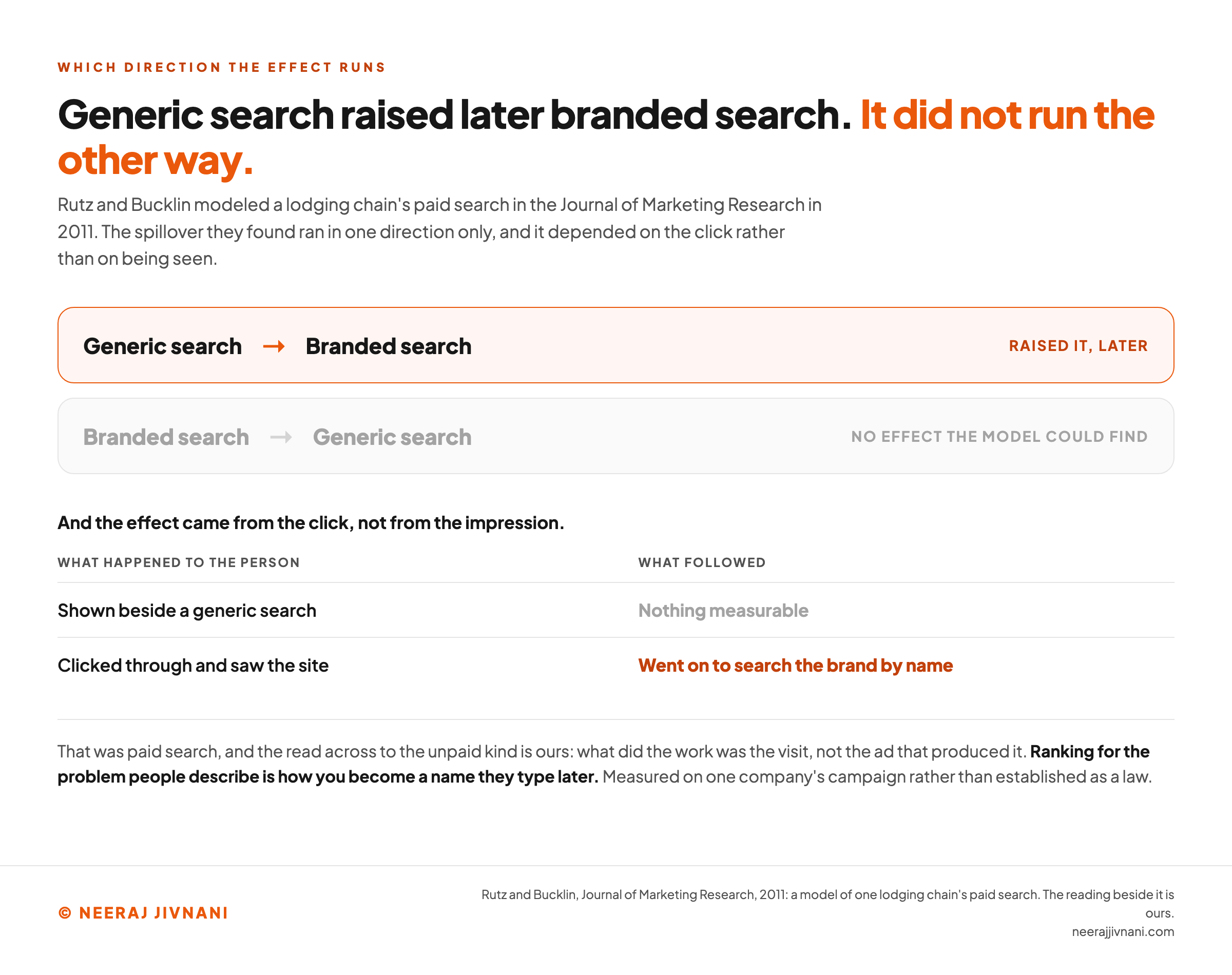
Rutz and Bucklin, in the Journal of Marketing Research in 2011, modeled a lodging chain's paid search and found that generic search activity raised later branded search, while branded search did not raise generic. The effect ran one way.
It also depended on the click rather than the impression. Being shown beside a generic search did nothing measurable; people who clicked through and saw the site went on to search the brand by name.
That was paid search, and the read across to the unpaid kind is ours: what did the work was the visit, not the ad that produced it. Ranking for the problem people describe is how you become a name they type later.
It was measured on one company's campaign rather than established as a law.
Owning the Page They Land On
There is a second job, much smaller and nearly all one-time. When somebody searches your name, that results page is your reception desk.
Your homepage should rank first, your knowledge panel should be claimed and correct, and the profiles ranking underneath you should be ones you run.
Then read the queries themselves for complaints.
Branded searching includes people who could not find something on your site. "brand login" sitting in your top queries is a navigation problem rather than a content opportunity.
When There Is Almost Nothing to Measure
A branded volume close to zero is information, not a failure. Nobody can remember a name they have not met.
Two things are worth doing anyway. Start the measurement now, so a baseline exists when the number begins to move.
Then walk the alphabet after a competitor your size, because the suggestions show you the shape your own branded queries will take.
Bidding on your own name at this stage is usually the wrong purchase, because there is no organic stream to defend and no competitor motivated to attack one.
Use this chart — embed code and citation
<a href="https://neerajjivnani.com/blog/branded-search/"><img src="https://neerajjivnani.com/infographics/branded-search/which-way-it-runs.png" alt="Two stacked direction rows showing which way the spillover ran in Rutz and Bucklin's 2011 model of a lodging chain's paid search. The upper row, highlighted in orange, runs an arrow from generic search to branded search and is annotated raised it, later. The lower row, dimmed, runs the arrow from branded search back to generic search and is annotated no effect the model could find. A two row table underneath separates what happened to the person from what followed: being shown beside a generic search produced nothing measurable, while clicking through and seeing the site was followed by searching the brand by name. A band at the foot says the study was paid search and that the read across to the unpaid kind is ours, because what did the work was the visit rather than the ad that produced it, so ranking for the problem people describe is how you become a name they type later, measured on one company's campaign rather than established as a law." width="1200"></a>
<p>Chart: <a href="https://neerajjivnani.com/blog/branded-search/">Neeraj Jivnani</a></p>Neeraj Jivnani, "What Branded Search Is, and How to Read Your Own Number Before You Spend on It", neerajjivnani.com, https://neerajjivnani.com/blog/branded-search/Free to republish with a link back to this page.
Short Answers to Four Common Questions
Four questions attach themselves to this subject, and the short answers below are the ones worth carrying.
What is branded versus non-branded search? A branded query contains your name, a product name or something only you own. A non-branded query describes the need without naming anybody. The first counts people who already know you; the second is where you meet the ones who do not.
What is pay-per-click (PPC) versus search engine optimization (SEO), on your own name? SEO earns the unpaid result, which on a branded query you almost certainly hold already. PPC rents the slot above it, charged per click. On brand terms specifically, the rented slot and the earned result usually lead the same person to the same page, which is why the decision hangs on whether a competitor is occupying the slot.
What are the 5 levels of brand recognition? Awareness is graded by how hard it is to get your name out of somebody: whether they know it when shown it, whether they can supply it themselves, and whether they supply it before anybody else's. However finely a framework slices those grades, a branded search sits in the same place. The box was empty, nobody offered a list, and your name came out anyway.
What is the 3-7-27 rule in branding? It is a maxim holding that people need three exposures to recognize a brand, seven to remember it and twenty-seven to be sure of it. Treat it as a shape rather than a measurement. Nothing in your search data says where anybody sits on that count, so it cannot change what you do with a branded number.
Read It Often, Spend on It Rarely
Branded search is one of the few honest numbers available to a small business. Nobody can be persuaded to type your name, so a rising line means something real happened out in the world.
Read it monthly, against the same list of terms and the same period last year, with both halves taken from filtered views so the arithmetic holds.
And spend on it only when you have looked and found somebody standing on your name. The rest of the time that budget belongs to the searches where people do not know you yet.