SEO vs SEM, and Which One to Pick If You Can Only Run One
Ads are a purchase and rankings are an application. See what each costs you, how long each takes to pay, and which half of SEM somebody means.

/ On this page8 sections
SEO vs SEM is less a choice between two channels than a choice between buying something and applying for it.
Search engine optimization (SEO) covers the results nobody paid for. Search engine marketing (SEM) covers the ones somebody did, and for some people it covers both.
Ads are a purchase: you pay and the position appears. Rankings are an application, and that difference decides what each one costs you, how long each takes to pay, and which to start with.
SEO vs SEM, the Difference Everything Else Comes From
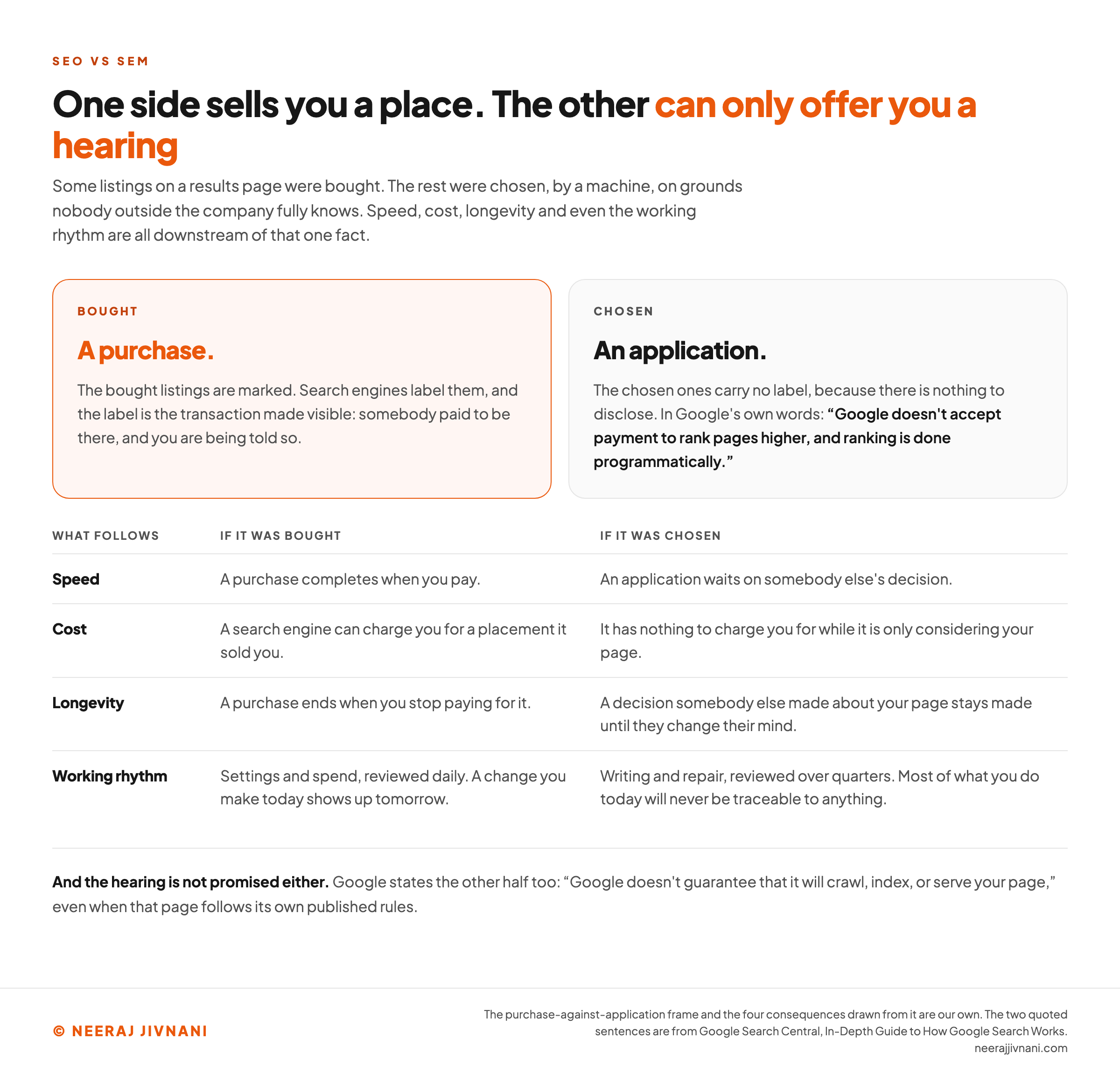
The difference is that one kind of listing on a results page was bought, and the rest were chosen by a machine, on grounds nobody outside the company fully knows.
The bought ones are marked. Search engines label them, and the label is the transaction made visible: somebody paid to be there, and you are being told so.
The chosen ones carry no label, because there is nothing to disclose.
Google states the rule about itself plainly: "Google doesn't accept payment to rank pages higher, and ranking is done programmatically."
It states the other half too, and that half is what you have to plan around. "Google doesn't guarantee that it will crawl, index, or serve your page," even when that page follows its own published rules.
So one side sells you a place. The other can only offer you a hearing, and it does not promise to hold one.
Speed, Cost and Longevity Are All Downstream
Speed is the difference everyone leads with, and it is a consequence rather than a cause.
A purchase completes when you pay. An application waits on somebody else's decision.
Cost works the same way. A search engine can charge you for a placement it sold you, and it has nothing to charge you for while it is only considering your page.
Longevity too. A purchase ends when you stop paying for it.
A decision somebody else made about your page, by contrast, stays made until they change their mind, which is both the appeal and the risk.
Even the working rhythm splits along that line. One discipline is settings and spend, reviewed daily, where a change you make today shows up tomorrow.
The other is writing and repair, reviewed over quarters, where most of what you do today will never be traceable to anything.
Use this chart — embed code and citation
<a href="https://neerajjivnani.com/blog/seo-vs-sem/"><img src="https://neerajjivnani.com/infographics/seo-vs-sem/bought-or-applied-for.png" alt="Diagram headed that one side sells you a place while the other can only offer you a hearing. Two cards sit at the top: a bought listing, labeled a purchase, which search engines mark so the transaction is visible; and a chosen listing, labeled an application, which carries no label because there is nothing to disclose, quoting Google that it does not accept payment to rank pages higher and that ranking is done programmatically. Below them a four-row table sets the two sides against each other on speed, cost, longevity and working rhythm: a purchase completes when you pay while an application waits on somebody else's decision; a search engine can charge you for a placement it sold you but has nothing to charge you for while it is only considering your page; a purchase ends when you stop paying while a decision made about your page stays made until they change their mind; and settings and spend are reviewed daily while writing and repair are reviewed over quarters. A band across the foot adds that the hearing is not promised either, quoting Google that it does not guarantee it will crawl, index or serve your page." width="1200"></a>
<p>Chart: <a href="https://neerajjivnani.com/blog/seo-vs-sem/">Neeraj Jivnani</a></p>Neeraj Jivnani, "SEO vs SEM, and Which One to Pick If You Can Only Run One", neerajjivnani.com, https://neerajjivnani.com/blog/seo-vs-sem/Free to republish with a link back to this page.
What SEM Means, and Why Two People Can Both Be Right
The term has two live definitions and you will meet both this week.
In the first, SEM is the whole of search marketing: the ads and the unpaid rankings together, with SEO sitting inside it as one of two parts.
In the second, SEM is the paid part only, and it sits beside SEO rather than around it.
Both readings are in current use among people who know the field, which is why you cannot settle it by looking the word up.
Neither camp is being sloppy. They inherited different vocabularies.
Pay-per-click, or PPC, is the term that should have solved this and did not. It names a billing model rather than a channel.
It describes how you are charged, which is per click, and says nothing about where the ad ran. Google Ads and Microsoft Advertising both bill that way, and so do platforms that have nothing to do with search.
So "we run PPC" and "we run SEM" are not synonyms, though they are used as though they were. One is a payment arrangement; the other is a discipline, or two, depending on who is talking.
What to Do When Somebody Says It
Nothing, most of the time.
The ambiguity is harmless in ordinary conversation, and correcting it makes you the person who corrects acronyms.
One exception is worth being strict about. When the word appears in a sentence that assigns a budget, a headcount or a deliverable, ask which part is meant before agreeing to anything.
"We are putting the SEM budget up" describes two entirely different projects. One of them lives inside Google Ads and the other lives in your own pages, and you find out which only after the money has moved.
Which half they meant
Somebody said SEM at you. Say what the sentence was doing, and it comes back twice, once under each reading of the word. Neither reading is marked correct, because neither one is wrong.
What was the sentence doing?
Pick one above. The ambiguity only costs something in sentences that assign a budget, a headcount or a deliverable, and the point of this is to show you which kind you just heard.
Both readings are in current use among people who know the field, so you cannot settle it by looking the word up. And pay per click is not a third option in this list: it names how you are charged, not where the ad ran.
What the Daily Work Is on Each Side
The two disciplines share a vocabulary and almost no daily work, which is why the same person rarely does both well.
Paid search is account work. You choose search terms to bid on, set what you will pay, write the ad, and point it at a page.
Then you spend most of your time inside Google Ads reading what people typed, and excluding the terms you do not want to appear against.
Search work is site work. You decide what your pages should answer, write them so a machine and a person can both follow them, and make sure they can be reached and read at all.
Then you try to become the sort of site other people mention, which is the part nobody can hand you.
The three familiar buckets, on-page, off-page and technical, sort that work neatly without making any of it easier.
The Same Word, Two Different Jobs
Keyword research exists on both sides and means different things.
On the paid side you are pricing a term. The question is what a click costs, whether that cost survives your margin, and which variations you are willing to be shown against.
On the unpaid side you are picking a fight. The question is whether you could plausibly outrank what is already there, which has nothing to do with price and everything to do with who holds the position now.
A term can be excellent on one side and hopeless on the other, in either direction. Cheap clicks on a phrase whose results are held by three enormous sites are common, and so is the reverse.
What Only the Bought Side Can Do
Two things are exclusive to ads, and neither of them is speed.
- Targeting. You can decide who sees an ad by place, device and time of day, and decline to show it to everybody else. An unpaid result gives you no say in who is eligible to see it.
- The auction. Position is decided per search, against whoever turned up for that search, and settled again the next time somebody types the same words.
That is a real capability and it is also the bill. You are renting attention by the event, and the rent falls due every time.
What Each One Costs, and What the Bill Is For
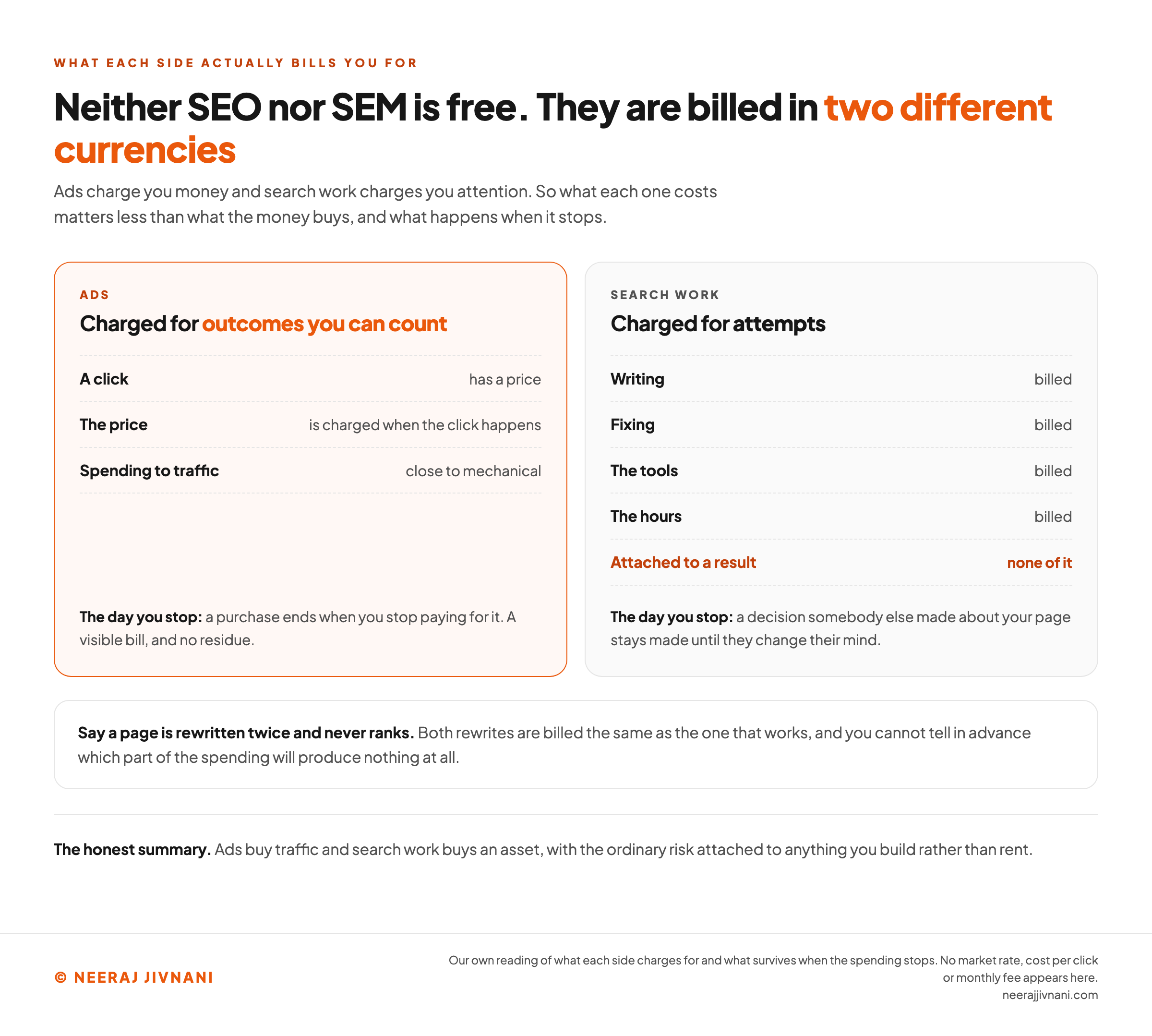
Ads charge you money and search work charges you attention, so what each one costs matters less than what the money buys and what happens when it stops.
Ads charge you for outcomes you can count. A click has a price, the price is charged when the click happens, and the link between the spending and the traffic is close to mechanical.
Search work charges you for attempts. You pay for writing, for fixing, for the tools and for the hours, and none of that spending is attached to a result.
Some of it will produce nothing at all, and you cannot tell which part in advance. Say a page is rewritten twice and never ranks: both rewrites are billed the same as the one that works.
That is why calling either one free is misleading. The unpaid side has no click price and a real bill; the paid side has a visible bill and no residue.
The honest summary is that ads buy traffic and search work buys an asset, with the ordinary risk attached to anything you build rather than rent.
What a Market Average Cannot Tell You
Cost per click and monthly fees vary so widely by industry, country and competition that a market average tells you nothing about your own case while sounding as though it does.
What is worth doing instead takes five minutes. Work out what one customer is worth to you, multiply it by the share of visitors who become customers, and you have the most a click can be worth before the arithmetic stops working.
Say a workshop knows both of those numbers. It now has the only figure in this comparison that describes its own situation.
Use this chart — embed code and citation
<a href="https://neerajjivnani.com/blog/seo-vs-sem/"><img src="https://neerajjivnani.com/infographics/seo-vs-sem/two-bills-two-currencies.png" alt="Figure headed that neither SEO nor SEM is free and that they are billed in two different currencies. Two bills sit side by side. The ads bill is charged for outcomes you can count and lists three lines: a click has a price, the price is charged when the click happens, and the link from spending to traffic is close to mechanical; it closes by saying that a purchase ends when you stop paying for it, a visible bill and no residue. The search work bill is charged for attempts and lists writing, fixing, the tools and the hours as all billed, then a highlighted line reading that none of it is attached to a result; it closes by saying that a decision somebody else made about your page stays made until they change their mind. A panel underneath gives a worked example: say a page is rewritten twice and never ranks, both rewrites are billed the same as the one that works, and you cannot tell in advance which part of the spending will produce nothing. A band across the foot reads that ads buy traffic and search work buys an asset, with the ordinary risk attached to anything you build rather than rent." width="1200"></a>
<p>Chart: <a href="https://neerajjivnani.com/blog/seo-vs-sem/">Neeraj Jivnani</a></p>Neeraj Jivnani, "SEO vs SEM, and Which One to Pick If You Can Only Run One", neerajjivnani.com, https://neerajjivnani.com/blog/seo-vs-sem/Free to republish with a link back to this page.
How Long Each One Takes to Pay
Ads produce traffic on the first day, and turning that traffic into profit takes considerably longer.
The gap between those two is where most first budgets are lost, because the traffic arrives immediately and looks like progress.
What you are buying in the early weeks is information rather than income. Which terms convert, which pages hold up, what a customer costs.
That is worth paying for, and it should be planned for as tuition.
Search work produces nothing for a while and then, sometimes, produces something that keeps producing. The wait is not a schedule.
It depends on the site, the subject, the competition and a decision you are not party to. Say a page goes live today: nothing about today tells you when, or whether, it will be chosen.
Anyone who hands you a firm number for this has measured somebody else's site. Published timelines on the question disagree with one another by more than a year, which is reason enough not to plan against any one of them.
The practical version is short. Do not judge an ad account before it has enough conversions to tell you anything, and do not judge a page before its subject has had time to move.
Which One to Start With, If You Can Only Run One
Start with the one you can sustain, not the one you can afford.
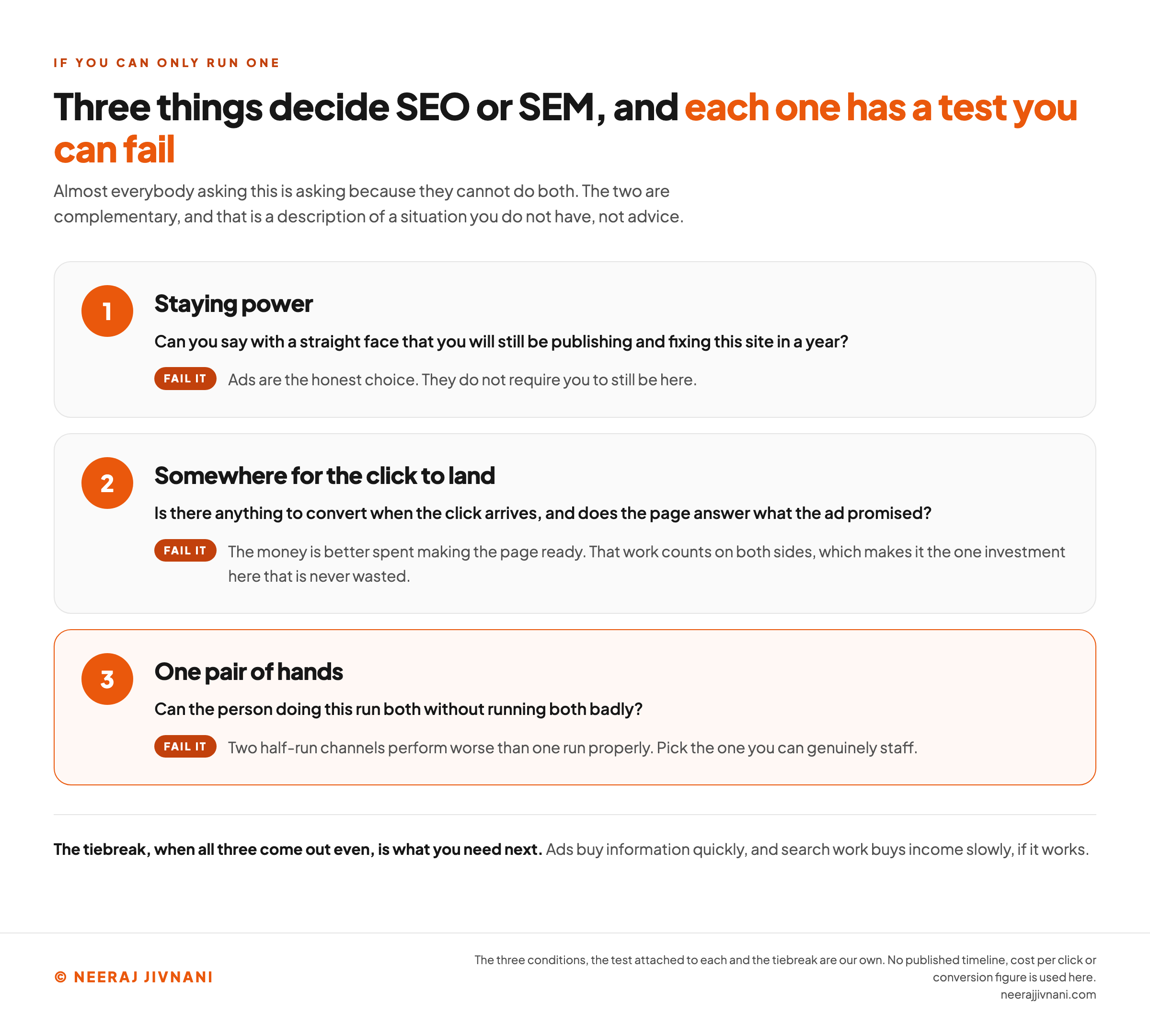
Almost everybody asking this is asking because they cannot do both. That is worth saying out loud, because the usual answer is that the two belong together and should be run as a pair.
That is a description of a situation you do not have, not advice.
Three things decide it, and none of them is the budget.
Staying Power
Search work is a bet on your own continuity. It pays back over a period long enough that the business, the site and your attention all have to survive it.
That is not a small assumption. A new business is still deciding whether it exists, and a page that starts working in eighteen months is no use to a company that will have changed direction twice by then.
If you cannot say with a straight face that you will still be publishing and fixing this site in a year, ads are the honest choice. They do not require you to still be here.
Somewhere for the Click to Land
Paid traffic is the fastest way to discover that a page does not convert, and the most expensive.
An ad account cannot repair a page that fails to answer what the ad promised. It will keep buying visits for as long as you fund it, and the report will show the clicks going up.
So if the page is not ready, the money is better spent making it ready. That work counts on both sides, which makes it the one investment here that is never wasted.
One Pair of Hands
Capacity is the constraint people notice last.
Both disciplines reward sustained attention. Neither degrades gracefully without it.
A neglected ad account spends money on the wrong searches. A neglected site quietly stops being worth picking.
If one person is going to do both, they will usually do both badly, and two half-run channels perform worse than one run properly. Pick the one you can genuinely staff.
The tiebreak, when all three come out even, is what you need next: information or income. Ads buy information quickly, and search work buys income slowly, if it works.
Use this chart — embed code and citation
<a href="https://neerajjivnani.com/blog/seo-vs-sem/"><img src="https://neerajjivnani.com/infographics/seo-vs-sem/three-tests-you-can-fail.png" alt="Figure headed that three things decide SEO or SEM and that each one has a test you can fail, opening with the note that almost everybody asking this is asking because they cannot do both. Three numbered panels follow. Staying power asks whether you can say with a straight face that you will still be publishing and fixing this site in a year, and says that failing it makes ads the honest choice because they do not require you to still be here. Somewhere for the click to land asks whether there is anything to convert when the click arrives and whether the page answers what the ad promised, and says that failing it means the money is better spent making the page ready, work that counts on both sides. One pair of hands, highlighted in orange, asks whether the person doing this can run both without running both badly, and says that failing it means two half run channels perform worse than one run properly. A band across the foot gives the tiebreak when all three come out even: ads buy information quickly and search work buys income slowly, if it works." width="1200"></a>
<p>Chart: <a href="https://neerajjivnani.com/blog/seo-vs-sem/">Neeraj Jivnani</a></p>Neeraj Jivnani, "SEO vs SEM, and Which One to Pick If You Can Only Run One", neerajjivnani.com, https://neerajjivnani.com/blog/seo-vs-sem/Free to republish with a link back to this page.
When Running Both Is a Real Option
There is a version of running both that is not a compromise, and it has one precondition. Somebody has to own each side.
When that is true, the two feed each other in ways worth having. What converts in Google Ads tells you what to write about, with real money behind the evidence rather than a guess.
The reverse holds as well. A page that earned its position makes a better landing page for an ad, because the qualities that got it chosen are the qualities that keep a visitor there.
The sequencing that usually works is to buy a narrow set of terms you are confident about while the slower work builds underneath, then stop buying a term once you hold the unpaid position for it.
What does not work is splitting a small budget in half to avoid making a decision.
That produces an ad account too small to learn from and a publishing effort too thin to be chosen, and it is the most common way this ends badly.
The Questions People Ask About SEO and SEM
Four things get asked about this comparison more than anything else. The answers are short and do not depend on each other.
What is the main difference between SEO and SEM? You can buy one of them and you can only qualify for the other. A search ad is a transaction that completes when you pay. A ranking is a judgment made about your page by a party that owes you nothing and may revise it without telling you.
Is Google Ads SEO or SEM? Google Ads is a platform for buying search ads, so it is SEM under either definition of the word. It is never SEO, which covers only the results nobody paid for.
Is SEO dead now with AI? No, and this comparison is unchanged by it. Answers generated above the results still draw on pages that were chosen rather than bought, and ads still appear because somebody paid. Whatever else those answers change about search, they do not turn either one into the other.
Which is best, SEO or SEM? Neither. Ads are better when you need to learn something quickly or cannot wait; search work is better when you can wait and intend to still be here. If you can only run one, decide it on staying power, on whether the page is ready, and on who is going to do the work.