SEO Is Not Dead, but Half of It Died, and You Can Tell Whether Your Pages Did
One kind of page has stopped earning its click, and the rest have not. See which side your own pages are on, and the check that settles it.

/ On this page8 sections
One kind of page has stopped earning its click. The rest have not.
The line between them does not run along how well a page was optimized. It runs along what the page was for.
Which side your own pages are on takes an afternoon to establish, and it is a more useful question than the one you typed.
What People Mean When They Say It
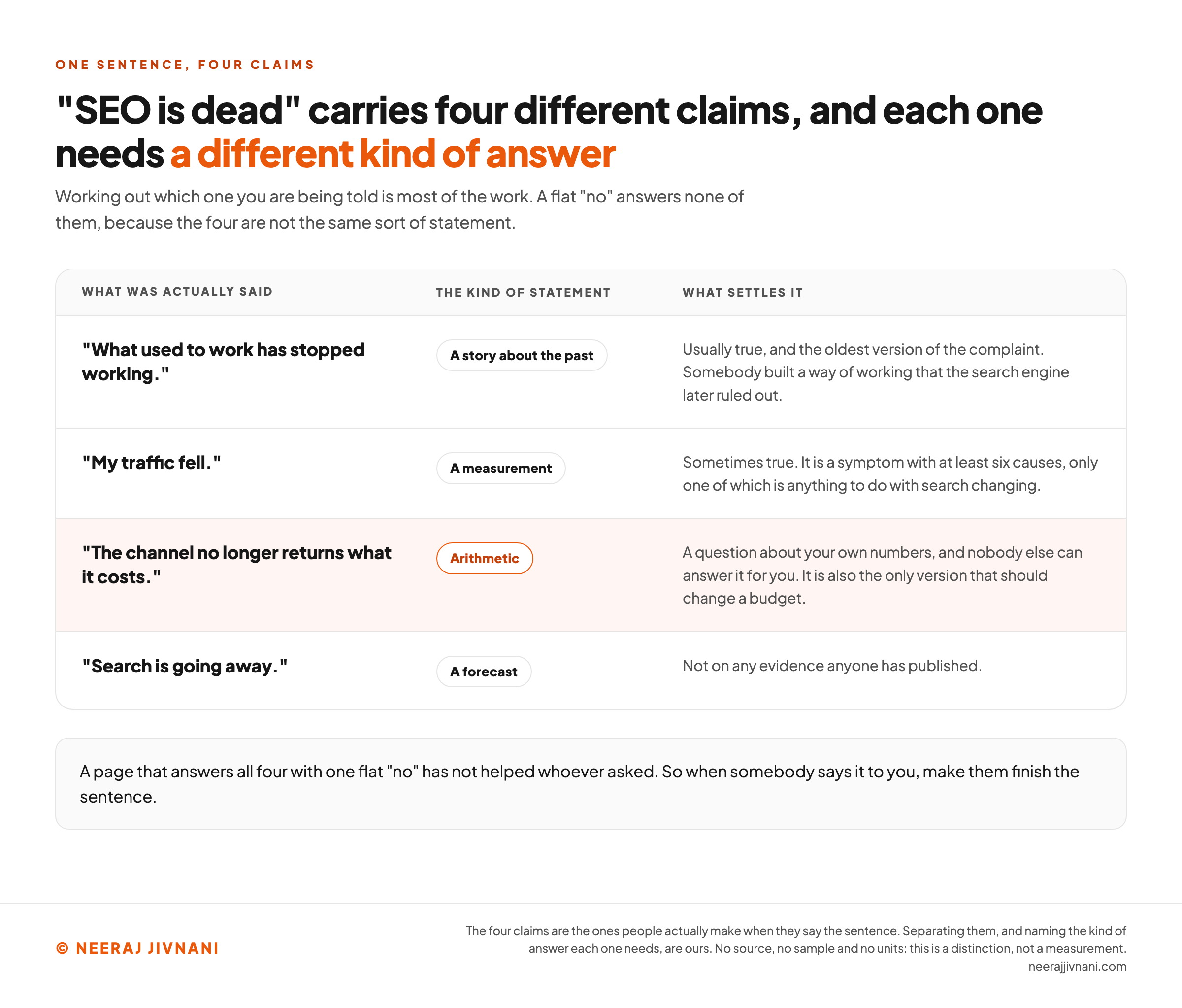
People use this one sentence for four different claims, and the four have four different answers. Working out which one you are being told is most of the work.
SEO covers a wide enough spread of work that a verdict on the whole of it settles nothing.
"What used to work has stopped working." Usually true, and the oldest version of the complaint. Somebody built a way of working that the search engine later ruled out.
"My traffic fell." Sometimes true. It is also a symptom with at least six causes, only one of which is anything to do with search changing.
"The channel no longer returns what it costs." This is a question about your own numbers, and nobody else can answer it for you. It is also the only version that should change a budget.
"Search is going away." Not on any evidence anyone has published.
Notice how different those are. The first is a story about the past, the second is a measurement, the third is arithmetic, and the fourth is a forecast.
A page that answers all four with one flat "no" has not helped whoever asked.
So when a colleague or a consultant says it to you, make them finish the sentence. If they have not separated the four either, the question does the separating for both of you.
Use this chart — embed code and citation
<a href="https://neerajjivnani.com/blog/is-seo-dead/"><img src="https://neerajjivnani.com/infographics/is-seo-dead/four-claims-one-sentence.png" alt="A three column table setting the four claims people make when they say SEO is dead against the kind of statement each one is and what settles it. What used to work has stopped working is a story about the past, and is usually true, the oldest version of the complaint, where somebody built a way of working that the search engine later ruled out. My traffic fell is a measurement, and is sometimes true, a symptom with at least six causes, only one of which is anything to do with search changing. The channel no longer returns what it costs, on the highlighted row, is arithmetic, and is a question about your own numbers that nobody else can answer for you, and the only version that should change a budget. Search is going away is a forecast, and is not supported on any evidence anyone has published. A line beneath says a page that answers all four with one flat no has not helped whoever asked, so when somebody says it to you, make them finish the sentence." width="1200"></a>
<p>Chart: <a href="https://neerajjivnani.com/blog/is-seo-dead/">Neeraj Jivnani</a></p>Neeraj Jivnani, "SEO Is Not Dead, but Half of It Died, and You Can Tell Whether Your Pages Did", neerajjivnani.com, https://neerajjivnani.com/blog/is-seo-dead/Free to republish with a link back to this page.
What Stopped Working
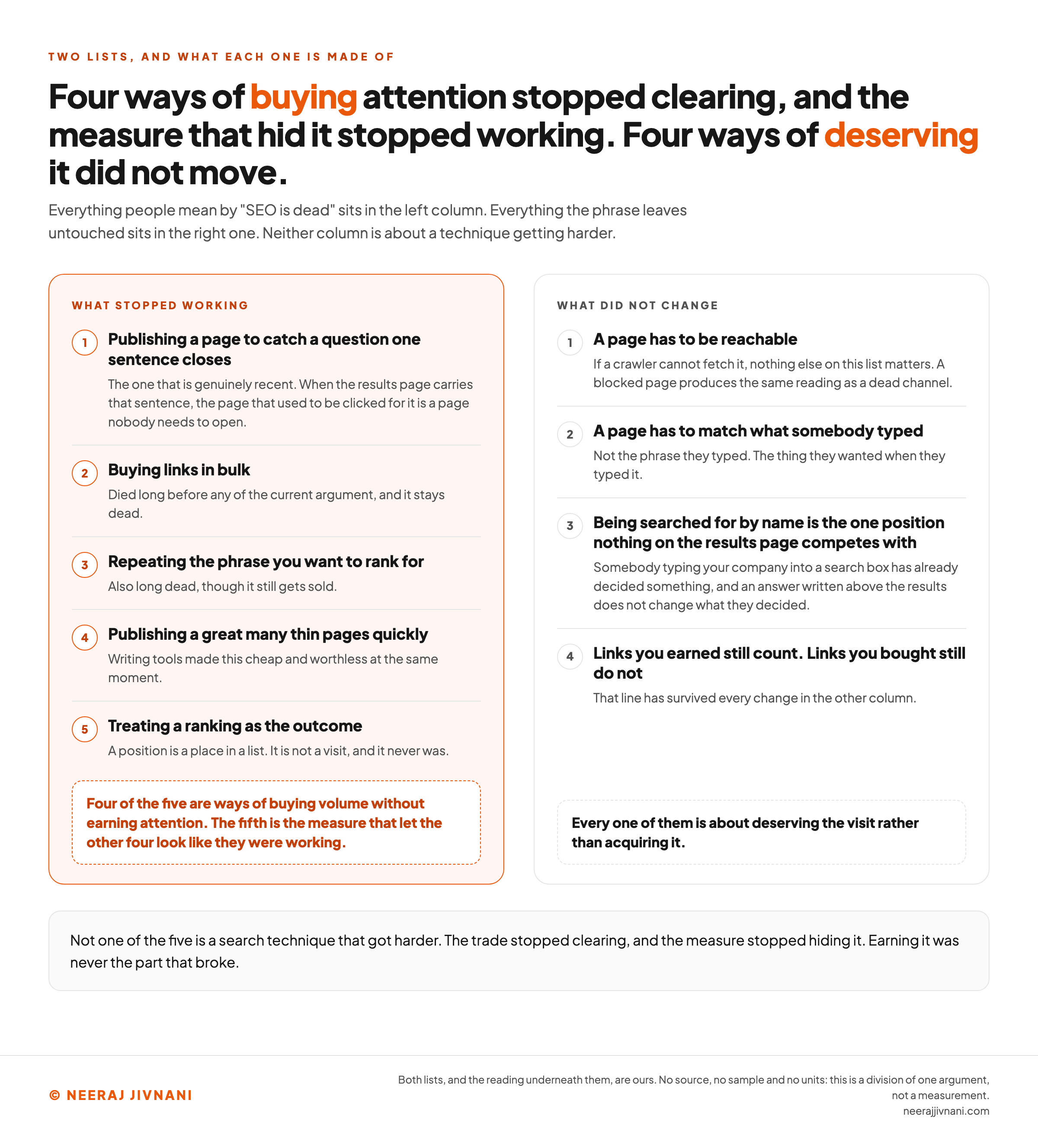
Five things stopped working, and they are worth naming precisely rather than gesturing at an era.
Publishing a page to catch a question one sentence closes. This is the one that is genuinely recent. When the results page carries that sentence, the page that used to be clicked for it is a page nobody needs to open.
Buying links in bulk. This died long before any of the current argument, and it stays dead.
Repeating the phrase you want to rank for. Also long dead, though it still gets sold.
Publishing a great many thin pages quickly. Writing tools made this cheap and worthless at the same moment, which is a bad combination for anybody who built a business on it.
Treating a ranking as the outcome. A position is a place in a list. It is not a visit, and it never was.
Four of the five are ways of buying volume without earning attention. The fifth is the measure that let the other four look like they were working.
Not one of them is a search technique that got harder. The trade stopped clearing, and the measure stopped hiding it.
That is why the people who say SEO is dead say it with such feeling. For some of them it is true, about the thing they were doing.
What Did Not Change
Four things did not move, and between them they still decide almost everything.
A page has to be reachable. If a crawler cannot fetch it, nothing else on this list matters.
This one belongs in an argument about whether search is dying for a reason that is not obvious. A blocked page produces the same reading as a dead channel: impressions gone, clicks gone, no explanation.
So it is the cheapest thing to rule out, and ruling it out costs one look in Search Console.
A page has to match what somebody typed. Not the phrase they typed. The thing they wanted when they typed it.
A page that carries the words and answers a different question loses to a page that carries fewer of them and answers the right one.
That was true long before any of this, and it is more true now, because the systems reading your page are better at telling the difference.
The Two Nobody Can Take Off You
Being searched for by name is the one position nothing on the results page competes with.
Somebody typing your company into a search box has already decided something, and an answer written above the results does not change what they decided. This is the half of search that the whole argument leaves untouched, and it is the half most worth building.
Links you earned still count. Links you bought still do not.
That line has survived every change in this list, which is a reasonable definition of a fundamental.
Notice that the four have something in common. Every one of them is about deserving the visit rather than acquiring it.
Set that against the list above, where four of the five were ways of buying attention. Earning it was never the part that broke.
Expect to be sold a new name for those four. Generative Engine Optimization and Answer Engine Optimization are the two you will hear most, and a renamed list is still the same list.
Use this chart — embed code and citation
<a href="https://neerajjivnani.com/blog/is-seo-dead/"><img src="https://neerajjivnani.com/infographics/is-seo-dead/buying-and-deserving.png" alt="Two columns setting five things that stopped working against four things that did not change. The highlighted left column lists publishing a page to catch a question one sentence closes, buying links in bulk, repeating the phrase you want to rank for, publishing a great many thin pages quickly, and treating a ranking as the outcome, each with a one line note, under a reading that says four of the five are ways of buying volume without earning attention and the fifth is the measure that let the other four look like they were working. The right column lists a page has to be reachable, a page has to match what somebody typed, being searched for by name is the one position nothing on the results page competes with, and links you earned still count while links you bought still do not, under a reading that says every one of them is about deserving the visit rather than acquiring it. A line beneath says not one of the five is a search technique that got harder, that the trade stopped clearing and the measure stopped hiding it, and that earning it was never the part that broke." width="1200"></a>
<p>Chart: <a href="https://neerajjivnani.com/blog/is-seo-dead/">Neeraj Jivnani</a></p>Neeraj Jivnani, "SEO Is Not Dead, but Half of It Died, and You Can Tell Whether Your Pages Did", neerajjivnani.com, https://neerajjivnani.com/blog/is-seo-dead/Free to republish with a link back to this page.
The Version of the Claim That Is True
One version of the claim is correct, and it is correct about a nameable set of pages rather than about an industry.
The test is not what kind of page it is. It is whether your page is the answer, or the place the answer leads.
If the reader's need ends the moment they have read your sentence, the results page can supply that sentence and you have lost the visit.
If your sentence is the start of something they have to come to you to finish, nothing has happened to you.
That distinction survives whatever the results page does next, which is why it is worth more than a list of page types. What follows is what the test usually returns, not a list to look yourself up in.
A definition, a conversion, a date, a spelling, a short how-many: those ended on your page and now end on theirs. Answer boxes and AI-written summaries are the mechanism, and a search that ends in one is a zero-click search.
A comparison, a price, a booking, a piece of proof that you can do the work, a way to reach a human: those never ended on the results page and still do not.
Say a firm sells industrial fasteners. Its page explaining what a thread pitch is has lost its visit, and its page listing which pitches it stocks in stainless steel has not.
Same site, same writer, same month. Opposite outcomes, and the quality of the writing decided neither one.
One page at a time
Is your page the answer, or the place the answer leads? Write the sentence somebody comes to one of your pages for, then read it where a results page would put it. It is not asked here what kind of page it is, because the test is not what kind of page it is.
Nothing here is scored and no verdict is offered about your site, because there is not one to give. Which side your own pages are on takes an afternoon to establish, one page at a time.
What to Do With a Page on the Losing Side
Retire it, fold it into something larger, or repurpose it. Do not defend it.
Defending it means spending this quarter making a page slightly better at a job that no longer exists. It is the most expensive item on the list and the easiest to talk yourself into.
The honest version is unglamorous. Some of what used to be traffic was never earned, and the pages that caught it were catching something that belonged to the search engine all along.
Whether Search Itself Is Shrinking
Search is not shrinking, and the clearest evidence for that is not an estimate from anybody in this industry.
Alphabet's own quarterly results, which report in millions, put Google Search and other advertising at $63,271 for the three months ended 30 June 2026, against $54,190 a year before.
The release reports the change as 17% growth.
That revenue figure comes from the company being asked about, reported to its investors, and it is worth reading carefully, because it does not say what people usually want it to say.
It measures advertising, not organic visits. Search revenue can rise while your own unpaid clicks fall, and for a lot of sites both of those are happening at once.
But a market where people had stopped searching would not look like that. Whatever else is true, the searching is not the thing that is receding.
Searching Now Happens in Several Places
The other half of the picture is that the search box is no longer only on one site.
People look for products inside marketplaces, ask assistants directly, and check a forum before they trust a review. All of that is real and none of it is new.
What it changes for you is smaller than it sounds. Being findable in more places is a distribution question, and it does not retire the pages you already have.
Will SEO Exist in Five Years
We do not make forecasts, so here is the honest version: name what would have to become true for the answer to be no.
- People would have to stop looking for things by typing what they want.
- Companies would have to stop wanting to be found by them.
- Whatever answered those people would have to stop drawing on pages that somebody published.
Nothing in the current evidence points at any of the three. What moves is which surface the answer appears on, and that has moved several times already.
Before You Decide It Died, Rule Out Six Other Things
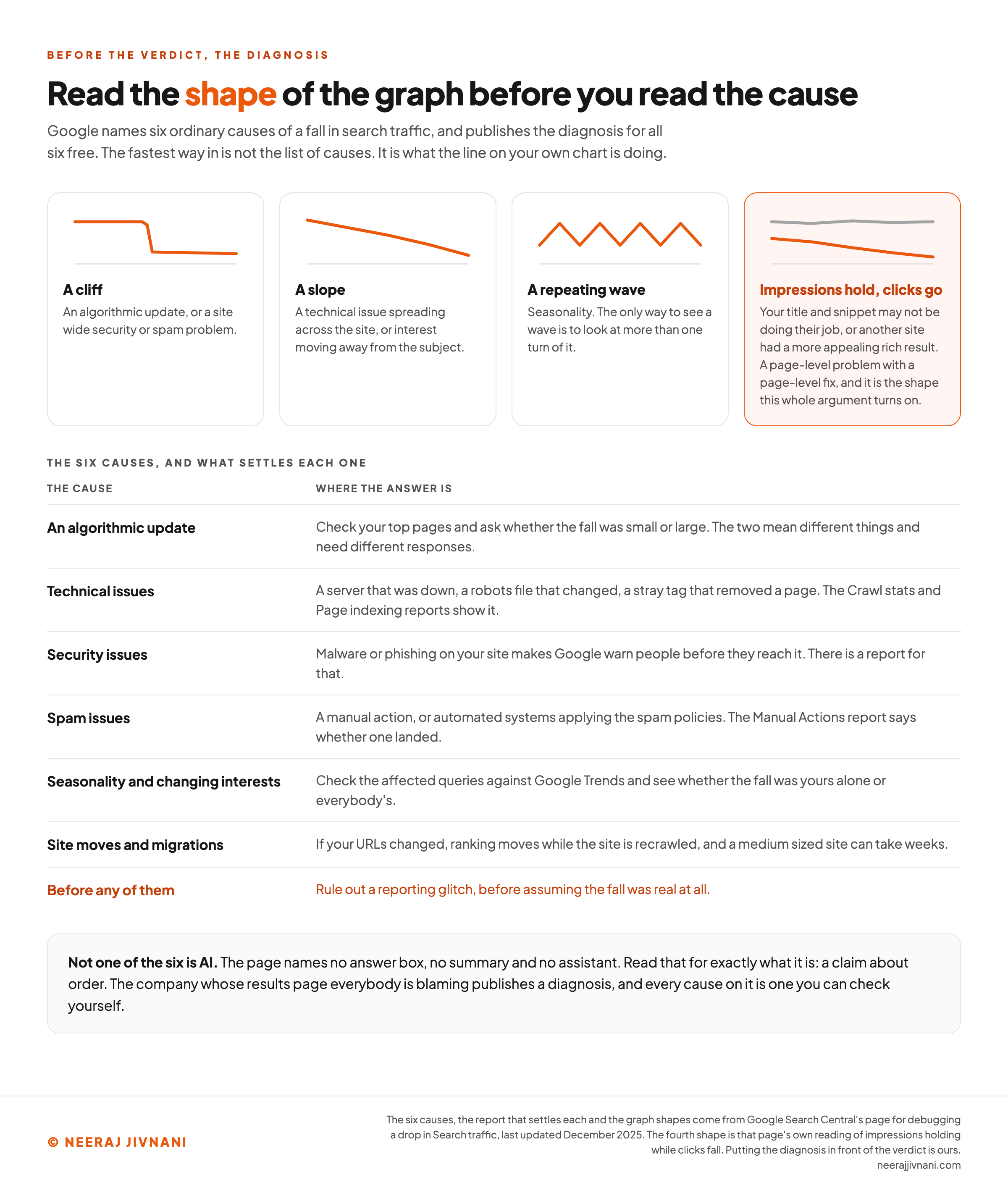
Google names six ordinary causes of a fall in search traffic, and publishes the diagnosis for all six free.
Google's own page for debugging a drop in Search traffic, last updated in December 2025, names them and pairs each with the report that settles it.
Every one of the six is settled by a report you already have access to. None of them turns on a view about where the industry is going.
An algorithmic update. Check your top pages and ask whether the fall was small or large; the two mean different things and need different responses.
Technical issues. A server that was down, a robots file that changed, a stray tag that removed a page. The Crawl stats and Page indexing reports show it.
Security issues. Malware or phishing on your site makes Google warn people before they reach it. There is a report for that.
Spam issues. A manual action, or automated systems applying the spam policies. The Manual Actions report says whether one landed.
Seasonality and changing interests. Demand for a query moves. The instruction is to check the affected queries against Google Trends and see whether the fall was yours alone or everybody's.
Site moves and migrations. If your URLs changed, ranking moves while the site is recrawled, and a medium-sized site can take weeks.
It also tells you to rule out a reporting glitch before assuming the fall was real at all.
Read the Shape Before You Read the Cause
The same page groups those causes by what the graph looks like, which is the fastest way in.
A cliff points at an algorithmic update, or at a site-wide security or spam problem.
A slope points at a technical issue spreading across the site, or at interest moving away from the subject. A repeating wave is seasonality, and the only way to see a wave is to look at more than one turn of it.
Then there is the shape this whole argument turns on, where the impressions hold and the clicks go.
Google's reading of it is that your title and snippet may not be doing their job, or that another site had a more appealing rich result.
That is a page-level problem with a page-level fix, and it looks identical to the thing people describe when they say search is dying.
Both readings can be true on different queries of the same site. Neither is settled by an opinion about the industry.
What That List Does Not Contain
Not one of the six is AI. The page names no answer box, no summary and no assistant.
Read that for exactly what it is, and no further. It is not a claim that answers written on the results page cost nobody anything, and Google publishes a report elsewhere showing how often your pages turn up inside them.
It is a claim about order. The company whose results page everybody is blaming publishes a diagnosis, and every cause on it is one you can check yourself.
That is worth more than any argument about the industry, because it is about your site and it produces an answer.
Use this chart — embed code and citation
<a href="https://neerajjivnani.com/blog/is-seo-dead/"><img src="https://neerajjivnani.com/infographics/is-seo-dead/read-the-shape-first.png" alt="A diagnostic card in two parts. Along the top, four small line charts of what a search traffic graph can look like: a cliff, which points at an algorithmic update or a site wide security or spam problem; a slope, which points at a technical issue spreading across the site or interest moving away from the subject; a repeating wave, which is seasonality and can only be seen by looking at more than one turn of it; and, on the highlighted card, a flat grey impressions line above a falling orange clicks line, which points at a title and snippet that may not be doing their job or another site that had a more appealing rich result, a page-level problem with a page-level fix and the shape this whole argument turns on. Beneath it, a table of the six causes and what settles each: an algorithmic update, checked against your top pages and whether the fall was small or large; technical issues, shown by the Crawl stats and Page indexing reports; security issues, which have a report of their own; spam issues, settled by the Manual Actions report; seasonality and changing interests, checked against Google Trends; and site moves and migrations, where ranking moves while the site is recrawled and a medium sized site can take weeks. A row above them all says to rule out a reporting glitch before assuming the fall was real at all. A line beneath says not one of the six is AI, that the page names no answer box, no summary and no assistant, and that this is a claim about order, the company whose results page everybody is blaming having published a diagnosis on which every cause is one you can check yourself." width="1200"></a>
<p>Chart: <a href="https://neerajjivnani.com/blog/is-seo-dead/">Neeraj Jivnani</a></p>Neeraj Jivnani, "SEO Is Not Dead, but Half of It Died, and You Can Tell Whether Your Pages Did", neerajjivnani.com, https://neerajjivnani.com/blog/is-seo-dead/Free to republish with a link back to this page.
Whether It Is Still Worth the Money
Whether the money still pays is the only version of the question that should move a budget, and it is arithmetic rather than opinion.
Take what the work costs you in a year. Set against it what arrived through unpaid search, valued the way your business already values everything else.
Say the work runs to 12 hours a month of somebody's time. You know what an hour of that person costs, and you can total the year.
If you cannot do that sum, the problem is your measurement, not the channel. It is possible to conclude SEO is dead when what you have discovered is that you never knew what it produced.
Two things make the sum harder than it used to be, and both are worth naming.
A visit that arrives after somebody read a summary of your page is still your visit, and nothing tells you it happened that way.
And a page can hold its position, keep its impressions and quietly lose its clicks, which looks like nothing at all on a rankings report.
What to Count Now
Count arrivals and what they led to. Stop counting positions.
A position was always a proxy, and it was a decent one while a place in the list reliably produced a visit. It is a worse proxy now, so it has to give way to the thing it was standing in for.
The comparison worth making is not against last month. It is against what the same money would do somewhere else, which is the question you would ask of any other line item.
Is Local SEO Dead
No, and it is one of the least exposed kinds of search, which is what makes the money question easier to answer there.
Somebody looking for a business near them wants an address, an opening time, a phone number and a way to get there. That is not a fact a summary can finish for them, because the point of the search is to arrive somewhere.
The work is the same work it was: a complete profile, accurate hours, real reviews, and a page that says where you are and what you do.
The Question Is Better Than the Answer to It
Whoever told you SEO was dead was partly right, and the part they were right about is narrower than it sounded.
The half that died was the half that was buying volume. If that was your half, no strategy brings it back, and the cheapest thing you can do is stop paying for it.
The half that is alive is the one that was always harder: being the page somebody needed to open, for a question a sentence could not close.
Before you accept anyone's verdict, take one of your own pages and ask whether its sentence is the answer or the place the answer leads.
And if the thing you are looking at is a drop in traffic, the six causes above will tell you more in a day than the argument will in a year.