What Off-Page SEO Is, and Which Parts of It Change a Ranking
Most off-page tactics never touch your ranking. See which ones move ordinary results, which move the map, and which you can cross off tonight.

/ On this page11 sections
Search engine optimization (SEO) splits in two, and off-page is the half that sits on pages you do not own. Most of the tactics filed under it never touch a ranking.
A few change where you come up in ordinary results, and a smaller set changes where you come up on a map. The rest is real work that moves nothing by itself.
Everything filed under off-page SEO sorts into those groups, and the sort is the part worth having.
Off-Page SEO Names a Place, Not a Task
Off-page SEO is the part of your search ranking that is decided by what sits on other people's websites.
The word "page" in the name is doing the work, and it gets read past. On-page is what is on your page; off-page is what is on everybody else's.
Define it instead as a list of activities carried out away from your site, and you get a twenty-item checklist with several items on it that do nothing.
An activity is not a signal.
What a search engine reads is whatever ends up published somewhere else with your name or your address on it.
The Question That Sorts Any Tactic
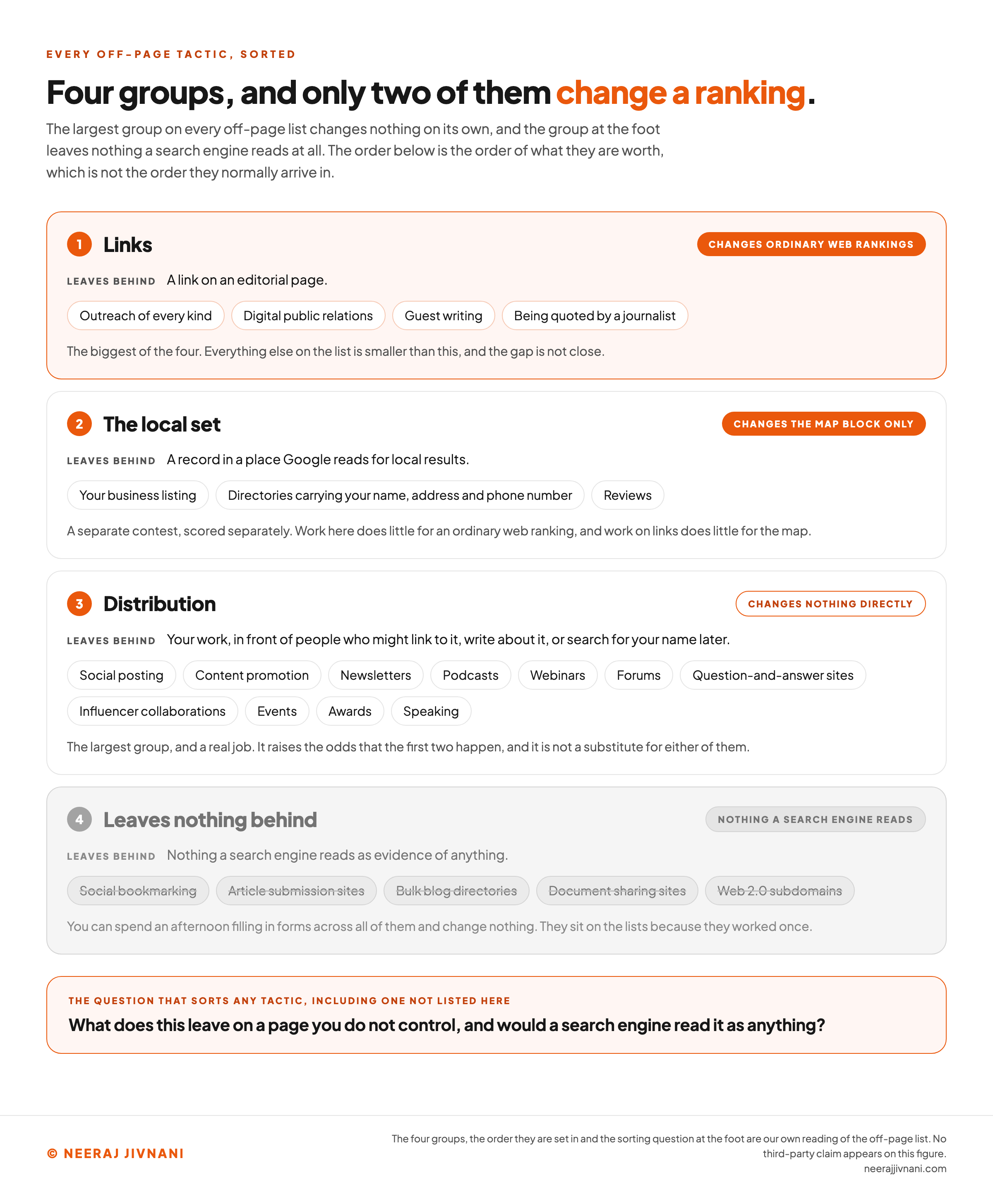
Ask one thing of any off-page tactic somebody puts in front of you. What does this leave on a page you do not control, and would a search engine read it as anything?
Three answers are possible, and they are the three groups below.
- It leaves a link on an editorial page. The ordinary web-ranking route, and the biggest of the three.
- It leaves a record in a place Google reads for local results. A different contest, with different inputs.
- It leaves nothing a search engine reads. Which does not make it worthless, and does mean it is not the thing that moved your ranking.
Hold that question through the list below. It outlasts any particular set of tactics, because it asks what a search engine can see rather than what a tactic is currently called.
The Line Between On-Page and Off-Page
On-page SEO is everything you can change by editing your own site, and off-page SEO is everything you cannot. The line between them is ownership, and it holds for anything new you meet.
Say you rewrite a page title. On-page. Say a supplier adds you to their stockists page. Off-page, and there was nothing you could type to make it happen.
The awkward cases fall out of the same test.
Your social profile lives on somebody else's domain and you fill it in yourself, which puts the filling-in on the on-page side of the line even though the page is not yours.
Where the Third Label Fits
A third label, technical SEO, belongs on the on-page side of that line. It covers your own server and your own markup, and you change it by editing your own site.
So the split is two questions stacked. Is this on your site or somebody else's, and if it is on yours, is it the words or the plumbing?
Internal linking gets filed as off-page work often enough to be worth naming. It is not.
A link from one of your pages to another is something you type, on a site you own.
Why the Rest of the Web Gets a Say
The rest of the web gets a say because the system was built on links from the start, and it still runs on them.
Google's guide to its ranking systems names PageRank as one of its core ranking systems used when Google first launched, and says it continues to be part of them. That is the plainest published answer to whether links still count.
There is a second reason, and it matters more for a new site.
Google's SEO Starter Guide says the vast majority of the new pages it finds every day are through links. A page nothing points at has to be discovered some other way.
Put those together and off-page work does two jobs. It is how you get found, and it is part of how you get ranked once you are.
What You Are Waiting For
The awkward part is the lag, and it is worth knowing at the start rather than working it out in the second quarter.
Nothing here shows up the same afternoon. A link gets published, a crawler reaches it, and whatever it is worth arrives slowly and mixed in with everything else that moved that month.
So judge this work on whether it is running rather than on last week's positions. That is a question you can answer today, and the ranking question is not.
The Off-Page List, Grouped by What It Changes
Every tactic on the usual lists falls into one of four groups, and the group tells you what to expect from it. Two of them change a ranking, one raises the odds that the first two happen, and one does neither.
The order below is the order of what they are worth, which is not the order they normally arrive in.
Links Are Most of It
If you do one thing off your own site, make it link building, the work of getting other sites to link to you. Everything else on the list is smaller than that.
A link is the thing a search engine was built to count, and most of the rest of the list is an attempt to cause one.
What belongs in this group: outreach of every kind, digital public relations, guest writing, being quoted by a journalist, and anything else whose output is an editorial link on a page about your subject.
The bound is worth stating too.
Links are slow, they are somebody else's decision, and no number of them rescues a page that was never worth ranking for the query.
The Local Set Is a Separate Contest
If your business has an address or a service area, a second set of results exists for you and it is scored separately.
That set is the map block above the ordinary results, and Google publishes a separate list of what decides it. How far the searcher is from the business is on that list, and no amount of writing changes it.
What belongs in this group: your business listing, the directories carrying your name, address and phone number, and your reviews.
Two consequences follow, and both catch people out. Work in this group does little for an ordinary web ranking, and work on links does little for the map.
Distribution Is Real Work With No Direct Effect
Distribution is the largest group on every list, and none of it changes a ranking on its own.
Social posting, content promotion, newsletters, podcasts, webinars, forums, question-and-answer sites, influencer collaborations, events, awards and speaking all sit here.
What they do is put your work in front of people who might link to it, write about it, or search for your name later. That is a real job, and worth doing on its own terms.
And this group is how the first group happens, which is a different thing from being a substitute for it.
A year of posting with nothing worth citing at the end of it produces a year of posting.
The Group That Leaves Nothing Behind
A handful of items on these lists ask you to fill in a form on somebody else's site, and the filled-in form is read as evidence of nothing.
Social bookmarking, article submission sites, bulk blog directories, document sharing sites and Web 2.0 subdomains, which are free blog pages on a big host, are the usual names. They sit on the lists because they worked once.
You can spend an afternoon filling in forms across all of them and change nothing.
One distinction keeps this honest. Publishing something people would read on one of those hosts is distribution, and it belongs in the group above. Opening an account and pasting a link into it is what belongs here.
At volume it gets worse than nothing. Google publishes a list of link practices it treats as spam and several of these sit on it, and its own Starter Guide warns that "you can overdo promoting your site and actually harm it".
Our answer here is short. Skip the group, and put the afternoon into one page worth citing.
Sort the checklist you were handed
What does this leave behind?
Tick the off-page work somebody has told you to do. Each item goes to the group it belongs to, and the group tells you what to expect from it.
Your list
Which of these are you being asked to do?
Nothing ticked yet
Ask one thing of any off-page tactic somebody puts in front of you. What does this leave on a page you do not control, and would a search engine read it as anything?
Hold that question through the list. It outlasts any particular set of tactics, because it asks what the machine can see rather than what the industry currently calls things.
Use this chart — embed code and citation
<a href="https://neerajjivnani.com/blog/off-page-seo/"><img src="https://neerajjivnani.com/infographics/off-page-seo/four-groups.png" alt="Four stacked cards sorting every off-page SEO tactic by what it changes. Card one, links, covers outreach, digital public relations, guest writing and being quoted by a journalist, and is marked as changing ordinary web rankings. Card two, the local set, covers your business listing, directories carrying your name, address and phone number, and reviews, and is marked as changing the map block only. Card three, distribution, covers social posting, content promotion, newsletters, podcasts, webinars, forums, question-and-answer sites, influencer collaborations, events, awards and speaking, and is marked as changing nothing directly while raising the odds that the first two happen. Card four, greyed out, covers social bookmarking, article submission sites, bulk blog directories, document sharing sites and Web 2.0 subdomains, and is marked as leaving nothing a search engine reads. A band at the foot gives the sorting question: what does this leave on a page you do not control, and would a search engine read it as anything." width="1200"></a>
<p>Chart: <a href="https://neerajjivnani.com/blog/off-page-seo/">Neeraj Jivnani</a></p>Neeraj Jivnani, "What Off-Page SEO Is, and Which Parts of It Change a Ranking", neerajjivnani.com, https://neerajjivnani.com/blog/off-page-seo/Free to republish with a link back to this page.
What a Mention Is Worth Without a Link
An unlinked mention of your name is worth having, and it is not worth chasing.
It is worth having because it is how people find you. Somebody reads your name in an article and types it into a search box, and that visit exists whether or not a link ever did.
It is not worth chasing because no published figure says what one is worth as a ranking input, and a mention does not do the job a link does.
Google's SEO Starter Guide names the same route, under its own heading on promoting your website: "One of the most effective and lasting ways is word of mouth."
Read mentions as evidence that the rest of the work is landing, and let them accumulate.
The Same Answer Holds for AI Assistants
The newer version of this question is whether being talked about changes how an assistant answers.
Probably, and the work does not change. The route to being cited by anything is being a page other people already cite, and nothing in the sort above moves because the result arrives as a paragraph instead of a list.
Reviews, and the Two Places They Count
Reviews work in two places: the map block, and the head of the person reading them. The search one is the smaller of the two.
For a business with an address, reviews are one of the inputs to the local set described above. That effect is real and it is confined to that block.
For everybody else, there is no ranking effect to collect.
A software company with a wall of reviews on a comparison site does not come up higher in ordinary results because of them.
The Half That Is Not About Ranking
The second job is worth more than the first, and it has nothing to do with search.
Somebody who has already found you is going to look you up before they buy, and what they read there decides it. That happens whether or not a single review ever moved a position.
So collect reviews for what they do to a decision, and treat any ranking effect as a bonus that applies to one kind of business.
What Social Media Leaves on a Page Google Reads
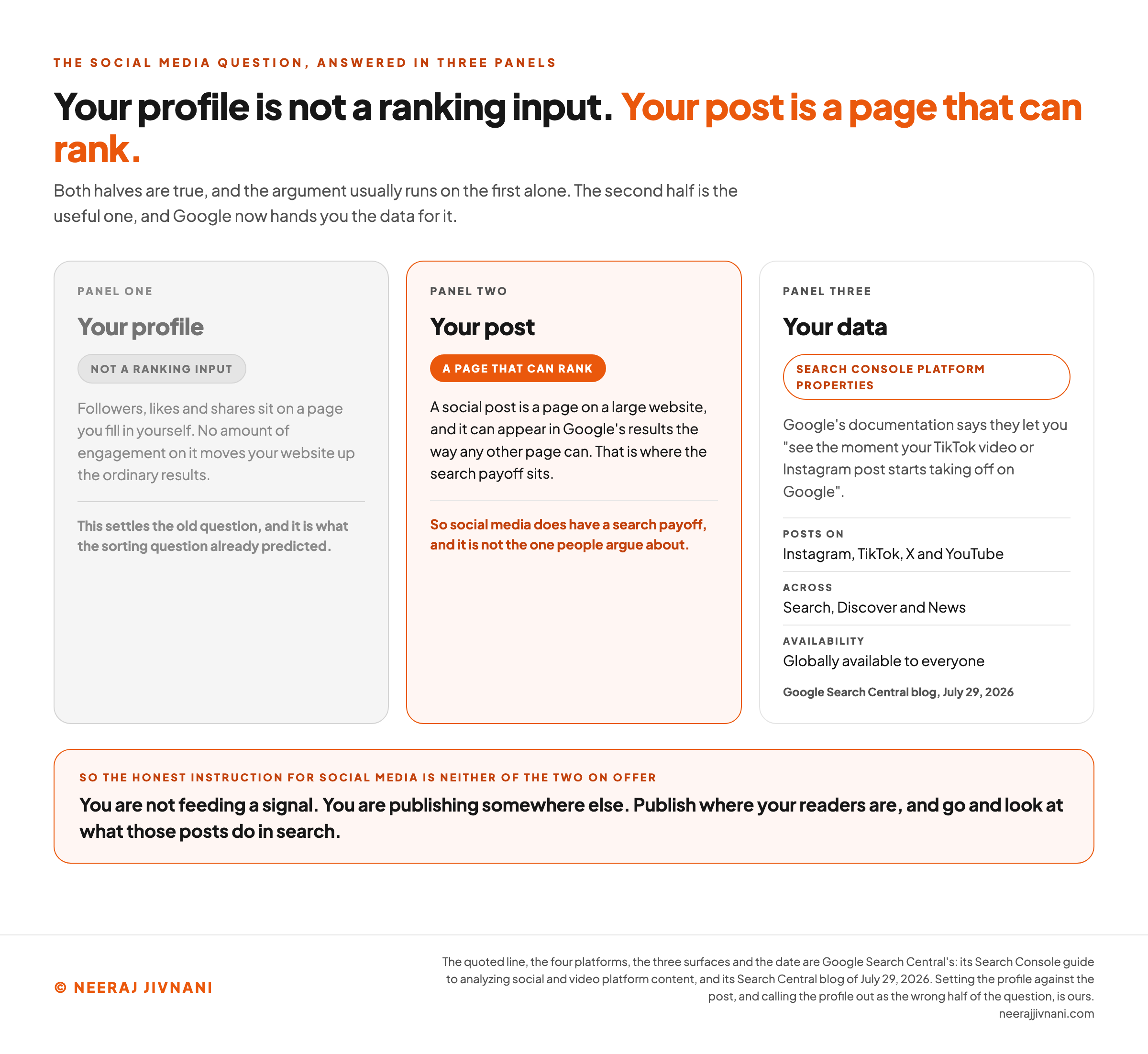
Your followers, likes and shares are not a ranking input, and your posts are pages that can come up in search on their own. Both halves are true, and the argument usually runs on the first alone.
The first half settles the old question. No amount of engagement on a profile you fill in yourself moves your website up the ordinary results, which is what the sorting question already predicted.
Your Posts Are Pages, and You Can Now Watch Them
The second half is newer and more useful. A social post is a page on a large website, and it can appear in Google's results the way any other page can.
So social media does have a search payoff, and it is not the one people argue about. You are not feeding a signal; you are publishing somewhere else.
Google now hands you the data for it.
Search Console carries platform properties, which its own documentation describes as letting you "see the moment your TikTok video or Instagram post starts taking off on Google".
Platform properties cover posts on Instagram, TikTok, X and YouTube across Search, Discover and News, and they are globally available to everyone, which Google's Search Central blog announced on July 29, 2026.
So the honest instruction for social media is neither that it is a ranking factor nor that it does nothing. Publish where your readers are, and go and look at what those posts do in search.
Use this chart — embed code and citation
<a href="https://neerajjivnani.com/blog/off-page-seo/"><img src="https://neerajjivnani.com/infographics/off-page-seo/profile-post-property.png" alt="Three panels answering the social media question for off-page SEO. Panel one, your profile, is greyed out and labeled not a ranking input: followers, likes and shares sit on a page you fill in yourself, and no amount of engagement on it moves your website up the ordinary results. Panel two, your post, is highlighted and labeled a page that can rank: a social post is a page on a large website and can appear in Google's results the way any other page can, which is where the search payoff sits. Panel three, your data, names Search Console platform properties, quoting Google's documentation that they let you see the moment your TikTok video or Instagram post starts taking off on Google, and noting Google's Search Central blog of July 29, 2026 stating they cover posts on Instagram, TikTok, X and YouTube across Search, Discover and News and are globally available to everyone." width="1200"></a>
<p>Chart: <a href="https://neerajjivnani.com/blog/off-page-seo/">Neeraj Jivnani</a></p>Neeraj Jivnani, "What Off-Page SEO Is, and Which Parts of It Change a Ranking", neerajjivnani.com, https://neerajjivnani.com/blog/off-page-seo/Free to republish with a link back to this page.
Where Trust Sits on This Map
Trust is what all of this is evidence for, and it is not a separate tactic.
You will meet E-E-A-T, four words covering experience, expertise, authoritativeness and trust, presented as an off-page job of its own. It is not a job.
It is a name for what the rest of the web already says about you, which is what every group above either produces or fails to produce.
So there is nothing on this map called "do E-E-A-T". There is being cited by people who know the subject, and there is not being.
Measuring Something You Do Not Control
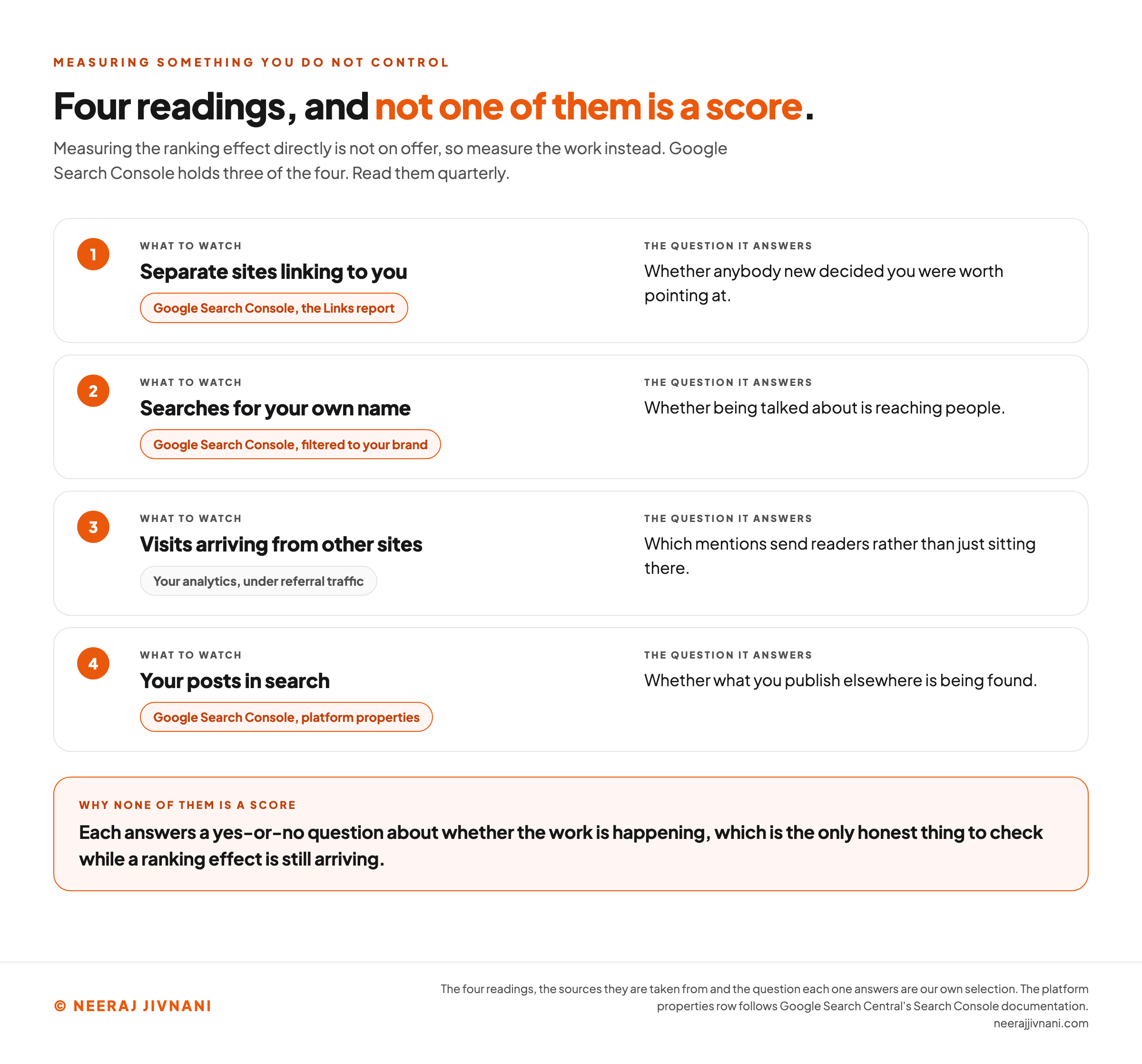
Measuring the ranking effect directly is not on offer, so measure the work instead. Four readings cover it, and Google Search Console holds three of them.
| What to watch | Where it comes from | What it tells you |
|---|---|---|
| Separate sites linking to you | Google Search Console, the Links report | Whether anybody new decided you were worth pointing at |
| Searches for your own name | Google Search Console, filtered to your brand | Whether being talked about is reaching people |
| Visits arriving from other sites | Your analytics, under referral traffic | Which mentions send readers rather than just sitting there |
| Your posts in search | Google Search Console, platform properties | Whether what you publish elsewhere is being found |
Not one of these is a score, and that is what makes them useful. Each answers a yes-or-no question about whether the work is happening, which is the only honest thing to check while a ranking effect is still arriving.
Reading Them After a Quarter
Read these quarterly. Nothing here moves fast enough for a weekly reading to say anything, and a weekly reading tempts you to change things that were working.
A flat quarter is the usual result, and it usually has a dull explanation.
It normally means the work did not happen, which is a calendar problem rather than a marketing one.
The reading worth acting on is a split: your name is being searched more and nothing new has linked to you. That points at what you publish rather than at how you promote it.
Use this chart — embed code and citation
<a href="https://neerajjivnani.com/blog/off-page-seo/"><img src="https://neerajjivnani.com/infographics/off-page-seo/four-numbers.png" alt="A four-row panel of the numbers that show whether off-page work is running, each paired with where it comes from and the question it answers. Row one, separate sites linking to you, comes from the Links report in Google Search Console and answers whether anybody new decided you were worth pointing at. Row two, searches for your own name, comes from Google Search Console filtered to your brand and answers whether being talked about is reaching people. Row three, visits arriving from other sites, comes from your analytics under referral traffic and answers which mentions send readers rather than just sitting there. Row four, your posts in search, comes from Google Search Console platform properties and answers whether what you publish elsewhere is being found. Three of the four are marked as coming from Google Search Console. A band at the foot notes that none of them is a score, and that each answers a yes-or-no question about whether the work is happening." width="1200"></a>
<p>Chart: <a href="https://neerajjivnani.com/blog/off-page-seo/">Neeraj Jivnani</a></p>Neeraj Jivnani, "What Off-Page SEO Is, and Which Parts of It Change a Ranking", neerajjivnani.com, https://neerajjivnani.com/blog/off-page-seo/Free to republish with a link back to this page.
Questions People Ask About Off-Page SEO
Four questions dominate this topic, and the rest of this section takes them one at a time.
What Is an Off-Page in SEO?
The phrase is usually "off-page SEO", and it covers the signals that live away from your own website. Who links to you, who mentions you, what your listings say, and what your reviews say.
Nothing on that list is something you can edit yourself, which is the feature rather than the flaw.
Is Off-Page SEO Still Relevant?
Yes, and the relevant part is narrower than the usual checklist suggests.
Links do the work, and for a business with an address, so do listings and reviews. The rest is promotion, which is worth doing for reasons that are not ranking.
What Are the Four Types of SEO, and Is Local One of Them?
Three labels are standard and the fourth varies. On-page, off-page and technical say where the work happens, and whoever adds a fourth almost always adds local.
Local earns its own name because it is a separate set of results with its own inputs, rather than a different place to do the same work.
Can a Site Rank With No Off-Page SEO at All?
On a search nobody is competing for, yes.
On anything commercial, a page with nothing pointing at it is up against pages that have something, and there is no way to spend your way out of that in a week.
The Page They Are All Pointing At
The one part of this you control is what the other groups are pointing at.
Links, listings, mentions and reviews are all somebody else's decision, and none of those decisions gets made about a page that gives the decider nothing to say.
Which is why the fourth group keeps getting done. It is the only one that needs nothing from you first, so it is the only one you can finish this afternoon, and finishing things is addictive.
Take the groups in the order they are set out instead. Make the thing worth pointing at, put it in front of the people who point at things, and if your business has an address, keep the listings straight.
If the first of those is missing, this is not an off-page problem yet, and no amount of work on the rest will turn it into one.