SEO Tips, Sorted by Whether You Can Finish Them
Nine changes you can make to a page today, each with the point at which it is finished, plus the two jobs that never end and what they cost you.

/ On this page6 sections
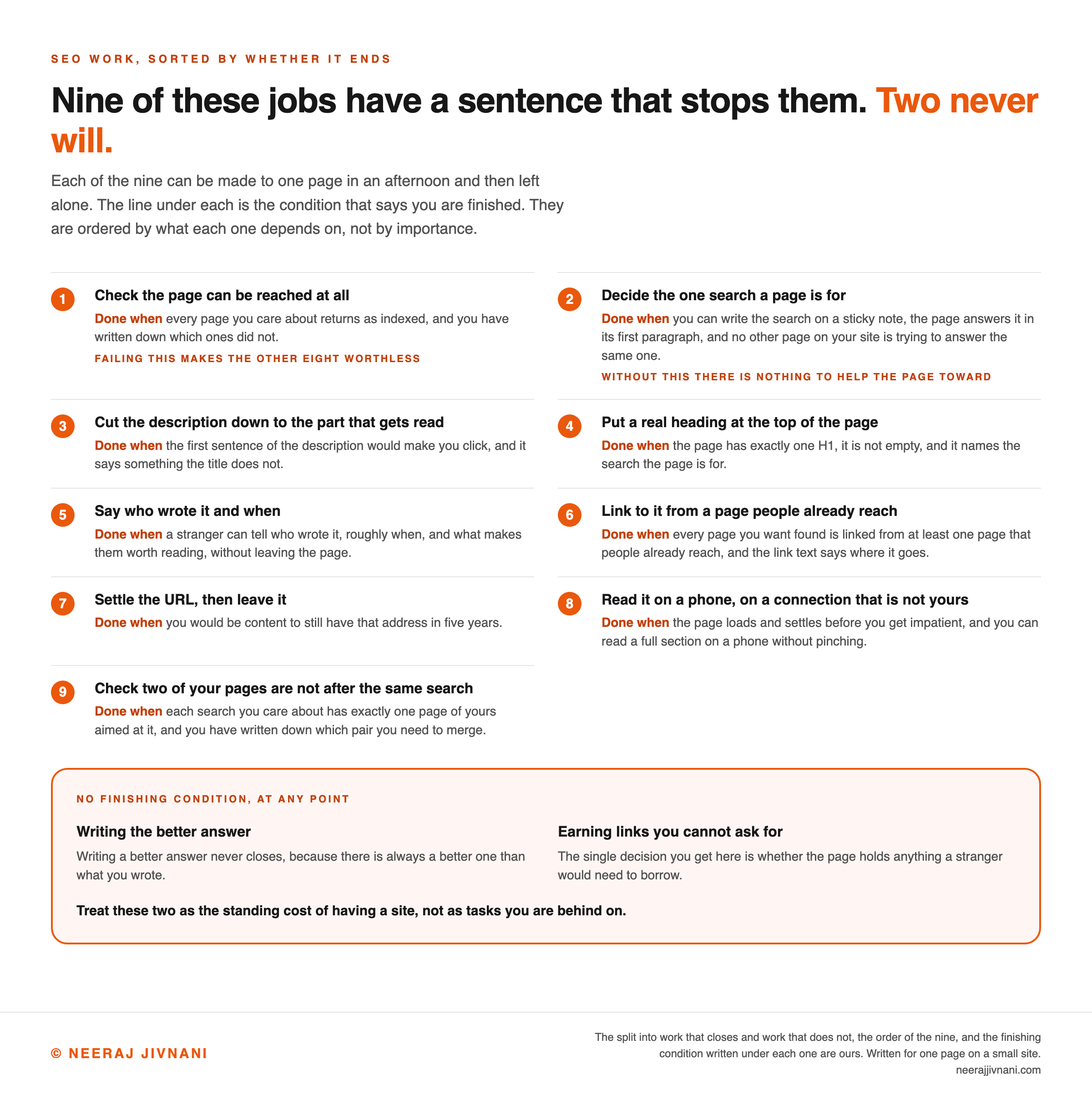
Nine of the SEO changes below can be made to a page this afternoon and then never thought about again. Each has a stopping point, and each one is named.
Two other jobs never finish at all, and those are worth budgeting for rather than putting on a list.
Which you do first decides more than how many you do. Start with the ones that close.
What Makes One SEO Tip Worth More Than Another
A tip is worth more when you can tell that you have finished it. Ask that one question of any piece of search engine optimization (SEO) advice and it falls cleanly into one of two piles.
Some of it is a job. You open the page, change something specific, and save it.
The job is then over until you rewrite the page. A title, a description, a heading, a URL, a link from one page to another.
The rest is a direction: publish consistently good work, build authority, improve your content.
None of those is a task. There is no afternoon at the end of which any of them is complete.
Say you have a page on how much notice a tenant has to give. Rewriting its title is Tuesday's work and then it is over. "Becoming the authority on residential lettings" is not on Tuesday's list at all.
Both kinds are real work. Only the first kind ever leaves your list.
So we would do the closing ones first, and not because they matter more. They come first because you can clear them, because they are cheap, and because an unfinished one is costing you on a page that already exists.
The nine below are the closing kind. Each ends with the sentence that tells you to stop.
Start With the Ones That End
The nine below are sequenced by what each one depends on, not by how much each is worth.
Reachability comes first because failing it makes the other eight worthless. After that, every change assumes the page already has one search behind it.
Check the Page Can Be Reached at All
Before anything else, confirm a search engine can fetch the page and is allowed to keep it.
This one is also the only failure with no symptom. A page blocked by a technical SEO setting renders, reads well and behaves normally for every human who opens it, so nothing ever prompts you to look.
Which means the check has to be scheduled rather than triggered. Put it on the calendar once a quarter and you will never need it in a hurry.
Three things block a page, and none of them announces itself.
- A rule in the site's
robots.txtfile telling crawlers to stay out. - A
noindextag left in the page's head by a theme, a plugin, or a staging setup nobody undid. - No link to the page from anywhere on the site, so a crawler may never find it.
The fastest way to settle it is Search Console's URL Inspection tool, which takes a URL and tells you whether that exact page is in the index.
Done when every page you care about returns as indexed, and you have written down which ones did not.
Decide the One Search a Page Is For
Decide the single search each page is for, in the words somebody would type.
Not a topic. A topic has no finishing condition, so a page aimed at one can never be declared done, and a search has one.
Then look at what already ranks for it. What you are reading is the kind of page winning, not what any of them says.
When the whole first screen is product pages or calculators, the search has already been answered in a format you do not publish. None of the other eight changes touches that.
Done when you can write the search on a sticky note, the page answers it in its first paragraph, and no other page on your site is trying to answer the same one.
Cut the Description Down to the Part That Gets Read
Write the meta description for the space a search result gives it, which is smaller than the space your editor gives you.
Know one thing before you start. Google's guide says the snippet is sourced from the page's own content, and that "occasionally the snippet may be sourced from the contents of the meta description tag".
So you are writing an alternate that may not be used. That is still worth doing well, and it is worth knowing you are doing it.
This is where the numbers are startling.
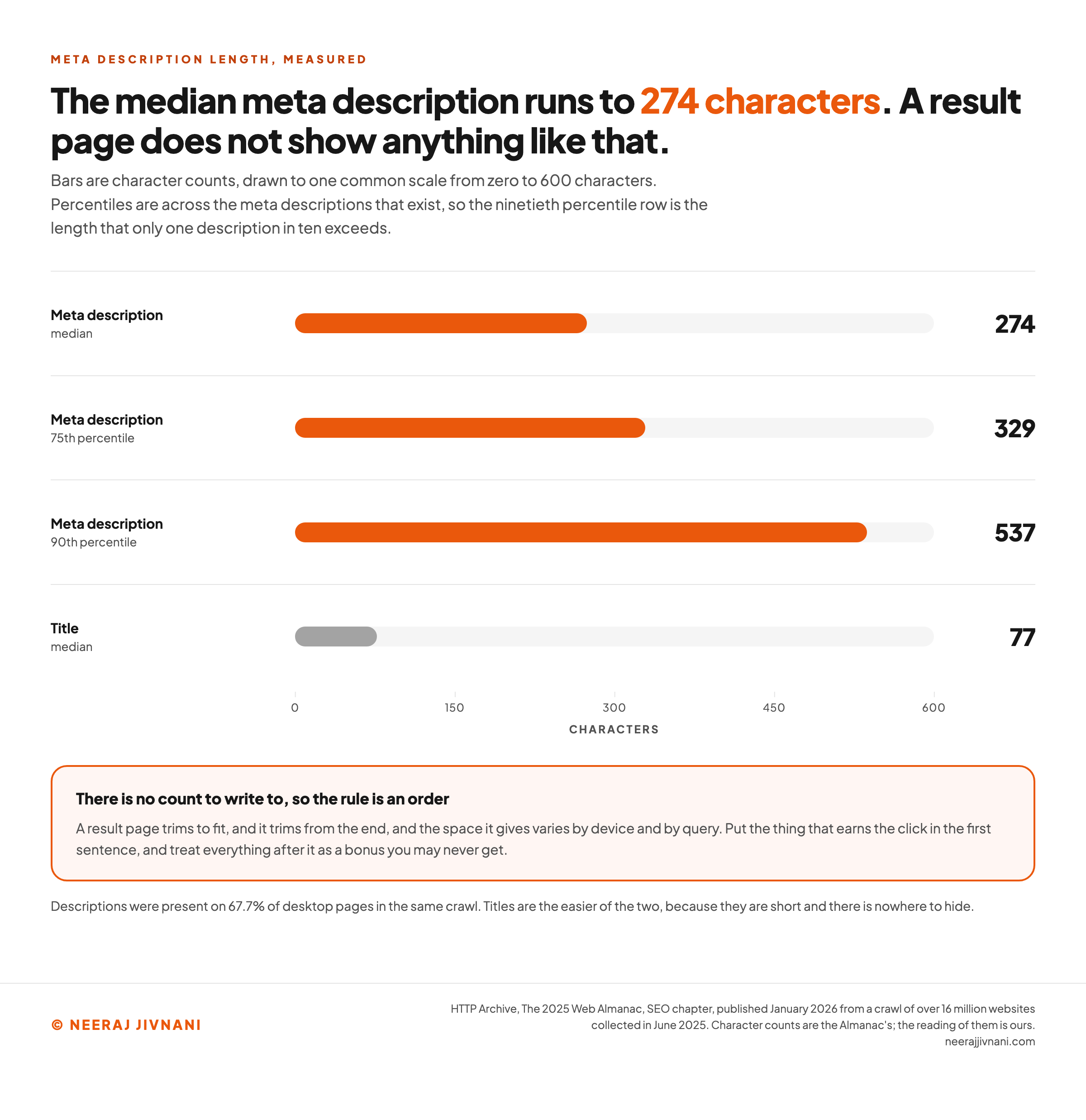
The median meta description runs to 274 characters in HTTP Archive's 2025 Web Almanac, from a crawl taken in June 2025. At the 75th percentile it is 329, and at the 90th it is 537.
Go and look at a page of results and count. Nothing on it is close to 274 characters, because a snippet is trimmed to fit and it is trimmed from the end.
So the practical rule is not a character count, because the space varies by device and by query. It is an order. Put the thing that earns the click in the first sentence, and treat everything after it as a bonus you may never get.
Descriptions were present on 67.7% of desktop pages in that crawl, so a third of them carry none at all.
The median title runs to 77 characters, a little over a quarter of what a description takes, and that is why titles are the easier field. There is nowhere to hide in one, so a bad title is obvious in a way a bad description is not.
A title is done when it carries the words somebody would type and still makes sense read out of context.
Done when the first sentence of the description would make you click, and it says something the title does not.
Put a Real Heading at the Top of the Page
Give each page a single H1 that names what the page is, in the reader's words.
The Web Almanac's 2025 crawl found an H1 present on 71% of desktop pages, and a non-empty one on 66%.
That five-point gap is the defect worth looking for: a heading tag that exists and says nothing. It is invisible on the page and shows up only in the source.
The temptation is to audit the whole heading tree. Skip it. Google's own SEO Starter Guide puts heading order on its list of things not to focus on.
Its words, in the December 2025 update, are that having your headings in semantic order is "fantastic for screen readers", but that "from Google Search perspective, it doesn't matter if you're using them out of order".
That cuts both ways. Order does not lift your ranking, and it does help somebody using a screen reader, which is reason enough to keep it tidy.
Done when the page has exactly one H1, it is not empty, and it names the search the page is for.
Say Who Wrote It and When
Put a real author name, not "written by the team", a real date, and one line explaining why either should be trusted on the page.
You will see this sold as improving your E-E-A-T, which stands for experience, expertise, authoritativeness and trustworthiness.
It is not a ranking factor. Google's own guide lists that idea under things it believes you should not focus on, and answers the question in three words: "No, it's not."
That is liberating rather than discouraging. There is no score to raise, so there is nothing to grind at.
What is left is a page that tells a reader who is talking. An unsigned, undated page asks a stranger to take a claim on faith from nobody in particular, and that is a real cost whatever the ranking systems do with it.
Done when a stranger can tell who wrote it, roughly when, and what makes them worth reading, without leaving the page.
Link to It From a Page People Already Reach
Add a link from the pages people already arrive on to the page you want found. Those are rarely the pages you would have nominated.
Most sites already link internally. The Web Almanac's 2025 crawl found a median of 43 links to the same site on a desktop page, rising to 174 at the 90th percentile.
So work backwards. Start from the handful that already bring you visitors, and ask whether the page you want found is one click from any of them.
Link text matters less than you would expect from how often it is raised. The same crawl found inner pages already using descriptive link text on 92.42% of desktop sites, so this is a check rather than a project.
Done when every page you want found is linked from at least one page that people already reach, and the link text says where it goes.
Settle the URL, Then Leave It
Give the page a short, readable URL made of words, and then treat it as permanent.
This one is different from the other eight, because its cost is asymmetric.
Getting it right before you publish is a moment's work. Changing it afterwards means a redirect, and every link anyone made to the old address then takes a detour.
Which is why we would spend that moment and then genuinely stop. No dates, no numbers, no year, nothing that turns into a lie in January.
On ranking, the URL buys you almost nothing. Keywords in the name of the domain or URL path, Google's own guide says, "alone have hardly any effect beyond appearing in breadcrumbs".
So the reason to do it is not ranking. It is that a person can read it, and a readable URL survives being pasted into a message.
Done when you would be content to still have that address in five years.
Read It on a Phone, on a Connection That Is Not Yours
Open the page on a phone, on mobile data, and read it as a reader would.
This one act replaces three jobs people usually run separately.
Speed, mobile-friendliness and readability are a single experience to the person having it, and they fail together.
The bar is public. In June 2025, 56% of desktop pages achieved good overall Core Web Vitals, on the 2025 Web Almanac's crawl.
Those are Google's measures of loading, responsiveness and stability. Interaction to Next Paint was fine almost everywhere, at 97%, while loading sat at 74% and visual stability at 72%, on the same crawl.
Most of what you will find is not exotic.
An enormous uncompressed image. A font that arrives late and shifts the text underneath it. A paragraph nine lines deep on a narrow screen.
Fix those, and then keep the habit of reading your own drafts on the device they will be read on.
Done when the page loads and settles before you get impatient, and you can read a full section on a phone without pinching.
Check Two of Your Pages Are Not After the Same Search
Look for two of your own pages trying to answer one search, because they will hold each other down.
The signal that would have carried one page is split across two, and neither gets enough of it to win.
You find these from your own list rather than from a report. Read your page titles and ask which two you could not tell apart if you were the one searching.
Done when each search you care about has exactly one page of yours aimed at it, and you have written down which pair you need to merge.
Take one page and walk the nine in order
Answer each one about a single page you already have. The order is the order they depend on each other in, so the first two decide whether the rest are worth doing at all.
1 of 9, and the rest depends on it
Check the page can be reached at all
Done when every page you care about returns as indexed, and you have written down which ones did not.
Is that true of your page right now?
Use this chart — embed code and citation
<a href="https://neerajjivnani.com/blog/seo-tips/"><img src="https://neerajjivnani.com/infographics/seo-tips/nine-that-close.png" alt="Two column layout of nine numbered SEO jobs, each showing the change and the finishing condition written under it in the form Done when, running from checking the page can be reached at all through to checking two of your pages are not after the same search. The first two carry an extra line marking them as gates, that failing the first makes the other eight worthless and that without the second there is nothing to help the page toward. A panel across the foot headed no finishing condition at any point holds two further jobs, writing the better answer and earning links you cannot ask for, with the reading that these two are the standing cost of having a site rather than tasks you are behind on." width="1200"></a>
<p>Chart: <a href="https://neerajjivnani.com/blog/seo-tips/">Neeraj Jivnani</a></p>Neeraj Jivnani, "SEO Tips, Sorted by Whether You Can Finish Them", neerajjivnani.com, https://neerajjivnani.com/blog/seo-tips/Free to republish with a link back to this page.
Use this chart — embed code and citation
<a href="https://neerajjivnani.com/blog/seo-tips/"><img src="https://neerajjivnani.com/infographics/seo-tips/written-and-shown.png" alt="Horizontal bar chart of four character counts drawn to one common scale from zero to 600 characters, with ticks at 0, 150, 300, 450 and 600 and the axis labeled characters: across the meta descriptions that exist, the median runs to 274 characters, the 75th percentile to 329 and the 90th percentile to 537, while the median page title runs to only 77 characters and is drawn in gray for contrast. A panel below records that there is no count to write to, because a result page trims to fit and trims from the end and the space it gives varies by device and by query, so the rule is an order rather than a length: put the thing that earns the click in the first sentence, and treat everything after it as a bonus you may never get. A closing line notes that descriptions were present on 67.7% of desktop pages in the same crawl." width="1200"></a>
<p>Chart: <a href="https://neerajjivnani.com/blog/seo-tips/">Neeraj Jivnani</a></p>Neeraj Jivnani, "SEO Tips, Sorted by Whether You Can Finish Them", neerajjivnani.com, https://neerajjivnani.com/blog/seo-tips/Free to republish with a link back to this page.
The Work That Does Not End
Two jobs here have no finishing condition. Pretending otherwise is how people end up feeling permanently behind on work that was never going to be complete.
What follows is what each one costs, rather than a method for finishing it.
Writing the Better Answer
Writing a better answer never closes, because there is always a better one than what you wrote.
What "better" means is narrower than it sounds, and it is not longer. The length follows the question, and a question with a short answer is finished when the answer is.
Better means the reader does not have to open a second tab. If the answer sends them somewhere else for the part that mattered, the page stopped short.
A page that once needed no second tab can start needing one, without anybody editing it.
What ages is rarely the writing. It is a figure that changed, a tool that got renamed, a step that no longer exists. Nothing announces any of it.
So the return visit is a fact check rather than a rewrite. Read the page as though somebody had sent it to you today, and mark the sentences you would now have to apologize for.
Earning Links You Cannot Ask For
The single decision you get here is whether the page holds anything a stranger would need to borrow.
Nobody links to a page to say it was clear. They link because they wanted to use something from it and could not restate it themselves.
Clarity is what keeps a reader. Borrowable material is what brings a link, and the two are not the same job.
Telling people the page exists is the only lever you have, and it is a slow one.
It also means telling specific people who had a reason to want it, not broadcasting. A thousand readers who cannot use the thing produce nothing; three who can may produce one link.
Everything after that is arithmetic nobody controls, which is why we would never put a link count on a plan.
What We Would Leave Alone
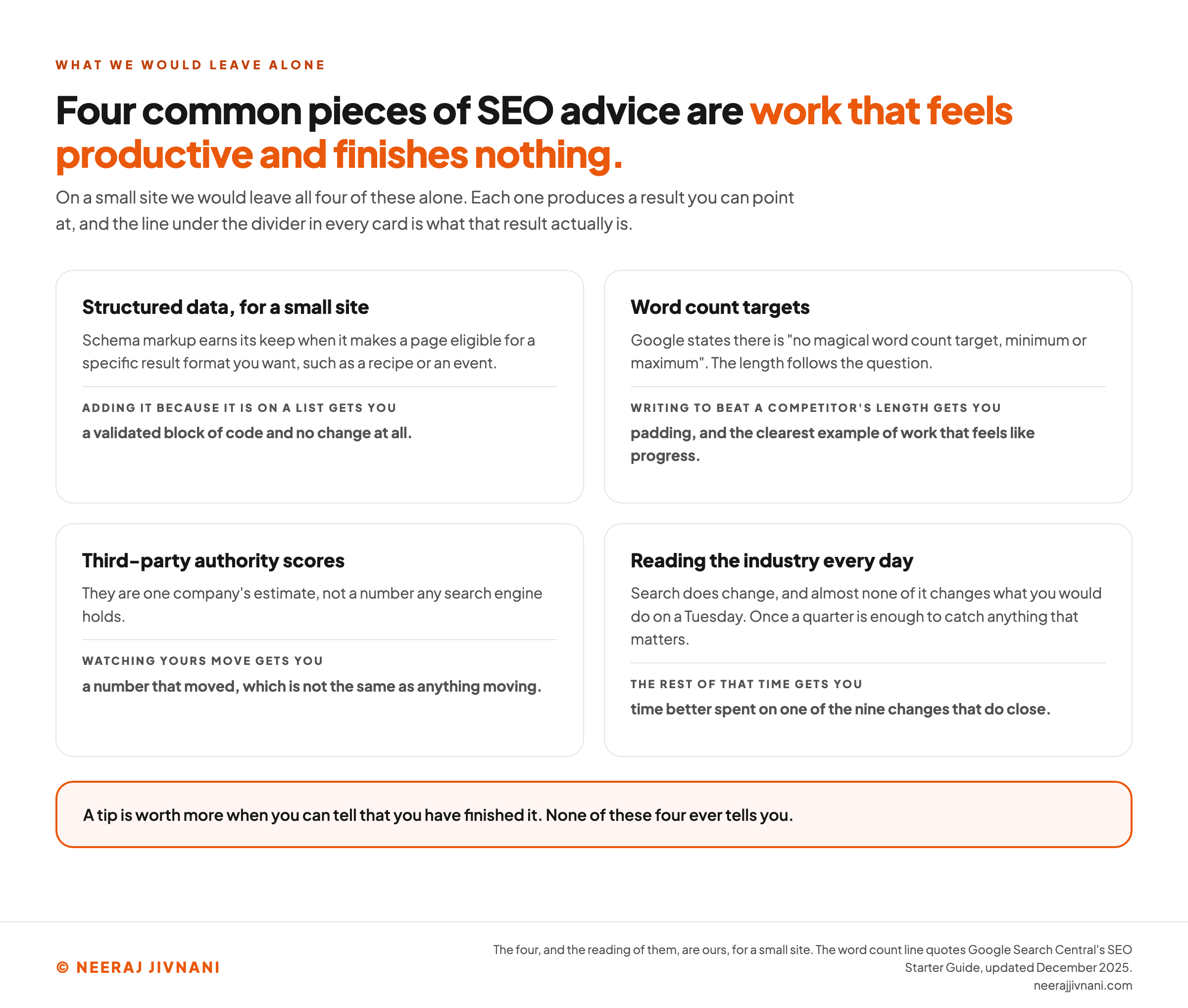
Four common pieces of advice are work that feels productive and finishes nothing. We would leave all four alone on a small site.
Structured data, for a small site. Schema markup earns its keep when it makes a page eligible for a specific result format you want, such as a recipe or an event. Adding it because it is on a list gets you a validated block of code and no change at all.
Word count targets. Google states there is "no magical word count target, minimum or maximum". Writing to beat a competitor's length is the clearest example of work that feels like progress and produces padding.
Third-party authority scores. They are one company's estimate, not a number any search engine holds. Watching yours move is not the same as anything moving.
Reading the industry every day. Search does change, and almost none of it changes what you would do on a Tuesday. Once a quarter is enough to catch anything that matters, and the rest of that time is better spent on one of the nine.
Use this chart — embed code and citation
<a href="https://neerajjivnani.com/blog/seo-tips/"><img src="https://neerajjivnani.com/infographics/seo-tips/feels-like-work.png" alt="Four cards naming common pieces of SEO advice we would leave alone on a small site, each with a divider and then the result the work actually produces: structured data added because it is on a list gets a validated block of code and no change at all, writing to beat a competitor's length gets padding, watching a third-party authority score gets a number that moved which is not the same as anything moving, and reading the industry every day gets time better spent on one of the nine changes that do close. A band across the foot reads that a tip is worth more when you can tell that you have finished it, and that none of these four ever tells you." width="1200"></a>
<p>Chart: <a href="https://neerajjivnani.com/blog/seo-tips/">Neeraj Jivnani</a></p>Neeraj Jivnani, "SEO Tips, Sorted by Whether You Can Finish Them", neerajjivnani.com, https://neerajjivnani.com/blog/seo-tips/Free to republish with a link back to this page.
Doing It Yourself, and When to Pay Someone
Almost everything above you can do yourself, alone, in a browser and a text editor.
None of the nine costs money or needs software. What each one needs is somebody who knows what the page is for, and that is you rather than anyone you could hire.
Writing and link building are where outside help genuinely changes the arithmetic, and they are also the two where it is hardest to tell whether you are getting any.
Writing the better answer needs somebody who understands lettings, or conveyancing, or whatever you sell, rather than somebody who understands search. Earning links takes months of somebody's time.
The honest test before you pay someone is whether they can tell you what will be finished, and when.
A proposal made entirely of the open-ended half is a proposal with no end in it.
One limit is worth naming, because no amount of paying anyone moves it. If your pages sit on somebody else's platform and that platform shuts crawlers out, the block is theirs to lift and nobody you hire can reach it.
The Questions That Come With This One
The same four questions get asked about this, and none of them needs a long answer.
What Are the Best SEO Strategies?
The ones you can finish. In order: make sure the page can be reached, give it one search to answer, and write a description whose first sentence earns the click. Those three are the ones you can finish before lunch.
What Is the 80/20 Rule for SEO?
There is no published 80/20 rule for SEO. The phrase borrows the Pareto principle, the observation that a small share of causes produces most of the effect.
The useful version is not a fixed short list. On any given page, one thing is holding it back, and finding which one beats improving the other eight.
Is SEO Still Worth It in 2026?
Yes, and it is now a question about which pages rather than about the whole site. Only one kind looks to have lost ground. If somebody can act on your answer without leaving the results, they will, and the traffic goes with them.
Everything requiring a decision is untouched. A summary cannot carry a judgment call, an unusual constraint or the reason the standard answer is wrong here, and those are what most sites should have been writing anyway.
How Do You Do SEO as a Beginner?
By finishing things. Pick the one page you would be most annoyed to lose, take the first two of the nine on it, and stop.
The value of starting there is not that those two matter most. It is that you will be able to tell you are done.
The discipline is stopping.
Nine changes have an end, and reaching it on one page beats half-finishing ten.